In 2007 Maxim Vengerov had to withdraw completely from violin playing, and stayed away for four years. He had suffered the after effects of a weight-lifting injury to his shoulder, and needed surgery. But he also described at the time that he felt he needed to re-learn the instrument. If people – like the writer of last night's programme introduction – now refer casually to his “effortless virtuosity”, it is clearly something which has been acquired with an intense effort and sense of purpose.
At the age of 41, the violinist has indeed now reached a delightful ease and naturalness of expression in his playing which is reminiscent of Oistrakh. If there were issues with posture earlier, they seem to be sorted out. He is who he is: he doesn't command with his tone like Isaac Stern used to do, or seek the sheer variety of timbre and presence of, say, Janine Jansen. Nor, on the evidence of last night's recital, does he necessarily feel compelled to take on the intellectual pinnacles of the repertoire, and to impose a sense of logic and rigour on them, like, say, Isabelle Faust or Alina Ibragimova.
He is very present as a teacher conducting masterclasses online, where his florid sense of imagery is used to describe the process of bringing character and expression to music. In that context he always appears completely committed and fulfilled. He performs and puts on a show in that role. By contrast, his on-stage persona as recitalist is unflamboyant, bordering on the anti-heroic. Last night he lapped up the increasingly fervent adulation from a full house at the Barbican with quiet, almost withdrawn respect.
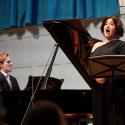
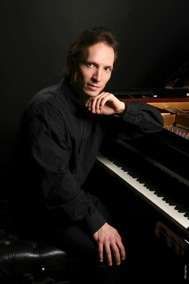 His first half consisted of two sonatas from the Viennese classical repertoire, and was all about elegance and beauty, restraint, and lightness of touch. A high-point was the intimate Adagio cantabile of Beethoven's Violin Sonata in C Minor Op. 30 No 2, which skirts around nine keys before returning quietly to the home tonality. There was an honesty, clarity and directness in Vengerov's phrasing, and his pianist Roustem Saitkoulov (pictured right) brought exactly the right, light “sempre leggiermente” touch which is instructed and required.
In the second half, Vengerov engaged with one more substantial work from the repertoire, the Ravel G Major sonata, before heading off into the repertoire territory which his loyal audience expects from him. Vengerov's approach to the Ravel was indirect and allusive. He played the opening in a whispered manner, almost as if from another room. The glissandi of the second movement blues were all characterful and invariably judged to perfection.
Then followed two unaccompanied works of impossible virtuosity: the last of the six solo sonatas by Eugène Ysaÿe, the one dedicated to Manuel Quiroga and including a habanera, to which Vengerov brought a vivid sense of the dance, and then, with even more superhuman demands on technique, the sixth of the Polyphonic Studies by Heinrich Wilhelm Ernst, a set of mind-bending variations on “The Last Rose of Summer.”
With the adulation increasing, each standing ovation more complete than the last, he played three encores, of which the third was Massenet's "Méditation" from Thaïs. It was telling that at the very apex of that long arc of melody, the forte top F sharp eleven bars from the end, Vengerov should withdraw instantly from it, choosing to mark it rather than to play it out. It seemed to sum up his wish to understate, to keep something – at least emotionally – in reserve, as has been commented before on this site.
Vengerov said very little last night. He introduced each of the three encores, he commented that it was “good to be back.” It is the most overworked cliché, but he chooses to let his violin do the talking. And as a listen to the radio transmission of last night's concert will demonstrate, he is at the peak of his expressive powers, and what his violin has to say is well worth listening to.