

The cellist and the pianist famously have a more competitive relationship in Brahms’ Cello Sonata in E minor than in many compositions for solo instrument and piano. Brahms composed it for the Viennese singing teacher and cellist Dr Joseph Gänsbacher – when, on first playthrough, Gänsbacher complained he couldn’t hear himself because of the piano part, Brahms bellowed back, “You’re lucky.”
Yet in the packed lunchtime concert performed by American cellist Alisa Weilerstein and Siberian-born pianist Pavel Kolesnikov, there was no sense that either musician was bludgeoning their way into the limelight. No surprise, given Kolesnikov’s characteristic luminous sensitivity, which brought a sense of air and light that was offset by Weilerstein’s sonorous, velvety tones on the cello.
From the first notes of the Allegro non troppo movement, Weilerstein asserted herself with a rich textured tone that had the punch of good black coffee. Kolesnikov’s accompanying – gently detached – chords had a crystalline clarity. When the piano took up the cello’s opening theme, the notes rang out like bells as Weilerstein provided a sumptuous sinuous accompaniment. Then, as the cello came into ascendancy once more, Kolesnikov played the increasingly fiendish piano passages with a skill that gave them the delicacy of filigree.
This was the first piece that Brahms wrote for a solo instrument accompanied by the piano, and he challenged the relationship between soloist and accompanist throughout with shifting textures and some outrageously counterintuitive rhythms. Kolesnikov’s assured performance meant that while it was always possible to appreciate the piece’s complexity, there was no sense of its difficulty. Weilerstein’s charismatic delivery, which went from plaintiveness to full fury, brought a sense of pathos and poetry.
The opening bars of the dance-like Allegretto quasi menuetto were distinguished by suppleness and lightness, subtly intensifying as the piece went through a series of harmonic progressions from A minor to C minor and back again. The lyrical trio, in which the two instruments mirrored each other, swooped deliciously from moments of quiet abandon in the higher passages to more shadowy intensity in the lower registers.
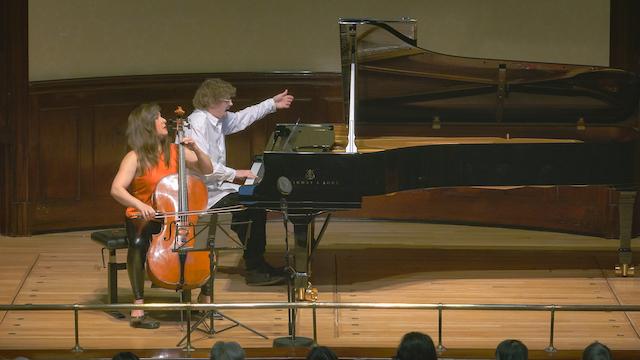
In the rhythmically rigorous fugal movement, Weilerstein and Kolesnikov released all the fire and agitation that had been building through the sonata. In the piu presto section towards the end, the descending piano sounded like brightly coloured cascades of fireworks, while the cello’s fury took on a multi-hued lyricism.
Following a rapturous reception from the audience – which included the Duke of Kent – we were on to Prokofiev’s Cello Sonata in C. This piece – composed in 1949 – was hugely influenced by the Zhdanov Decree, which was first introduced in the Soviet Union in 1946, and clamped down on music which was too dissonant or difficult to interpret.
Like the Brahms, the sonata opened with an extended statement in the lower registers of the cello, but the similarity ended with a sequence of jabbing chords on the piano that accompanied Weilerstein’s angry pizzicato. Then suddenly we were swept up by a lilting melody on the cello that wouldn’t have sounded out of place in a tsarist ballroom. After this the music became more haunting and dreamlike, before sterner rhythms intervened, eventually leading to thunderous chords on the piano and more frantic pizzicato. A tirade of flawlessly executed demi-quavers on the cello led to the darkly tremulous ending.
A seasonal lurgy meant that I was threatened with a bad coughing fit, so I was forced to leave the auditorium towards the end of the second movement and listen from just outside. Happily, the Radio 3 recording (on BBC Sounds for the next 28 days) meant I was in a position to confirm my observations when I got home. In the Moderato movement a more playful spirit presided at the start, before a frenzied dialogue erupted between Weilerstein’s cello and Kolesnikov’s piano, with spread chords on the cello and a spiky staccato accompaniment. Brief moments of levity, reprising the opening theme, were interspersed with passages of anguished urgency, which eventually evaporated in the piano’s transcendentally glittering arpeggio at the movement’s conclusion.
The final Allegro ma non troppo movement kicked off with an ebullient lightness before Weilerstein swept us up with a swooningly lyrical melody that was offset by Kolesnikov’s more articulated interjections. The colourful freneticism of the cello’s double-stopped passages towards the end was particularly resonant, while the piano’s surging scales escalated the drama. Throughout, Weilerstein’s heartfelt expressiveness ensured a nuanced emotional narrative that was heightened by Kolesnikov’s capacity to convey the architectural vastness of Prokofiev’s vision. Following more effusive applause from the audience, they sent us out into the streets with an exquisitely lyrical rendition of Dvorak’s Songs My Mother Taught Me.

Comments
All agreed. Weilerstein and…