

If it were true, as Timothée Chalamet has said, that ballet as an art form has become a museum, the job of running a national ballet company would be easy. Ballet never ceases to evolve, and to prove the point I’d be happy to offer the actor my plus-one on any night of his choosing, if only he’d return my calls.
English National Ballet has been as front-footed as any in the business of supporting new work, new talents, new directions. This takes an appetite for risk and above all money. After seeing the company’s latest double bill, which included a world premiere by an untried choreographer, I found myself trying to imagine the pitch ENB’s artistic director Aaron S. Watkin must have had to make to the board. “He’s a cross-genre artist and part of the LGBTQ+ community! He was movement director for Burberry’s ‘If I was an Animal’ campaign and he was a dancer on Taylor Swift’s Eras tour!” There must have been more. Yes, Watkin had seen a short piece made by Kameron N. Saunders a few years ago, but searches reveal little by way of a back catalogue. To commission a 35-minute work for presentation on a major London stage on this evidence is risk-taking on a grand scale.
And the result is a grand-scale dud. There was good reason why Proper Conduct was placed after the half-time interval at Sadler’s Wells. If it had gone first, the audience might have gone home early and missed out on a gem. Body & Soul (Part I) was made by the Canadian choreographer Crystal Pite for Paris Opera Ballet in 2019, but it’s an excellent fit on ENB whose dancers have applied themselves with gusto to the quicksilver demands of her fast-forward dance palette.
As with much of Pite’s work – and in this case we’re talking about a serious back catalogue – it sounds more complicated than it looks. A programme note talks about conflict and connectedness, dual systems, duets between body and soul, while what we see on stage is immediate and clear. Even a voiceover in French turns out to be no hindrance as it comprises only a few basic phrases (“left, right, left, right …. He turns to the left, he extends his hand, he holds his head…”) repeated ad infinitum. With Pite, you can rely on there being at least one brilliant idea on which everything hinges. Here it’s not only that recorded speech can make a sterling musical soundtrack (the words stretched and reversed and transformed into percussion by composer Owen Belton) but that the meaning of words can change according to what we see.
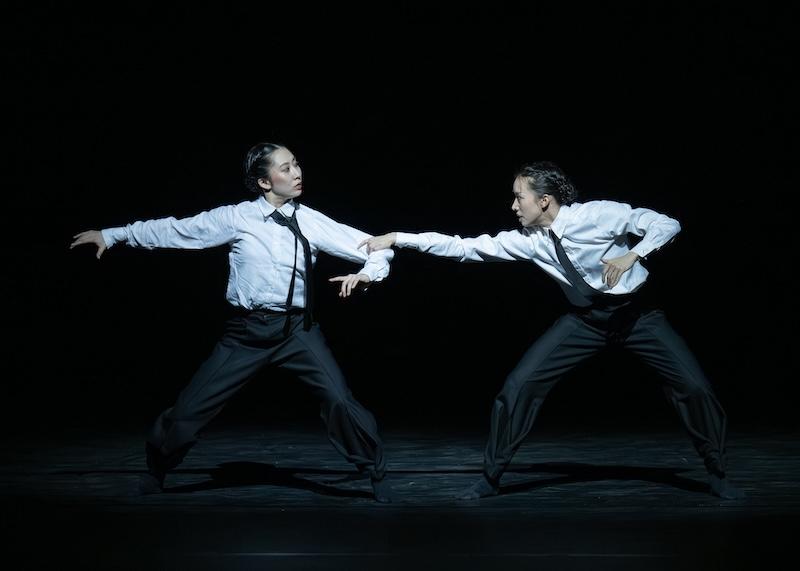
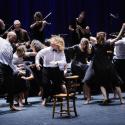
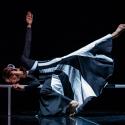
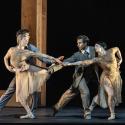
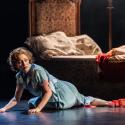
Multiple short scenes unfold. In the first, we see two men apparently fighting each other, or perhaps they’re post-fight but still angry. Their actions are so precisely synched to the spoken directions it’s as if they’re being controlled by a puppeteer. Next, we get one of Pite’s signature swarms, a mass of bodies moving as one, or in this case two, as opposing groups hurl themselves through surging waves of militaristic ritual. Another scene sees two young women (pictured above) dressed for the office – are they workmates or backstabbers? To a sublime slow Chopin Prelude, two lovers are shown in a moment of uncertainty, their intimacy punctuated by sudden rebuffs. Her head-butts are at once shocking and telling and sad.
Nancy Bryant’s costume design plays into the movement, unisex dark greatcoats flaring out as the dancers turn and crouch and leap. Elsewhere, white shirts create a striking contrast in lines and curves against the black. Intriguingly, Pite’s life-partner Jay Gower Taylor gets a credit for scenography even though the piece is danced entirely in an empty dark space. All to the good. Everything about this performance suggests the start of a new and fruitful relationship for English National Ballet.
Which cannot be said of the world premiere from Kameron N. Saunders – his first time working with a ballet company and possibly his last. It would be a relief to be able to affirm that the generic and unremarkable movement he had devised was instantly forgettable, but alas no. While it’s not untrue to say that Saunders’ work crosses boundaries, it only confirmed for me the low level of craft that often passes for choreography in the world of arena pop.
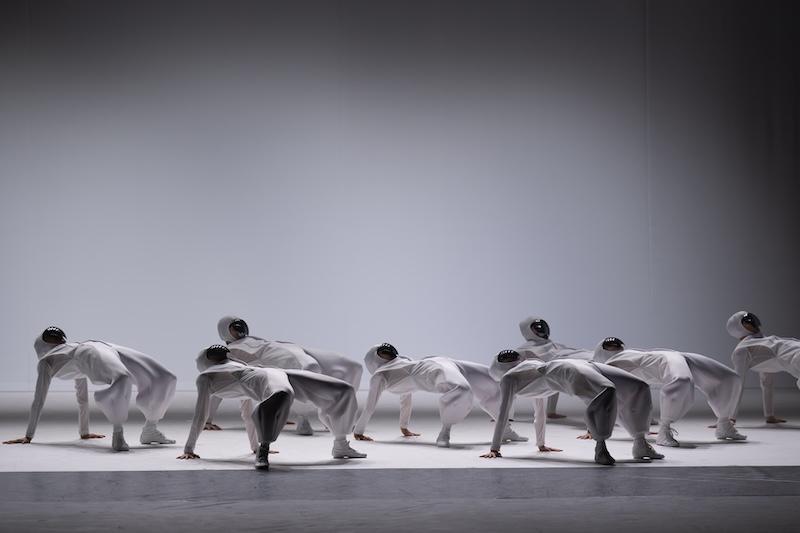
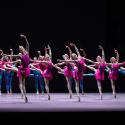
The only material of any interest is given to one dancer, rubber-limbed Jose Maria Lorca Menchón, a narrator-cum-Kameron-as-clown figure who throws some deft hip-hoppy shapes. Again, steps are synched to a recorded voice but this time the tone of the text swings uncertainly between cynical and didactic. What is Proper Conduct trying to say? Scene one has the dancers skipping about in 1970s print frocks and jolly coloured shorts, all sunny and innocent. Scene two is a dim-lit brothel heaving with simulated sex. One guy appears to remove his trousers front of stage, baring his butt for all to admire, but you later detect flesh-coloured tights. The final scene (pictured above) is like something out of The Handmaid’s Tale, everyone marching about in white suits and visored helmets, each with a single little white light (a soul?) in place of eyes. The wages of sin is a full lobotomy. The poor orchestra – for there is the ENB Philharmonic en masse in the pit – ploughs through a transcription of Brandon Finklea and Harold Walker III’s electronic score. It sounds dire.
What shines through this mess is the professionalism of the dancers, their unflinching commitment, energy and skill. Saunders’ choreography hardly shows them at their best and they must know it, but still they smile and give it all they’ve got. That’s true grit.
- Body & Soul, Sadler's Wells till tomorrow, Theatre Royal Plymouth, 30 April to 2 May
- More dance reviews on theartsdesk


Add comment