Former Royal Ballet principal Federico Bonelli has brought his Northern Ballet company south in the latest of its trademark narrative ballets. His dancers are a huge credit to him, but I wish they were appearing in a more challenging piece.
The television adaptation of Anne Lister’s story put her firmly on the map as an early sighting of an English lesbian. Her sexual preferences, unlike male homosexuality, weren’t technically illegal but were still shocking to the politer parts of Victorian society, Those who saw the two TV series may find this stage version a tad tame, though at least they will be well versed in its plot. It does, however, retain that essential swagger of Lister's as she strides through the Yorkshire countryside in her mannish frock coat and boots, brandishing a cane and topping it all off with the kind of headgear that women used to wear to go fox-hunting. Which I suppose you could argue is what Lister is doing.
Annabelle Lopez Ochoa’s choreography for Lister (a role shared between three dancers: Gemma Coutts, Nida Aydinoglu and Amber Lewis) is all sweeping, scissoring legs, dramatic arabesques and extensions, and bravura jetés. I saw Aydinoglu, who attacked the role with gusto, springy of step and projecting Lister’s aggressive energy with suitable force. In her duets with her conquests, first long-time married lover Mariana (Sarah Chun), then, when Mariana hasn’t the courage to leave her husband, Ann Walker (Julie Nunes), she is the dominant partner, slinky and serpentine, as they do tasteful approximations of lesbian sex.
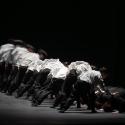
But Lister’s repertoire of steps is somewhat limited. Lovely though some of the ensemble moves are — there is a particularly impressive though short early scene where men in top hats perform low arabesques, perfectly synched and identically angled, reminiscent of Raeburn’s portrait of the skating Reverend Robert Walker — I found myself yearning for a fouetté or two, something with more intricate footwork. More lifts? More pointe work? An extended period of dancing that helped unpack the character, not just the plot line? Lister gets some of those but is the only character that does.
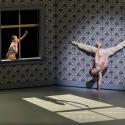
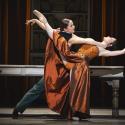
Things rev up a little in the Paris scenes, where she learns to indulge her tastes in pyramids of women's bodies. And there is a funny quartet composed of Christopher Rawson and his wife trying to insert themselves between Anne and the target of her seduction, Ann Walker (pictured below, with Rachael Gillespie as Ann, Coutts as Lister, George Liang and Alessandra Bramante as the Rawsons).
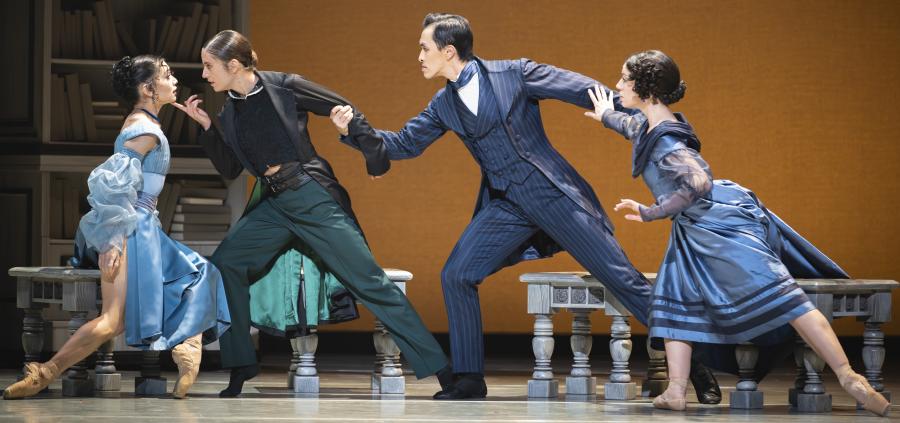
The piece also has such forward momentum, determined to cover all the key points in Lister’s story, that it becomes bitty and episodic. A scene is set, key moves are performed to project its narrative content, then on to the next episode. The speed of its progress is enabled by the clever device of movable bookcases with screens attached that project sections of background — skies, countryside, close-up bodies, a stained-glass window. And for Lister’s epic walks, there’s a treadmill.
Peter Salem’s music has to fit this fragmented design, served up as short bursts to match different scenarios and moods, though there are repeat appearances for the exuberant folksy fiddles that accompany Lister’s ebullient striding and deal-making. For her seduction scene with Ann Walker, the pace slows and the orchestration becomes sparer; at one point its repeated arpeggios sound like a lost section of Max Richter’s for Woolf Works. But it’s a score that doesn't always match the sometimes tempestuous emotions of the main characters.
The overall project, in fact, is rather too polite, perhaps understandably: this isn’t a Macmillan ballet. There’s violence in the scene where Lister is beaten up by a gang of thugs, who leave her prostrate and miserable at the close of the first act, but she’s bounced back as the second begins. Her male opponents are otherwise an unalarming bunch, even businessman Rawson, her main antagonist. Mostly she inspires a comic kind of fear, as if she is an alien life-force to sheltered types like her relatives, who respond to her by rattling their teacups as a clock’s noisy ticking registers the tedium of their lives.
Suranne Jones’s TV Anne has many of these same characteristics, but she also projects the emotional depth beneath her impatience and ebullience, the heartbreak when Mariana abandons her, her almost cruel tough-mindedness when she has to assert herself against the rebellious miners in her pits. We see Ochoa’s Anne in the same scenes, but the choreography doesn’t help us feel the intensity of what she’s going through.
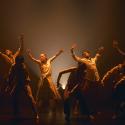
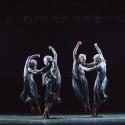
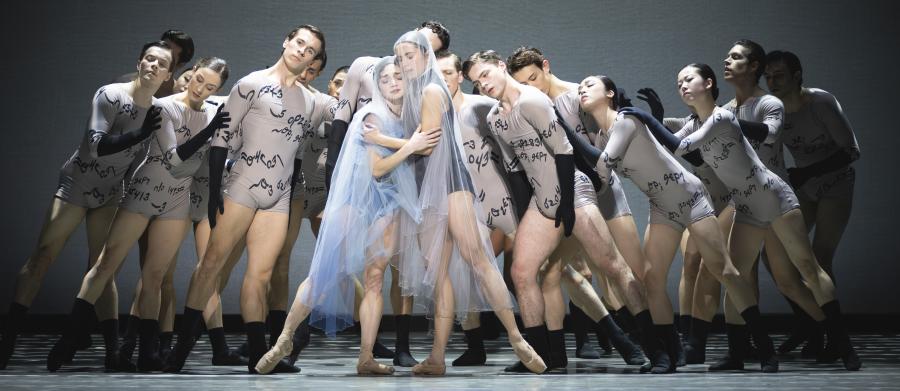
The TV version also has the benefit of voiceovers reading out some of the torrents of prose Anne wrote as an outlet for her simmering emotions — the documents that allowed a later researcher to unearth her story. Here they are projected onto the floor and scenery, and embodied by the corps, dubbed the Chorus of Words (pictured above with Gillespie and Coutts), in pale leotards covered in script. Their scenes are a further example of how well drilled the company’s dancers are, but the extraordinary content of Anne’s diaries — which include coded descriptions of her love affairs — can’t be fully communicated. Hers is a fascinating story but in this treatment it ends up more perky than passionate. The dancing and stage design, though, are a treat.