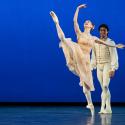
Rambert is celebrating its first 100 years with a triple bill that emphasises the youthful vitality of the company. “We’re 100, and we’re just getting started,” they enthusiastically declare. “The next century starts here.”
Like many of the best things in Britain, our first dance company was set up by an immigrant – a Polish woman dedicated both to dancing and promoting others. On leaving Diaghilev’s Ballet Russes where she’d danced with Nijinsky, Marie Rambert came to this country in 1914.
As a child she was nicknamed “Quicksilver” because she never stopped moving, and on arrival she didn’t waste any time. She began teaching ballet, founded her own dance school and, in 1926, established her own company – The Ballet Club. The first production, A Tragedy of Fashion was a comic take on queer fashion which she danced with Frederick Ashton, the as yet unknown dancer and choreographer who was working as a butcher’s accountant!
She had already become a name to reckon with and in the audience was Ninette de Valois, who would found The Royal Ballet five years late and Diaghilev, who came to see the show twice. The rest is history, as they say, except that the company is not dwelling on the past but looking towards the future.
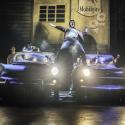
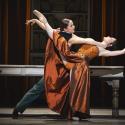
The evening starts beautifully with the premiere of Bobbi Jene Smith & Or Schraiber’s In Crimson (main picture). A red theatre curtain creates a shallow, slightly claustrophobic space resembling a piano bar – home to both intimate and chance encounters. A man sits listening while Yonatan Daskal plays Bach on an upright piano. Gradually the music coaxes him into movement and, as if against his will, he begins to embody the sound with glorious, though reluctant, fluency.
Others join him and emotions soon run high in a series of rapidly shifting duets that explore the squabbling dynamics of different relationships. Attractions and rivalries are played out to comic effect with movement snippets ranging from ballroom and Scottish country dancing to wrestling and polka which end in a daft, chest-thumping, gorilla-type stand-off. Perched on the piano, Naya Lovell sings a chanson in husky French, while Hannah Hernandez dances a tragi comic evocation of romance and heartbreak which provokes another round of confrontational duets and athletic solos. Sometimes verging on slapstick, the piece is funny, clever, fast-paced and perfectly timed. I could have watched it for hours.
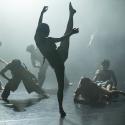
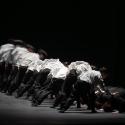
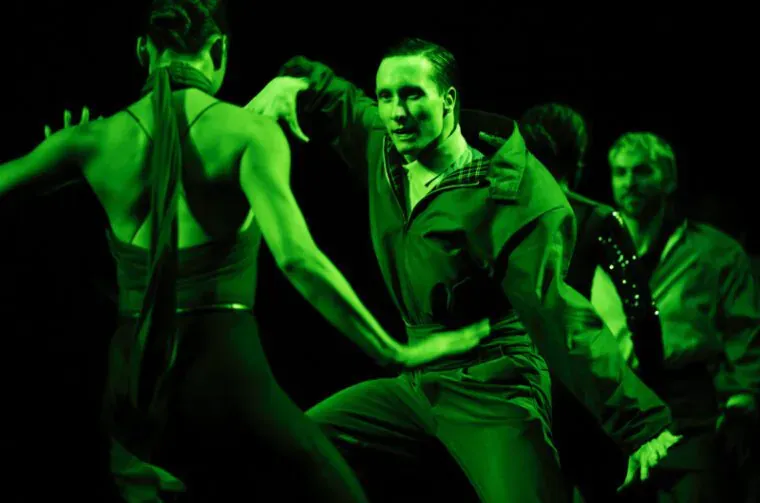
(LA)HORDE’S Hope(e)storm (pictured above: photo by Hugo Glendinning) opens with a face off between two rows of dancers confronting one another across an empty stage. Without warning, one group hurl themselves at their opposite number knocking them over in the process only to be dragged to another spot from where they launch themselves again and again. The loud electronic noise accompanying this onslaught is interrupted by a snippet of Elvis’s Jailhouse Rock and the dancers form into a neat row. The precision of the complex line dances that follow are like the polar opposite of the mayhem that precedes them.
Gradually this genteel hopping and skipping morphs into a full-blown lindy hop revival in which various partners show off their amazing jive skills as the beat quickens to an insistent, rave style tempo. With its high octane synchronicity and infectious energy, the piece is incredibly joyous and uplifting.
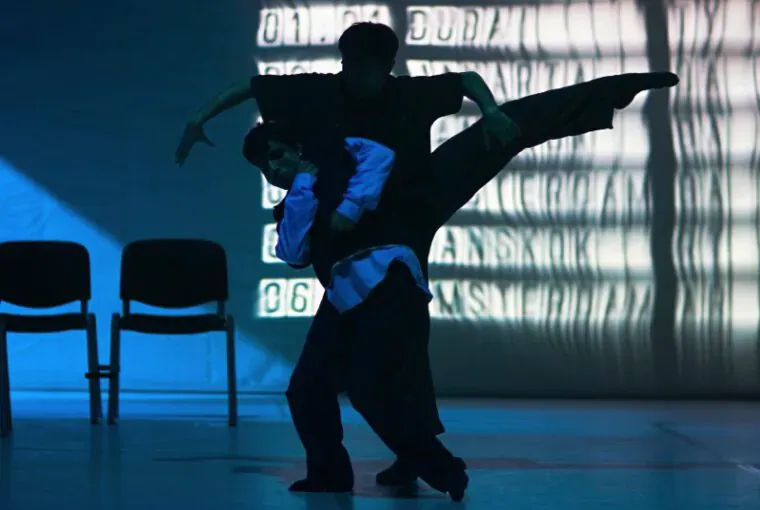
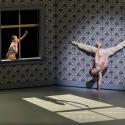
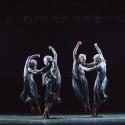
Emma Evelein’s Gallery of Consequence (pictured above: photo by Yiling Zhao) takes place in an airport departure lounge peopled by bored, frustrated or nervous travellers eager to be on their way. Dominating the space is a departure board flashing up messages such as “alone”, “scared” and “isolated” that reflect the mood of the passengers. It’s fertile ground for an exploration of existential angst and one passenger undergoes a prolonged panic attack surrounded by fellow travellers, one of whom manages to calm him down with the help of deep breathing.
An airport lounge could be a compelling metaphor for life in an age of uncertainty, but Evelein throws away the opportunity for meaningful exploration by opting for the safety of comic overkill. The dancers all move in animation style as if they were video game robots, which makes it impossible to engage with them as real people or believe in their emotional trauma.
They queue up at check in and go through security and passport control and, as if to compensate for the sense of alienation built into the piece, these interactions are carried out in ludicrously over the top mime. A recorded conversation between airline staff is similarly accompanied by absurdist pirouettes and gyrations that are too crass to be funny. Everything ends in tears as all flights are delayed, missed or cancelled, and the passengers file out despondently leaving one guy behind, who, inexplicably, gets showered in glitter.
It’s a sad ending to an otherwise wonderful evening. Fingers crossed that, rather than fizzling out, Rambert gets showered in enough gold – despite the difficult financial climate – to continue its onward creative journey.
- This is Rambert is on tour until July 15
- More dance reviews on theartsdesk