Henri-Georges Clouzot is one of the giants of French cinema history, such a versatile master of entertainment that his qualities as an auteur and art-house director are sometimes forgotten. This new collection of his restored films includes some of his very best work: Le corbeau (1943), a tale of poison pen letters in wartime France; Quai des Orfèvres (1947), the complex and twisted story of a pianist and composer’s jealousy – stirred up by his neurotic singer wife; and the only colour film he made, La prisonnière (1968) which plunges with almost perverse relish into the eroticism that was often close to the surface in much of Clouzot’s work.
Best known for The Wages of Fear (1953) and Les Diaboliques (1955), both characterised by a nerve-rattling mix of violence and suspense, Clouzot was fascinated by extremes of human emotion, which he evoked in highly dramatic ways – his action sequences are shot and edited with formidable precision and an unerring sense of suspense. It is for this reason that he has often been compared to Hitchcock, but the strength of his films doesn’t come from holding back as it does with Hitch, but rather through almost operatic dramatisation. The unfolding of the narrative often features twists and turns – as much for the protagonists as for the watching audience. He is a master of the metaphorical cliff-edge.
Sexual and erotic passion surges through all his films
Le corbeau, made during the Nazi Occupation of France, describes the disintegration of a community in the face of a torrent of anonymous letters, denouncing various inhabitants of a small town, most of all the doctor, a marvellous performance by Pierre Fresnay (pictured below with Ginette Leclerc, left, and Michèle Francey, right). The film was attacked by both left and right – it was made through a Nazi-backed production company, Continental Films, but the portrayal of a poisoned community didn’t please the Church or supporters of Pétain either. The film has not aged, for it is much more than a chronicle of its times: Clouzot was fascinated by the mixture of good and evil in all of us – he was in no way a Manicheist, but instead a director who could not resist staring into the abyss and coming back with magnificently crafted portraits of the depths.
Sexual and erotic passion surges through all his films. There is a magnificent moment in Le corbeau where, after a series of smouldering looks, the über-sensual character played by Ginette Leclerc bites the doctor’s hand, as he is trying (albeit reluctantly) to silence her. In Quai des Orfèvres, the drama is driven by sexual obsession, a mesh of criss-crossing fatal attractions, including a beautifully understated but highly erotic relationship between the singer Marguerite (Suzy Delair) and her lesbian friend Dora (Simone Renan). The police inspector, in a totally assured performance by the great Louis Jouvet, navigates through the amorous passions, duplicity and latent violence with the mastery of a demi-god: canny, philosophical and in some way above it all.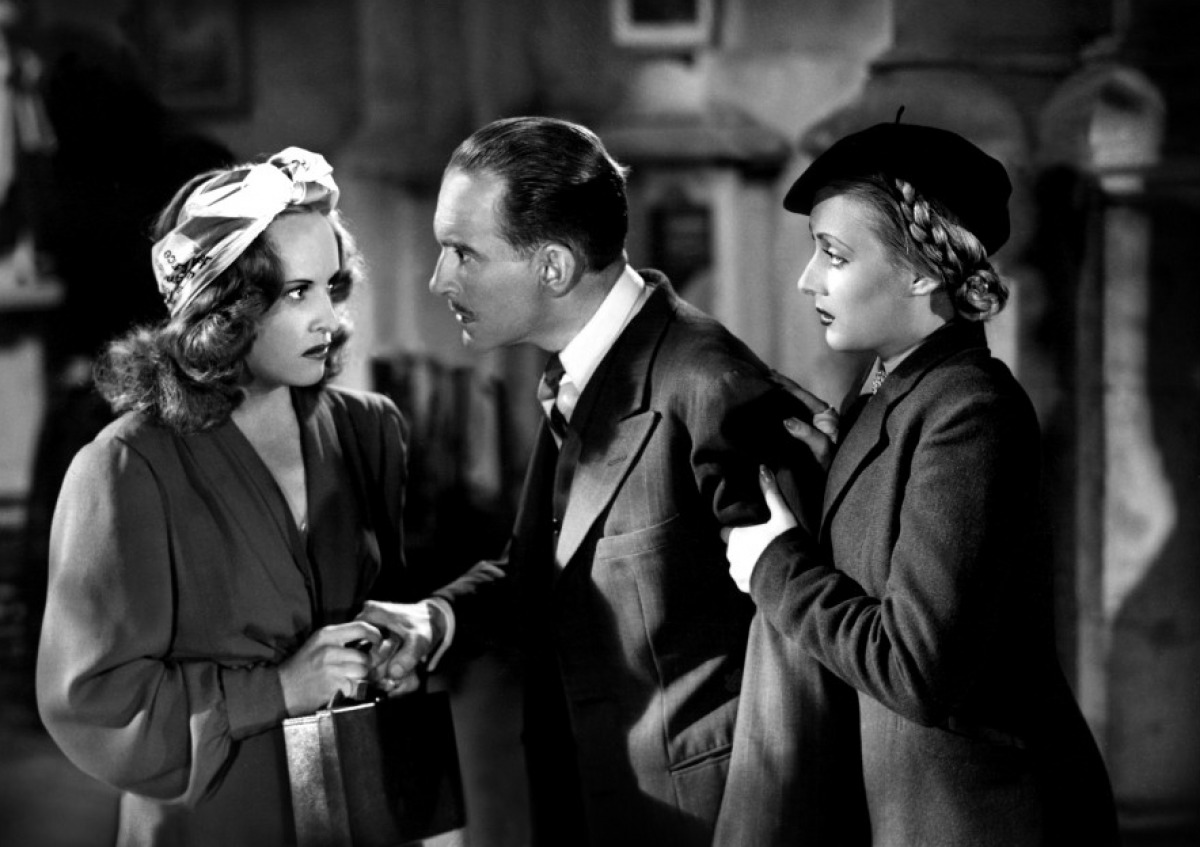 The undercurrent of sex in both these films surfaces more explicitly in La prisonnière, Clouzot’s last cinema work. It is less well-known than his other films, and was never distributed in the USA. It shares a great deal with Michael Powell’s Peeping Tom, Buñuel’s Belle de Jour and Antonioni’s Blow-Up, as one of the main characters, the trendy gallerist Stanley Hassler (a suitably spooky Laurent Terzieff), a specialist in kinetic and op art, has a fondness for photographing women in submissive poses. Josée (a sultry Elisabeth Wiener) wants to submit – to the horror of her husband Gilbert (Bernard Fresson), one of Hassler’s artists.
The triangle sizzles with unspoken violence – the mirror of the sadomasochistic scenes which Hassler photographs – and culminates in an unexpected and very dramatic dénouement, as characteristic of Clouzot’s mastery as anything else he created. Each of these releases is supplemented by an informative and thought-provoking bonus, containing valuable material about Clouzot, the making of the films and their content, with contributions from French critics and historians.