

“I never abandoned you,” says Jule (Ophélia Kolb; Call My Agent!) to her 10-year-old daughter Claire (Jasmine Kalisz Saurer), setting a fairly low bar as far as motherhood is concerned.
Swiss-American director Jasmin Gordon’s first feature, with a screenplay by Julien Bouissoux, is a compelling, though too mysterious, portrait of a single mother versus society. Set in a wealthy town in the mountainous Lower Valais in Switzerland, Jule, a woman on the margins, gazes out from her window at the murmuring trees that, in a hypnotic, recurring motif, seem to offer a portal for escape.
She lives in a flat with her three children, Claire and her brothers Loïc (Paul Besnier), aged eight, and Sami (Arthur Devaux), six. All three give outstanding performances, as does Kolb.
In the first scene Jule does, in fact, abandon them briefly in a café in a bleak retail park where they share a lemonade. We never find out where she’s been. Strangely, she’s left her car in the car park. The sun-ravaged waitress is suspicious and unfriendly and calls security, at which point they flee, running through fields and across lethally dangerous motorways, eventually ending up at home, where they fall asleep in the living-room. How long the journey took them isn't revealed, so there's a sense of unresolved jeopardy. “I looked for you all day,” Jule tells them later.
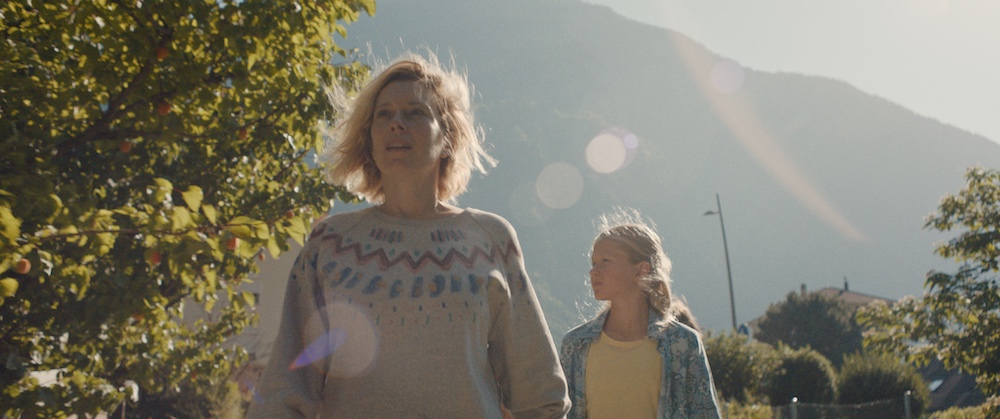 It’s clear that Jule has a wild streak, which worries Claire, who seems older than her years (both pictured above). “Mum, are you sure we’re allowed?” she often asks, when Jule picks cherries from trees or unlocks the front door of a house she says they’re going to buy and encourages them to choose their bedrooms, only for them to have to scarper when she spots the estate agent outside. And why, Claire wonders, is there a bag under the sink with someone else’s passport in it?
The kids long to be somewhere permanent and Jule longs to provide it, but as far as we can see she has no job. In Nancy, where they lived before, she did something with figures, or so Loïc, who is on the spectrum, tells the nosy, disapproving head-teacher (Michel Voïta) when he asks (the kids have had unexplained absences from school, and their mother doesn’t respond to enquiries as to why). Anyway, Jule seems convinced that she should, by rights, be allowed to buy the house, and tries to persuade an agency to give her a loan. “How can I give you a loan when you’re three months behind with the rent?” asks the clerk.
Jule always has an answer for her children: the people (presumably the bailiffs) who seem to be taking an inventory in the apartment are, she says, measuring up for re-decoration. But we’re moving, surely, says Claire. No reason not to decorate, her mother says, with a desperate smile. “I’m managing very well on my own,” she insists when Claire suggests, as a mother would, that she might need help.
 The cards are stacked against her, she believes, but she maintains a brave face, and Kolb is brilliant at conveying the intensity of her balancing act. The only option is to steal, though she doesn’t seem very good at it. There are many tense scenes in the car; somehow she manages to afford to run one, though the petrol gauge is on empty.
The other parents look at her dubiously when she turns up late at a birthday party for one of Sami’s school friends. She’s managed to bring a present, shoplifted from a supermarket that, you discover, she’s been banned from, yet somehow she gets away with it. Has she done time in prison? When the four of them go swimming in the river, one of the few carefree occasions, she covers up her ankle monitor with cling-film from her sandwich. “When is the doctor going to remove it?” asks Claire. I can’t help it if I have weak ankles, mutters Jule. Lying is second nature but also a necessity.
We know nothing of Jule’s past, so it’s hard to empathise completely, but when she spits at the estate agent in furious defeat, “No one wanted this house except me, no one,” she’s so wonderfully vehement that you can’t help being on her side (and she’s got the nerve to ask for a 10 per cent discount because of termites). When everything falls apart, leaving too many unanswered questions, Jule may still be the perfect mother as far as her kids are concerned.


