

The Brits are back in the Oscar race big-time, with Benedict Cumberbatch, Eddie Redmayne, Felicity Jones, and Rosamund Pike among the first-time Academy Award hopefuls who will be duking it out in the leading categories.
film reviews
Nick Hasted

First there’s an “Allahu Akbar”, then an American tank’s rumble and clank. It’s an ominous and wearying start, the sound of Islam and invasion intermingled in the Iraq War, a violent conflict that today simply expands. When director Clint Eastwood lets us see, too, we’re by the treads of the tank, then within seconds we’re on a rooftop with Chris Kyle (Bradley Cooper), who spots a woman in a hijab with her child. They have a grenade, and he lines them in his crosshairs. Cut.
Emma Dibdin

Stream-of-consciousness is a tough thing to pull off in the movies. Voice-over narration has now fallen so far out of favour that no internal monologue survives the journey from page to screen even remotely intact, and having your lead character slavishly deliver chunks of a novel seldom recreates the odd magic of reading those same words in one’s own head.
Jasper Rees

It is 30 years since Shoah. In the filmography of the Holocaust Claude Lanzmann's document is the towering monolith. At nine-and-a-half hours, it consists of no archive footage at all, just interviews with witnesses unburdening themselves of memories. Of all those conversations, there was one in particular which Lanzmann held back. After the three and a half hours of The Last of the Unjust, it is clear why.
Graham Fuller

Woods and forests were given a fresh impetus as a psychic terrain for the cinema by Lothlórien, Fangorn, and the other sylvan spaces so ethereally or threateningly rendered in The Lord of the Rings films and, to a lesser extent, by the Mirkwood of the second Hobbit movie. All distorted black boles, labyrinths of tangled branches, knobbly roots, and conically sun-strafed clearings, they were movie woods to rival the great Gothic forest of Fritz Lang’s Die Nibelungen: Siegfried (1924) and the magical Athenian wood Warner Bros.
Katherine McLaughlin

Steve Carell makes the move from the light comedy of the American workplace to the dark side of that country as delusional blue-blood John Eleuthère du Pont in a transformative and creepy performance that borders on the grotesque.
Foxcatcher is based on a shocking true story set in the wrestling world. Though some of the events occurred in the 1990s and over a longer time period, director Bennett Miller sets his film towards the end of the 1980s. Miller’s previous feature, Moneyball, was also set in the sports world but instead of focusing on the players he chose to look at the maths behind the game. In a similar way he subverts the long arduous road-to-glory sports story by exploring the inner lives of Olympic gold medal-winning wrestler, Mark Schultz (Channing Tatum, pictured below right), his brother and coach, Dave (Mark Ruffalo), and the aforementioned mercurial man who supported their training sessions in the grounds of his grand home in preparation for the Seoul 1988 Olympic Games.
Miller’s precise, cold and detached composition alongside Greig Fraser’s expert cinematography, echo the isolation, paranoia and clinical view of du Pont’s ever-watchful eye and deteriorating mind-set. A sinister atmosphere is established from the outset and the dread is palpable.
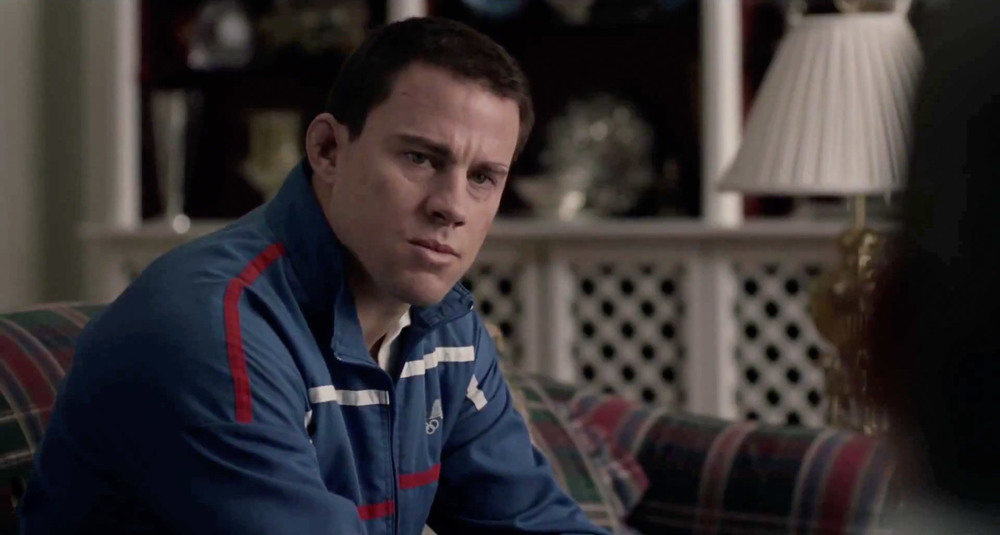 Carell mimics the meticulous pronunciation of a politician delivering a meaningless speech, his pregnant pauses bristling against the nape of your neck like a slithering snake. A particularly memorable scene which sees du Pont offering Schultz cocaine while travelling in his private helicopter is hypnotic. Du Pont gleefully exhales a list of the things he collects, furthering the sense of pride in ownership that has been instilled in him by his mother (the excellent Vanessa Redgrave) and it's terrifying. Miller makes it clear from the start that no good will come from the teaming up of these proud patriots, but here he turns du Pont into something quite monstrous.
If du Pont plays the politician it's Mark Schultz who takes on the role of keen supporter. At first he is put under the spell of great promises, then he engages in amicable relations before finally he begins to notice the cracks in the veneer as the perennial smile fades from the face of his patron. Tatum refuses to play Schultz as a knucklehead. He was, in fact, greatly aided by the real-life wrestler and it shows not only in his stance and mannerisms but the way in which he reaches into the psyche of a professional athlete.
Miller’s powerful and surefooted psychological drama possesses an intensity and haunting elegance which demands you bear witness to chilling and bleak sights.
Overleaf: watch the trailer for Foxcatcher
Marina Vaizey

The octogenarian Frederick Wiseman is a cult documentary film maker, with his own idiosyncratic and recognisable idiom. He has both vast experience and extraordinary independence. Characteristically, he makes long, prize-winning, fly-on-the-wall inside-the-institution films: reportorial, non-judgemental, loosely narrative, and wide in subject – from a hospital for the criminally insane, to a high school, the largest university in California (Berkeley), or the Paris Opera Ballet.
Tom Birchenough

French actress Marie Rivière had a specially close relationship with director Eric Rohmer. After seeing his work for the first time in the early 1970s, Rivière expressed her admiration in a letter, which led to a succession of parts and culminated with her appearing as heroine Delphine in Rohmer’s 1986 The Green Ray (Le rayon vert): the part was in some way centred on the experiences of the actress, who was allowed to develop the story through almost total improvisation.

Matt Wolf

Filmgoers will either find Denis Villeneuve's latest art-house thriller to be a tantalising head trip or so much celluloid posturing, but there's no denying its contribution to the rise and rise of leading man, Jake Gyllenhaal. Racing up the outside track as a potential Oscar nominee for Nightcrawler even as he is making a (splendid) Broadway debut in the Nick Payne play Constellations, Gyllenhaal here gets to impress twice over and for a simple reason: Javier Gullon's script casts the hirsute star in two different, teasingly complementary parts.
Thoughts of Jeremy Irons's career-best work in Dead Ringers come to mind, or the sort of conceit one might expect from David Lynch, whose shimmering reality-vs-illusion landscape comes to mind here. And while the surface narrative is apparent enough, its larger meanings remain up for grabs, and one can only begin to imagine the PhD students who are going to be probing every frame for its fullest meaning for some years to come.
 For now, let me just say that I admired Enemy more than I warmed to it, and that there are numerous other movies whose deeper resonances seem to me more immediately worth mining (Lynch's Mulholland Drive to name but one). But whether you tune out to this movie or (as some are said to have been) are freaked out by it, there's no denying the absolute command of Gyllenhaal, who over time has learned to put his puppyish appeal to one side in favour of a more forceful, declarative style of performance that should serve him in good stead as he gets older and less obviously "cute". Think of this as part of Gyllenhaal's thespian insurance plan for an ever more varied screen future.
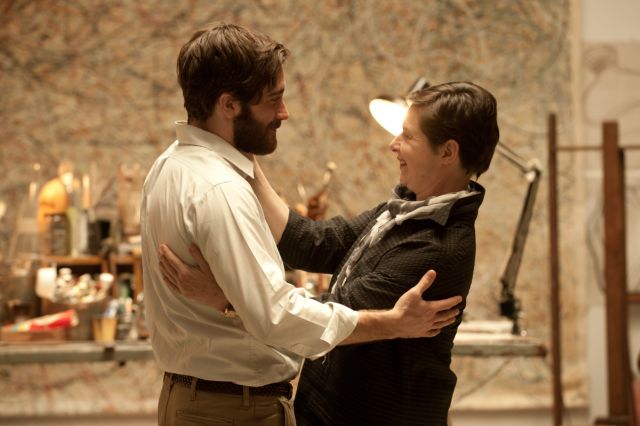
Roughly half the film casts Gyllenhaal as Adam Bell (pictured above with Isabella Rossellini, who plays his mother), a faintly nerdy college professor who seems to spend his time when not lecturing having sex with his girlfriend (Melanie Laurent), and who can blame him for that? At least, that much is true until Adam rents a film one evening in which he happens to espy a bit-part actor, Daniel aka Anthony, who looks uncannily like himself, bodily scar and all. As purposeful – almost ominously so – as Adam is indrawn, Anthony responds to Adam's obsessional interest in him by commandeering significant (for which, read sexual) aspects of his doppelganger's life, the stakes escalating as the subconscious and the supernatural begin to take hold as well.
What follows tells perhaps the battle of a battered psyche or suggests a veiled political parable about societal misrule as it is allowed to infiltrate even the most ordinary lives. Or maybe the film is just about giving its leading actor the opportunity to push in two separate if ever-intersecting directions. Some won't care whereas others will be rapt. You could do worse than ponder Enemy's Cronenbergian affinities (yes, him too) and allow respect for Gyllenhaal to override the more self-conscious meanderings of what looks set to be this new year's murkiest film.
Watch the trailer for Enemy overleaf