Outside his home country Madagascar, Damily was first heard via a couple of tracks on the 2004 French compilation album Tsapiky, Panorama D'une Jeune Musique De Tulear, an overview of the tsapiky dance music of the south-west of the island. He’d moved to France in 2003. His first internationally issued full-length album, Ravinahitsy, followed in 2007. Since then, there’s been three more albums: the last of which was 2018’s Valimbilo.
The new compilation Early Years – Madagascar Cassette Archives soundtracks a previously untold backstory by revealing what Damily’s music was like on his home turf, before the move to France – when his audience was still local only. Six tracks are collected, taken from four cassette-only albums which until now have been obscure beyond Madagascar. The years covered are 1996 to 2002 (not 1995 to 2002, which is what the release is promoted as). The three earliest tracks are credited to Orchestre Safodrano (from 1996) and Orchestre Masoandro (1997), bands featuring Damily on guitar.
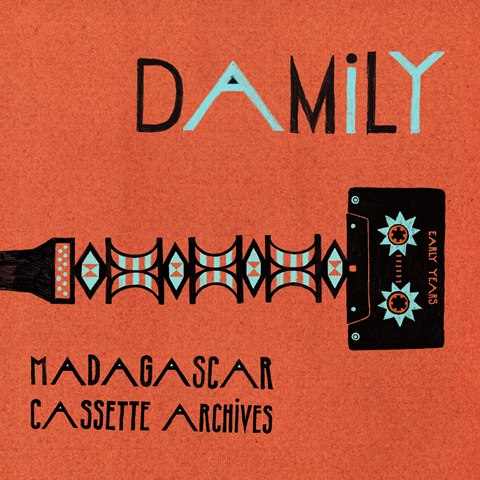 As a result of the widely available albums, Damily has become synonymous with tsapiky, a groove-based, spiralling, uptempo music frequently so furious it only just sticks to its rails. On Madagascar Cassette Archives, the tracks are less produced, pricklier and more direct than what’s been issued so far by the French and Swiss labels which picked up Damily. His records have become increasingly polished.
He’s been in tsapiky bands from 1986 and the first cassette album arrived in 1994 – at least seven were made for his Madagascar audience. The last, Andao Tsika Hitsinjaky, came out in 2002. Two of its tracks are collected. The other selections come from Jagirike Vol.1 (1996: the Orchestre Safodrano cassette), Tamaraky (1997: two tracks, as by Orchestre Masoandro and mistitled Pamaraky here. pictured below left) and Lazan’ny Tany (1997). Madagascar Cassette Archives is a selective series of snapshots.
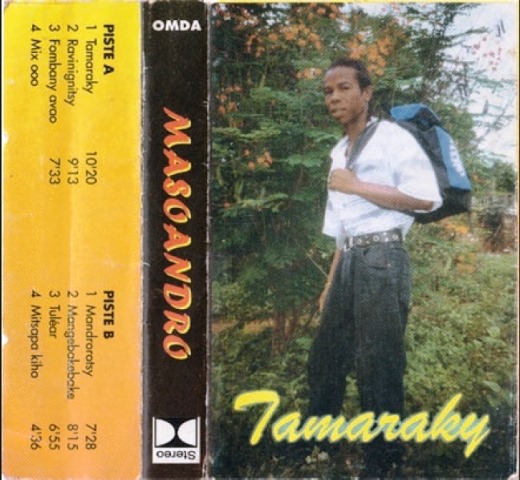 Equally inexact is the nature of tsapiky itself. The style evolved in the 1980s and, according the liner notes, the music's characterised by the use of “cheap loudspeakers, second-hand amplifiers…drums made of barrels and zebu skin. A lot of things were combined...the marovany (zither), mandolins and accordion, polyphonies…the role of the bass was reinvented with increasing[ly] melodic lines, and the guitar was becoming predominant. The playing was now completely centred on the guitar. A tsapiky orchestra is not a group of musicians, it's a group of musical equipment: an electric guitar and bass, drums, two amps, one or two speakers and one or two microphones for the voice(s).” The result was upbeat, upfront, with extravagant vocals. South African township styles seem to be in the mix.
On Madagascar Cassette Archives, the sparse “Mipay Havelo” (2002) is a standout. A trio recording, its circularity and shuffling hand percussion compel. In contrast, “Nahoda Pamelon Anake” (1997) features a six-piece outfit with two vocalists, one of whom is the keening Gany Gany who continued working with Damily in France. It’s brilliant – there’s the shuffling rhythm again. An elastic bass guitar works against it. All the while, Damily’s guitar relentlessly twists through the whole. The six tracks collected raise the question of what the rest of the material Damily issued on cassette in Madagascar is like.
Anyone who has seen him and his band at one of their regular festival appearances needs Madagascar Cassette Archives as it uncovers another Damily, one whose music was more rough and ready than anything issued after his move to Europe.
- Next Week: Keith Relf – All The Falling Angels Solo Recordings & Collaborations 1965–1976. Celebration of The Yardbirds’ frontman
- More reissue reviews on theartsdesk
- Kieron Tyler’s website