Like Lemmy, the bassist with their fellow London-based freaks Hawkwind, Pink Fairies crossed the bridge between the late-Sixties underground and the great British punk rock boom of 1977. After being sacked from Hawkwind Lemmy formed the punk-friendly Motörhead, whose debut album was issued in ’77. Their short-stay first guitarist was the Fairies’ Larry Wallis. After he exited Motörhead a fleetingly reformed Fairies issued a single on Stiff in 1976, the label’s second release.
Wallis then produced The Adverts and issued his own single on Stiff in 1977. His pre-Motörhead band’s drummer Twink re-emerged in the same year fronting The Rings, who released a punk-tailored single and supported The Damned, who themselves later recorded an unreleased version of the Fairies’ “The Snake”. Punk had not exterminated Pink Fairies.
 In this context and bearing in mind the cross-pollination with Motörhead, revisiting Pink Fairies’ albums ought to be instructive. Maybe the special ingredient enabling them to dodge punk’s year-zero bullet courses through their records. Potential elucidation comes with The Polydor Years, which collects their three Polydor albums: Neverneverland (released in May 1971), What a Bunch of Sweeties (July 1972) and Kings of Oblivion (June 1973). Housed in a very retro double fold-out jewel case, each of the three discs – one for each album – is as per the 2002 reissue of the individual albums and has the same bonus tracks. Although The Polydor Years features no previously unheard music, it is keenly priced at around £10.
Pink Fairies were formed in 1969/70 by members of Mick Farren’s band The Deviants. Their initial line-up was fluid, but coalesced around Russell Hunter (drums), Paul Rudolph (guitar, vocals), Duncan Sanderson (bass) and Twink (drums, vocals).
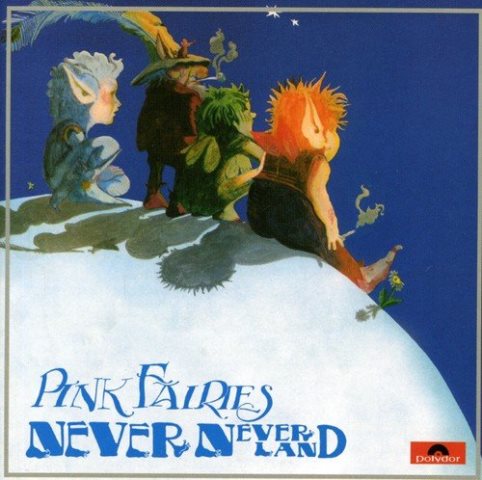 In this form, Polydor signed them and Neverneverland was recorded. The instability continued when Twink left and they then made What a Bunch of Sweeties as a trio. By the time they began Kings of Oblivion after a brief hiatus, they were Hunter and Sanderson plus new guitarist Larry Wallis.
Initially, the most striking aspect of Neverneverland is the deadening, flat-as-a-pancake production. The playing is more polite than would be expected and there are nods to other bands: at 1.40 in, “Say You Love me” borrows a brief snatch of Cream’s “Tale of Brave Ulysses”; the pastoral Pink Floyd colours the drifting “Heavenly Man”, which intriguingly points towards the Floyd’s “Us and Them”. “War Girl” could pass as a 1969/70 Fleetwood Mac track. Waywardness only comes to the fore on the elongated though structured chugger “Uncle Harry’s Last Freak-Out”.
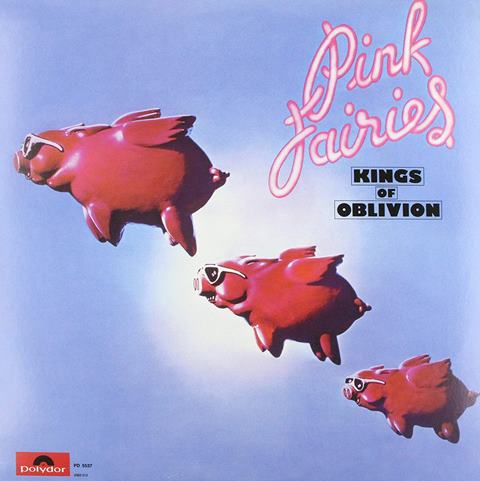 What a Bunch of Sweeties begins with some terrifically unfunny spoken “uranus” jokes which stoned listeners may have found jolly funny. Just the once, though. The album includes off the wall cover versions of “Walk Don’t Run” and “I Saw Her Standing There” and is more fragmented than Neverneverland. “Portobello Shuffle” is an uninspired boogie. “The Pigs of Uranus” is a bluegrass-indebted comedy song. Again, the production is rotten. It’s like listening through a pillow. As before, there’s little evidence to support received notions of Pink Fairies as freak-rockers par excellence.
Kings Of Oblivion is the most interesting album of the three. Despite more dreadfully flat production, it kicks off with an energised take of “City Kids”, which Motörhead carried on playing after Wallis had left them. With this, it’s finally possible to just-about hear where Pink Fairies connected with punk. The other highlights are “Chambermaid”, a leering rocker with the memorable couplet “I don’t care if she looks like a dog, just so long as she does a good job,” and the appealingly Who-ish “I Wish I Was a Girl”.
This a band which would play live naked, yet on the journey between the stage and the studio Pink Fairies mislaid their freakiness. Furthermore, none of the albums are pre-punk signifiers of what was to come. Maybe you had to be there to get this much-loved band.
- Next week: Jambú e Os Míticos Sons Da Amazônia – top-notch dip into the music of north-Brazil city Belém
- Read more reissue reviews on theartsdesk
- Kieron Tyler’s website