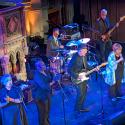
Over the years, Ronnie Scott’s, one of the premier jazz clubs in the world, has hosted some truly transcendental music. There’s something about the horseshoe layout of the seating that promotes exceptional intimacy. When the music zings and the audience feels it, there is a positive feedback loop which elevates the event beyond the merely ordinary.
Steve Coleman and Five Elements, although still jet-lagged, in the early stages of an intense European tour, rose to the occasion, with an incandescent set that had the punters bewitched and – for Ronnie’s – unusually quiet. Unlike many other star acts, Coleman didn’t hide away backstage between sets, but hung out at the bar and near the mixing desk, engaging warmly with people and greeting old friends. It felt as if he were feeling the audience’s vibe, preparing himself to the cliff-edge and risk that any of his performances incarnates.
He is clearly a band-leader, inspiring his fellow musicians, but his role is one of a shamanic enabler rather than a chief. The cohesion of the group is remarkable, they are all stellar, and Coleman clearly knows this. Rich Brown, surely one of the best younger bass-players mentored by the likes of Buster Williams, provides a minimalist anchor to the whole. His solos on the a six-string bass are lyrical and virtuosic, though most of the time, he's playing three or four note riffs, repeated over and over as mantras in a meditation. With great sensitivity, he can provide rhythmic counterpoint as well as being in sync with Sean Rickman, a drummer as subtle with the tonal range of his well-equipped kit as can be. Rickman exploits the pitch range of his tom-toms and the varied timbre of his cymbals, intervening fiercely in response to Coleman and to trumpeter Jonathan Finlayson’s flourishes, while sometimes displaying supernatural instinct when urging them on to new creative heights. Thinking poetically about the five elements of the band’s name, Brown’s bass provides earth and grounding, while Rickman’s ‘s drums sets off the fire.
The range of an alto sax goes from sweetly plaintive to razor-sharp joy and Steve Coleman mines every possibility from his instrument. He evokes a lineage that draws from Charlie Parker as well as Ornette Coleman, both musicians that played a crucial part in taking the alto into new territory. In one particularly thrilling instance, sax and trumpet quote from the theme of Parker’s bebop classic “Moose the Mooche”, speed-fuelled in its time, but invigorated here by extra high energy – a brief but intoxicating echo of one of the tap-roots of this equally innovative music.
This may have been a matter of my own mood on the night, but I found the moments when Coleman played alone – teasing a breathy sound out of his sax, as if searching for a mood or melodic idea that eluded him, – the least engaging: a necessary moment of respite perhaps, amidst the high energy of most of the set, but I found myself disengaging, though instantly drawn back in again when the collective music-making took off.
Jonathan Finlayson has a soft tone at times reminiscent of trumpeter Booker Little – who graced some of the best music made with Eric Dolphy and his quintet in the 1960's. There are echoes too of the tonal fluidity of some Arab trumpet players, not least Ibrahim Maalouf. Finlayson's cool reserve provides the perfect foil for Coleman’s combination of attack as the notes cascade out his horn, and the aching lyricism to which he's irresistibly drawn. They both excel in a contrast between staccato jabs and near-liquid runs, shifting between dialogue and unison. As has often been said, this is a band in which everyone, including the exceptionally melodic drummer, plays with rhythm as much as with tone.
At their most potent, Coleman and Five Elements feed off intuitive communication, the fruit of years of playing together, a multi-dimensional pow-wow rather than a simple two-way conversation. And yet, there's plenty of the call-and-response so fundamental to African and African-rooted music, not least in gospel, a musical form so fundamental in jazz, often the cradle of some the music's greatest talents. The always exciting way in which the band moves seamlessly from carefully composed moments to improvisation is at times reminiscent of Charlie Mingus, another shamanic figure. As in the case of the great bass player,who encouraged collective improvisation, this is deeply spiritual jazz.
Coleman is exceptionally well-versed in music from other cultures, not least from Africa. His time with the Dagomba drummers of northern Ghana, among other experiences, taught him the way in which intricate polyrhythms express not just community, but a remarkable musical sophistication that provides a context for reaching beyond everyday consciousness.
There were moments in the set at Ronnie’s – shared by musicians and audience alike – when we experienced what Africanist Robert Farris Thompson described as the “flash of the spirit”, a quality of being delightfully close to ecstasy.