Four people walked out of Filter’s A Midsummer Night’s Dream last night. The rest stayed to cheer an hour and 20 minutes of fast and furious filleted Shakespeare from a company which has made its name merging visual and musical forms, reinventing classics and creating new devised pieces.
Their previous brush with the bard, the RSC collaboration Twelfth Night, was a gas: refreshing, funky, playful – all you would wish for in a revisionist production. Thinking of them as a pocket-sized British version of the Wooster Group is perhaps overdoing it, but what's certain is that with Sean Holmes again in charge as the Lyric’s artistic director (as he was with several of Filter's previous productions), the company have gone out of their way to deconstruct a play that can so easily fall into Victorian whimsy. Indeed, the front of the programme shows a typically romanticised illustration: a little fairy girl with gossamer wings and a beatific smile alighting on a leaf; a picture of Ruritarian and rural innocence. Well, you won’t find much of any of that in Filter’s punk version. It is a very knowing, subversive, modernist rendering that plunders as many technological and cultural references as it can lay its hands on.
As for the sense of ethereal otherness and magic, the production positively teems with it
A distinctly republican smell hovers over this Dream, set in motion by Ed Gaughan’s Irish warm-up Peter Quince. His quicksilver introduction embraces a ruby description of ancient Athens – "a more stable economy with a homosexual subculture, not unlike Brighton" - and a rich anti-royalist vein: "We're buying a yacht for the Queen to celebrate her Diamond Jubilee in the worst economic crisis since the war. Now that shows a real sense of being in touch with the people, doesn’t it?" He finishes by winding up the audience by promising a surprise guest star to play Bottom - one Gary Oldman.
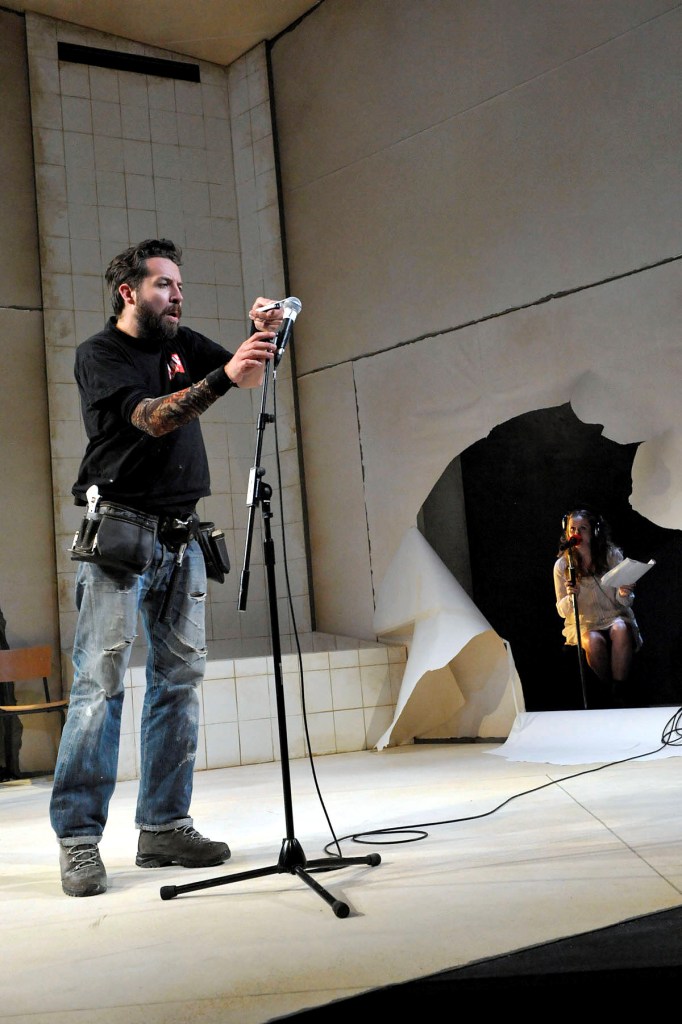 Shouts of delirious anticipation from the audience prove premature. With more false starts than a Middle East peace settlement, this Filter constantly up-ends expectations, climaxing in a flour-strewn all-out brawl that David Hayes and Dereck Chisora might have revelled in. Lysander (John Lightbody) and Demetrius (Simon Manyonda) even resort to pistols. But this mayhem is set within strict parameters. As Ferdy Roberts’ insufferable know-it-all stagehand Puck (pictured right) reminds us, these are but shadows, echoes of an idle dream. We have but slumbered here. All will be well.
Oh, that life could always put its disasters so neatly by. But in the interim, Holmes provides young audiences with an entree to Shakespeare that is constantly inventive, often very funny, and which loses its philosophical way only towards the end. Whilst great chunks of, to Filter’s mind, unnecessary (and presumably boring) narrative have been jettisoned, so too has some of the poetry and, more tellingly, the sense of love as a restorative and healing power.
In between, we have Waterloo Road’s Mark Benton taking on Bottom as the Oldman stand-in. He is drawn out of the audience in a conceit that inevitably soon expires but proves extraoardinarily apt, gradually taking over as a hard rock fan initiating songs into the proceedings. We have tons of blue spray paint (love-in-idleness, don’t you know!), rambler tents and, best of all, Jonathan Broadbent’s Oberon – small and bespectacled, his accident-prone Superman-cum-Batman is a delicious satirical swipe at the usual autocrat who dominates events.
As for the sense of ethereal otherness and magic, courtesy of mikes and digital sound devices, the production positively teems with it. Designer Hyemi Shin provides a set that resembles a crummy, rundown dance hall and tiled bath-house, surrounded by paper walls that create a fantastic source of unexpected and explosive exits and entrances. All in all a mixed blessing but, for at least two-thirds of the duration, a hugely entertaining one.
- A Midsummer Night’s Dream at Lyric Theatre, Hammersmith until 17 March