

Janáček’s stark Prelude is a stunner: there’s no conventional beginning, no conventional thematic development; it simply starts, as if a light switch has been flicked on, and the baleful opening theme is distorted, repeated, squeezed until it leads into an extraordinary stretch of solo violin writing. Based on Dostoevsky’s novel, Janáček’s final opera isn’t a faithful adaptation – it’s a selection of loosely linked scenes spread over three concise acts.
A new inmate, Goryanchikov, arrives and is flogged as a political prisoner. In the closing minutes he’s pardoned and released, while the rest of the prisoners return to their cells. It’s remarkably static - the Opera North chorus barely move a muscle for long stretches – and the few standout arias are monologues in which prisoners recount their gloomy back stories. But it’s also one of the most moving, musically exciting of 20th-century operas and a brilliant display of mature, late Janáček – echoes of the brassy Sinfonietta and the ecstatic Glagolitic Mass are everywhere.
John Fulljames recently directed a witty, coherent production of Janáček’s The Adventures of Mr Brouček for Opera North, a picaresque comedy with plenty of scope for set pieces. Here, the challenge is much greater – how do you manage to make an opera set in a Siberian prison camp dramatically and visually thrilling? Brouček made imaginative use of video back projection, and here Fulljames playfully has some of the surtitles (not strictly necessary, as the opera is given in David Pountney’s translation) unfolding directly onto the stage set, as if we’re reading graffiti scratched on breeze-block prison walls. It’s a striking effect, also used when Skuratov’s grim back story is projected onto a rolling sheet of cotton, as if we’re reading film credits.
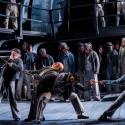
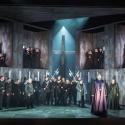
Flourishes like this prevent the greyness prevailing, as does the care with which Fulljames makes his cast move around Dick Bird’s stage set. Watching the emptying of slop buckets near the beginning is compelling, as is the beautifully choreographed forced-labour scene, here updated so that the prisoners are wielding welding torches. Bruno Poet’s subtle, sombre lighting lets us discern just enough.
The singing is consistently impressive: Alan Oke’s Skuratov and Robert Hayward’s Shishkov are both standouts, despite the contrast between the beauty of their delivery and the bleakness of the stories they recount. There’s excellent support from the Chorus of Opera North, but the evening is made unmissable by flawless orchestral playing under Richard Farnes, with each mercurial gear change achieved without effort. The textural spareness is frequently startling, and an augmented percussion section really let rip, with rattling chains, anvils and tubular bells.
Add comment