There's a good deal of irony in the most controversial production of the Globe to Globe season turning out to be one of the least interesting. The Merchant of Venice was performed by Israel's Habima National Theatre, a company which has incurred the wrath of some for performing in the Occupied Territories, and there were protestors tonight, mainly of the flag-waving variety. The drama in the yard and the galleries was not matched on stage, I can unhappily report.
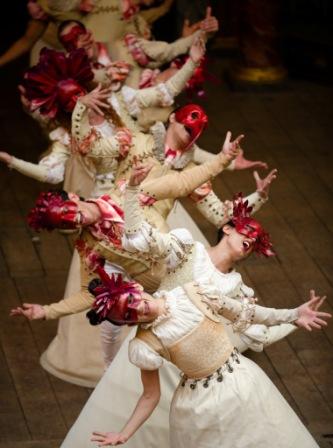
Played as a straight period piece, with velvet and doublets and ruffles for miles, this Merchant gave us a rather listless interpretation, despite the cheerful carnivalesque opening, continuous music and frequent playing for laughs. The playing for laughs - Jessica comically hesitating whether to drop her father Shylock's gold into Christian Lorenzo's arms, for example - undermined the tension, as did overly rapid scene changes: when Shylock discovers Jessica has gone, he should be allowed more than 15 seconds to mourn.
 Shylock, however, played by Jacob Cohen, was perhaps the one thing this production got right. (Of course, it's an important one to get right.) Freed from the grand shackles of Shakespeare's language, Cohen made Shylock seem… ordinary. Small. A real person instead of a pantomime villain or larger-than-life showman, as he often is.
Forsaking the opportunities to grandstand, Cohen gave us a man who went about his business and wanted nothing from people but civility, which the Venetians never gave him. He was driven to his extremity - he did not always occupy it. The bookending images of Shylock wrapped in his prayer shawl and then looped similarly in the endless contract he signed with Antonio hinted at some greater theatrical imagination than we saw for most of the play. (Regarding the contract, one day someone is going to do a really good anti-capitalist version of Merchant.)
As to race, Habima seemed to have something to say. We saw the princes of Morocco and Arragon, played by minor cast members, black up or moustache up and adorned with national costume, then act as stereotypes, thus highlighting the other forms of cultural crudity that can be read into the play. This reading - that there are lots of xenophobic caricatures in Merchant beyond Shylock - did effectively point out the double standards applied to portrayals of Shylock: he's not the only funny foreigner, you know. Still, one idea was not enough to give the evening the dynamism it sorely needed.