

Robert Altman’s 1973 deconstruction of the private eye movie freely adapts and updates Raymond Chandler’s final completed novel from 1952. With Leigh Brackett (the remarkable female screenwriter who worked on Howard Hawks’s Chandler classic The Big Sleep in 1946 and The Empire Strikes Back in 1981) and his M*A*S*H star Elliott Gould, he offended purists, but caught some of Seventies LA's confusion.
Gould’s Marlowe is a shambling anachronism, dawdling past his mostly half-naked, zonked hippie girl neighbours, callous police and psychotic criminals with the same laconic response: “It’s okay by me.” His late-night pursuit of food for his cat is his most committed piece of detective work, till the plot’s fog lifts to reveal pervasive betrayal.
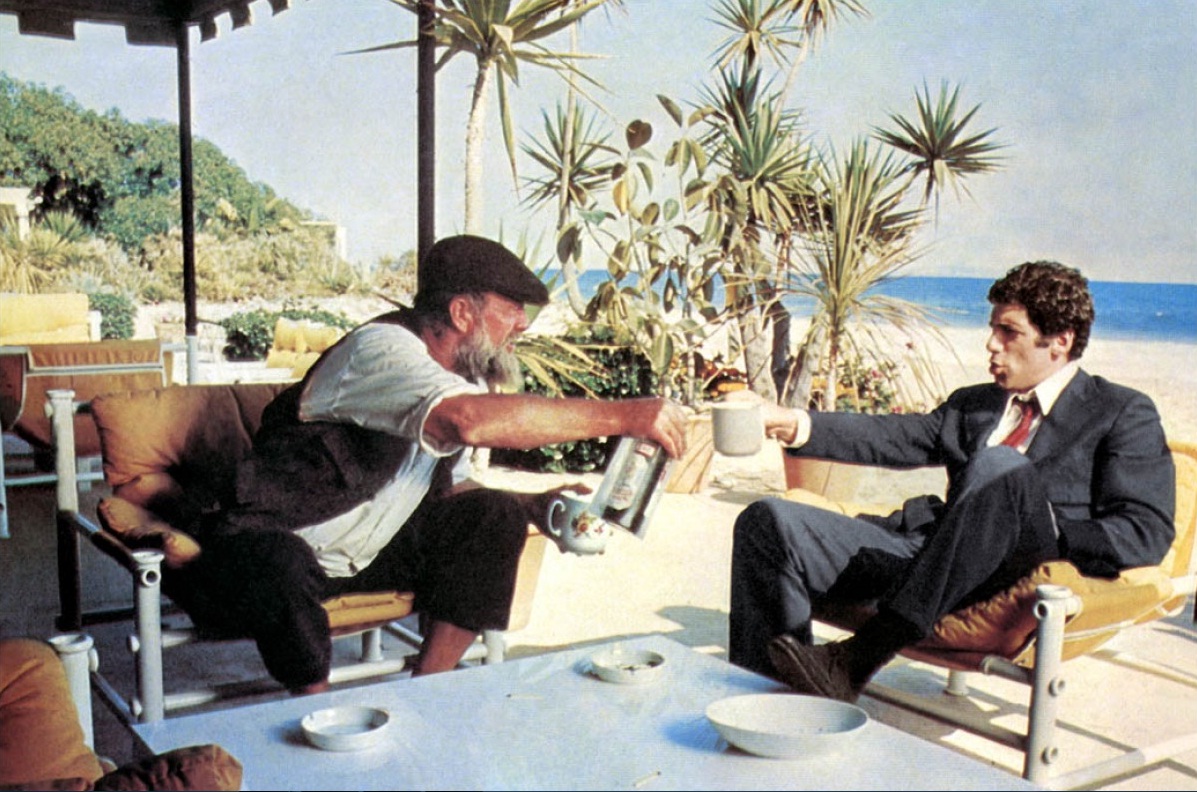 Interludes in LA’s rich enclave Malibu in the company of roaring Hemingwayesque drunk Roger Wade (Sterling Hayden, pictured above left) and his wife Eileen (Nina van Pallandt) are ripe with enigma and insinuation, the waves ghosting in as Gould and Hayden improvise on the beach over a bottle. According to Altman, Hayden was too genuinely drunk and stoned to do anything else. He fitted right into a troubled and intriguing cast: Gould’s sanity was in doubt after destructive behaviour on his last movie three years before; van Pallandt was a Danish aristocrat; Jim Bouton, in the key part of Marlowe’s missing friend Terry Lennox, a Major League baseball player. Arnold Schwarzenegger even appears as a heavy.
Non sequiturs abound in a film Altman typically intended as genre satire, Gould sometimes smirking as he goes along with the gag. Like the Coens later, Altman’s ironic eye for the material sometimes weakens it. The lightly worn, aching melancholy of his similarly skittish 1971 Western McCabe and Mrs. Miller leaves this the inferior, more uncertain film. The repeated spectre of suicide and sadistic violence, though, climaxes in almost nihilistic vengeance by Marlowe. As on those older mean streets, some things in Seventies America aren’t okay with him at all.
Watch the trailer for The Long Goodbye











Add comment