

Derived from Markus Zusak's bestseller, director Brian Percival's movie is well cast and brimming with good intentions, but it's too long, too safe and too uneventful to do justice to its subject matter. The story charts the rise of Nazi Germany through the eyes of Liesel Meminger and her adoptive parents the Hubermanns, but the horrors are sanitised and the anticipated emotional punch is never delivered.
The Hubermanns are struggling to make ends meet, and have adopted Liesel (luminously played by adolescent Canadian actress Sophie Nélisse) because state funding is available to foster parents. Liesel's mother was a Communist and a fugitive from the Nazis, and the train journey to her new home during which her younger brother dies hints at a litany of privations and horrors to come. Instead the piece unfolds almost as a kind of fairy tale, with National Socialism standing in for giants or dragons, as Liesel is comforted and introduced to the joys of reading and literature by kindly Hans Hubermann (an unimpeachably benign and wrinkly Geoffrey Rush). Emily Watson plays his wife Rosa as overworked, fretful and bad-tempered, which makes her the only vaguely realistic element in the story (Liesel and the Hubermanns, pictured below).
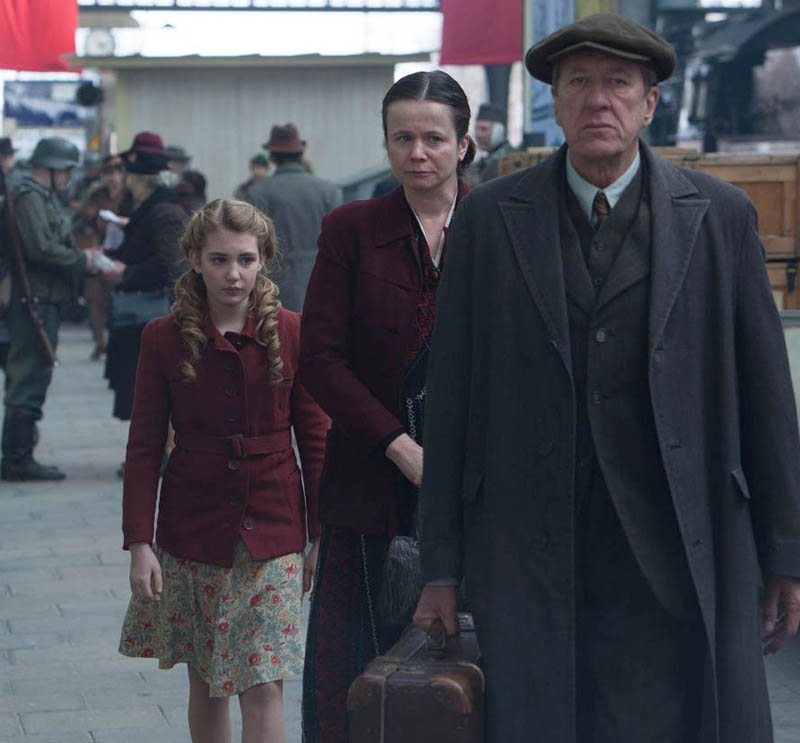 The none-too-subtle message is that reading and the exercise of the imagination represent the route to a full life and a rounded personality, and by extension a world which doesn't have Nazis in it. This is hammered into the viewer's consciousness when the Nazis hold a book-burning orgy in the square in the Hubermanns' home town (this picturesque Brothers Grimm-style 'burgh is supposedly near Munich, though Michael Petroni's screenplay does its best to impart as few facts as possible about anything).
Liesel impulsively rescues a book from the embers, not realising that she's been spotted by Ilsa Hermann (Barbara Auer), wife of the glum-faced local Burgermeister. Later Ilsa will introduce Liesel to her home library, the books wherein belonged to her son, who has been killed in action. The packed shelves become a wonderland of escape and enchantment for Liesel as the war grinds on and swarms of Allied bombers begin to appear overhead. When she is barred from visiting the library by Burgermeister Hermann, she takes to climbing in through the window to help herself, hence the story's title.
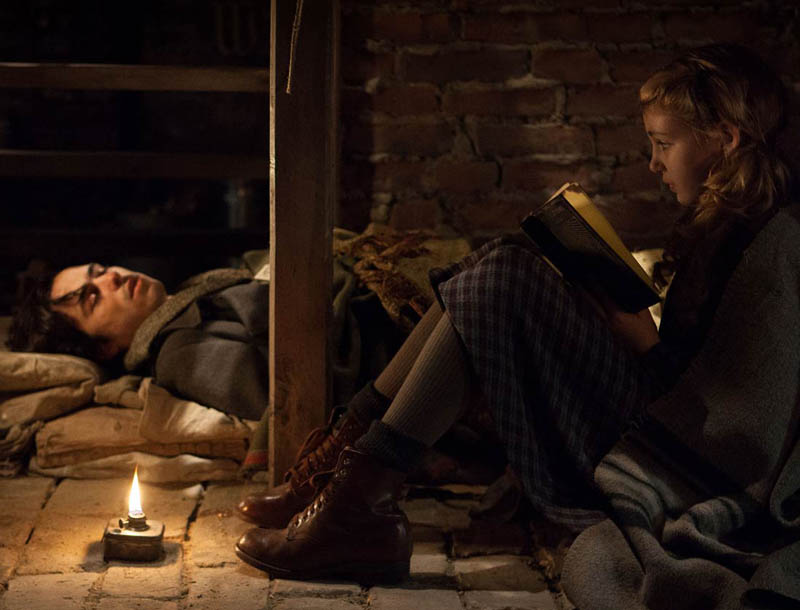 There are somewhat cursory depictions of the Führer's depredations, such as a brief glimpse of Kristallnacht and Jews being beaten up in the streets, or exclamations of master-race horror when young Rudy, Liesel's neighbour and would-be boyfriend, blacks himself up with coal dust to impersonate the American athlete Jesse Owens, superstar of the 1936 Berlin Olympics. In the book, Hans Hubermann is reluctantly forced to join the Nazi party, but in the film he has resisted doing so, since we're not dealing in shades of grey here. The Hubermanns' decision to hide a Jewish refugee, Max (Ben Schnetzer, pictured above with Sophie Nélisse), the son of an old army friend of Hans from the First World War, places them in appalling danger – though the film stoutly resists any temptation to exploit the possibilities this might have opened up – but also affirms that they're squarely on the side of the angels. Handsome Max encourages Liesel's ambitions to both read and write.
Ultimately The Book Thief feels like a children's guide to the Third Reich, breezing past all the really dark stuff in favour of presenting a bright, positive message. Zusak's book used Death as its narrator, integrating him tightly into the narrative structure, but writer and director haven't a clue how to make this work filmically. Their Death is an intermittent voice-over by Roger Allam, popping up at random intervals to say something facetious in a supercilious tone. Perhaps the irony of making a film extolling the wonders of reading books was lost on them.








Add comment