

An auspicious debut with the Royal Philharmonic for Vasily Petrenko. Just watching him conduct, it is clear that he is a natural communicator, always giving a clear, generous beat and never missing a cue. No surprise, then, that the orchestra was on his wavelength from the start last night in Mahler's Second ("Resurrection") Symphony, reflecting back all his dynamism and focus. That immediacy was balanced by careful planning on Petrenko’s part, with tempo choices finely calibrated for dramatic power and structural coherence.
Symphonic order was Petrenko’s guiding principle in the first movement. The fierce opening passages were propelled by rugged accents from the lower strings. But then in the second subject, and for much of the development, he brought the dynamics down to a whisper. Tempos remained brisk, but for long stretches a chamber-like intimacy was afforded by the delicacy of the string and woodwind playing. All the better to contrast the gravity of the first movement’s coda. Some real weight from the brass here, easily filling the Albert Hall (no mean feat), but with Petrenko still maintaining brisk, unwavering tempos.
Though the programme told us to expect one, Petrenko wisely dispensed with the five-minute break, pushing on into a similarly driven Andante. His strategy here was to set an austere, if suitably rustic, second movement against a more free-flowing and lyrical third. That contrast was emphasised through the neat phrasing of the woodwinds in the second and the rich portamento of the strings in the third. The orchestra was on good form throughout. Some weaknesses – shaky ensemble, faltering runs – were occasionally revealed in the more exposed passages of these middle movements, but never to the point of distraction.
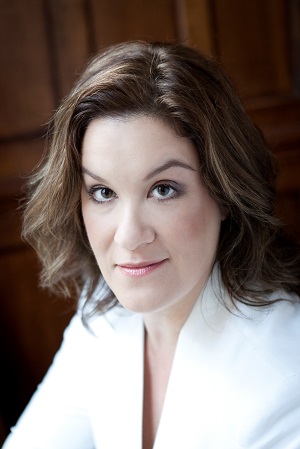 More dynamic extremes in the fourth movement, with Alice Coote (pictured left by Ben Ealovega) literally inaudible in her first entrance (perhaps an unintended consequence of placing the soloists behind the orchestra), though growing into a warmly expressive performance, elegantly supported by brass chorales and clarinet. Slow tempos throughout the movement afforded the music breadth, and Petrenko was able to rely here on Coote’s impressive support and tonal control across the lengthened phrases.
The finale was taken at a steady pace, too. That, combined with Petrenko’s care in shaping the phrases, brought a rare precision and clarity to the usually raucous tuttis early on. As in the first movement, underlying structural concerns were revealed as the movement played out, with Petrenko moderating the earlier sections to afford more weight to the climax. Ailish Tynan proved an ideal balance for Alice Coote, similar in tone, but distinguished by a broader vibrato. And the Philharmonia Chorus were spectacular in the closing passages. Yet again, Petrenko took the dynamics down to nothing for their first entry – a magical effect. Chorus, brass and organ all had something saved up for the spectacular ending. Some real bronze church bells were a nice touch, and Petrenko was able to control the dynamics to let them carry across the texture.
No coasting, then, from Petrenko, even in this familiar work. His account was distinctive, well-structured and beautifully paced. Well-communicated too, with the Royal Philharmonic and the Philharmonia Chorus both giving their best. Petrenko is much in demand, and an infrequent visitor to London, but there is clearly chemistry here, and potential for a fruitful artistic relationship ahead.





Add comment