

The first thing you hear are the marimbas – music that’s pounded, punched out of the air by hundreds of fists. Later the instruments give us dances and songs, but this musical violence is never truly absent from an orchestra made up entirely of percussion. It’s the heartbeat of A Man of Good Hope, a tale whose chapters are measured out in blows, beatings, rapes and murders, whose very horizon is barred with corrugated iron.
Jonny Steinberg’s 2015 book tells the story of the author’s encounter with Assad Abdulahi, a Somalian refugee he met in South Africa. Fleeing Mogadishu after the murder of his mother, the young Abdulahi is tossed from conflict to conflict, pushed from Kenya to Ethiopia – all before his 20th birthday – before finally seeking his future and fortune in South Africa. The losses, the costs are incalculable, but the emphasis throughout is on Abdulahi’s dogged refusal to stop putting one foot in front of the other, his persistent attempts to restart, to rebuild.
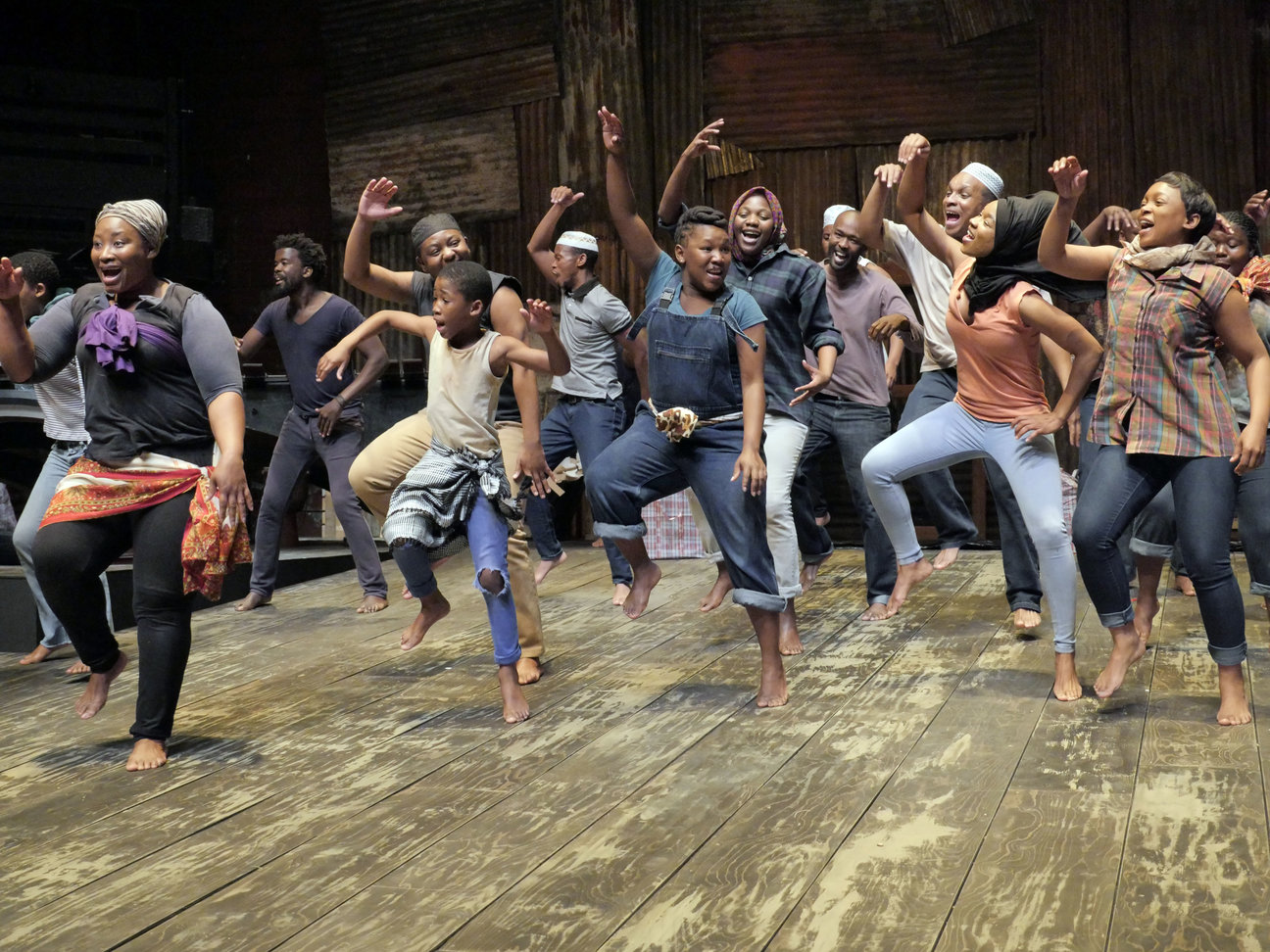 Now award-winning South African theatre company the Isango Ensemble have transformed Steinberg’s book into a performance piece. Part play, part opera, part musical, it’s a piece that makes up its identity as it goes along, mirroring the reinventions of its hero. Along the way it borrows from the musical cultures of Zambia, Zimbabwe, Kenya, South Africa and America – the latter the Promised Land, always just a few papers out of reach.
The company of performers Isango have assembled are astonishing, storytellers in the broadest sense, who turn their hands to just about anything. A fluid cast of characters (including four who share the central role) makes this real ensemble piece, and the episodic structure and many shifts of mood and location demand the slickest and tightest of treatments if the whole show isn’t to become grounded under its own weight. It’s thanks to the deceptively light-touch direction of Mark Dornford-May and especially the music direction of Mandisi Dyantyis and Pauline Malefane that this doesn’t happen.
But there’s no getting away from the fact that the story isn’t a natural fit for the theatre. Broken up into so many short episodes, no sooner do we establish character and context than we are on to the next. Inevitably issues (and they are the big ones – the nature of exile, of family, questions of nationhood and xenophobia) become simplified, essentialised in this swift telling. Progress is further hampered by the operatic episodes, which slow things up to no obvious benefit. The necessity of this kind of art-song (as opposed to the more obviously diegetic community songs and dances) is not established, and feels mawkish rather than emotionally intensifying.
 Yet the music is brilliantly handled by the ensemble. The four Assads (the richly operatic Ayanda Tikolo, sparky Zoleka Mpotsha pictured above, Luvo Tamba and the young Phielo Makitle) set the pace, supported by Pauline Malefane as Assad’s cousin Yindy – all tragic weight and thick tone – and the pouting Busisiwe Ngejane as his first wife Foosiya.
Abdulahi’s story is a resonant one, and Isango’s theatre-making is skilful, yet something here doesn’t quite click. The very theatricality of A Man of Good Hope, the crowd-pleasing energy of its songs and dances, seem problematic. Hope is one thing, but it’s a fine line between optimism and euphemism, and in this telling Steinberg’s tale sounds just a little too pat.
- A Man of Good Hope is at the Young Vic until12 November
- Read more theatre reviews on theartsdesk






Add comment