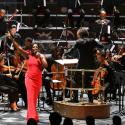
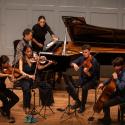
There’s a lot to be said for the planning that clearly went into this concert by the Cardiff-based new music ensemble, Uproar. Starting with Ligeti’s Chamber Concerto, it added three new commissions for (more or less) the same band and a fourth, existing piece previously composed to go with the Ligeti.
The risk, I suppose, is that plenty of the model work, as well as its actual scoring, will rub off on the new pieces. All but one of the four did indeed give the slight impression of having filtered through Ligeti’s originally startling combination of ambient cosmic noise and passing musical asteroids (it was perhaps his own fault that it turned up, to his surprise, as one component of the soundtrack to the film 2001). On the other hand, all of them were evidently at pains to reinterpret these procedures, and I’m pleased – if also a little sad – to report that Ligeti’s somewhat bland tapestry of micro-polyphonies did not always show up particularly well against the colourful and inventive new pieces it had supposedly inspired. Leaving out the exception, which I’ll come to, the new/newish works are landscapes, rather than space-scapes, slow journeys through terrains of the mind and the memory. To be exact, Litang Shao’s Floating Theatre is a seascape, on which she superimposes events as if (to clutch at the meaning of her title – there were no programme notes) the bits and pieces of daily life had been cast adrift on Hokusai waves, or some Chinese equivalent, including at one point the audience’s mobile phones, through which, bafflingly, a chorus of avian tweets was relayed. I couldn’t detect a particular structure over-all, but found the changing colours and movement constantly absorbing. It’s good to hear new music with a sense of harmony, of complexity resolving into simplicity (and back again), something I’m afraid I can’t always hear in the early Ligeti.
Anna Thorvaldsdottir’s Hrím (a title I’m in no danger of trying to interpret) reads the background-foreground idea more gently, slow polyphonies of solo strings and woodwind overlaid by fragments of melody, instrumental gestures, a Bartók pizzicato, a chime of bells. Here, too, form seems to have given way to process, as on any journey in unknown country. One listens in detail and traces a discourse that satisfies or surprises, and might end at any point, which is both the pleasure and, occasionally, frustration of new music.
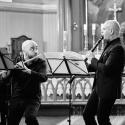
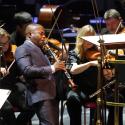
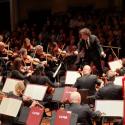
In Hrím the discourse is on the whole serene. This is the previously composed work, and perhaps the most Ligetian. Ashley John Long’s Imagin’d Games (why the elision?) is more unsettled, cast as a series of images that fade and re-form, eventually, into something less fragmented. The title, again, is provocative without explanation. I might imagine a chess game where the early moves are short and sharp, the later ones less so. But this is too literal. The real appeal of this music, as of the other works, lies in its feeling for colour and motion. Long, the double-bass player in the Uproar ensemble (pictured above), has the ear of a musician who often finds himself listening to the rest of the orchestra. David John Roche’s virtues, as displayed in his Harm Reduction – the exception I mentioned – are quite different. Roche (pictured above) has no truck with nit-picking micro-sonorities but throws the instruments together into a glorious confusion of rock and film music heard, so to speak, unamplified through the walls of his childhood house in the Valleys (I’m extrapolating from the press release). The energy and exhilaration of these ten minutes were irresistible and did no favours to the refined but somehow inhibited squirmings of the Ligeti, which followed.
All this Michael Rafferty conducted, and the Uproar Ensemble played, with the unfussy professionalism we’ve come to expect of them. Rafferty has done away, after a lifetime of “New Music”, with the annoyance that so often goes with such events, the Irritation Concert factor of interminable platform rearrangements, the five-minute pieces of dutiful avant-gardism, the polite, unenthusiastic applause. Here we were in the presence of a proper, well-planned concert of works by creative musicians who know what they are about, who want to surprise and delight but not exasperate us. How refreshing!
- Further performances at Merthyr Tydfil, 22 March and Cilgerran, 23 March
- More classical music reviews on theartsdesk