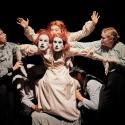
Without wishing to get all Kirstie and Phil about this, theatre, more often than you’d imagine, is about location, location, location. One of the reasons why the National Theatre’s knockout The Curious Incident of the Dog in the Night-Time was so potent was because director Marianne Elliott welded the audience to all four sides of the action. Transferred to a West End stage, the tension between stage and audience is undeniably different. Is the show still a triumph? Oh yes.
A murder mystery with added maths – and a huge emotional kick in the telling – this is a stage version of Mark Haddon’s two-million-plus-selling Whitbread Book of the Year. Yet the greatest compliment one can pay it is that despite cleaving to the tenor of the original, it never feels like an adaptation.
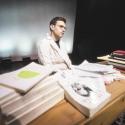
Christopher is a mathematical genius with a ruthlessly exacting mind
In the opening blazing flashes of light, we see Christopher (Luke Treadaway, reprising his arresting performance) discovering his neighbour’s dead dog. Aged 15 years, 3 months and 2 days, he determines to solve the mystery. That would be fine, were it not for the fact that Christopher’s severe behavioural difficulties don’t allow him to understand the complex circumstances surrounding the dog’s death.
Christopher is a mathematical genius with a ruthlessly exacting mind that struggles with the notion of empathy – think Saga Noren in The Bridge - and operates with utter adherence to literal meaning. This renders him incapable of not telling the truth, which makes him both an unusually reliable and fascinating narrator. But his behaviour is compromised by the fact that he screams when touched and has inviolable personal routines that enable him to survive among other people, just. His detective work, however, proves to be nothing like as clear-cut as he imagines which gives rise to surprising bursts of humour. But as far more than he bargained for is revealed, the mood darkens and intensifies. The truths he uncovers put his ability to cope under deeply distressing pressure.
Essentially, what the creative team has done is contradict Christopher’s stated hatred of metaphor. He cannot comprehend non-literal meaning, but to make audiences understand and empathise with Christopher and his family, the exuberantly inventive production uses theatrical metaphor to attach jump-leads to the imagination.
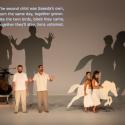
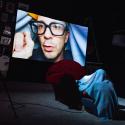
 To a degree, that’s easier in a standard theatre configuration because the action is framed for a single point-of-view. Where formerly the floor was used to display Finn Ross’s video and Paule Constable’s light patternings reflecting Christopher’s state of mind, these elements are now still more arresting spread across the back and side walls of Bunny Christie’s graph-paper set.
Ironically, although the actors no longer have to present themselves to all four sides, the clearer focus slightly robs the first half of some of its propulsion. But any earlier loss is counterbalanced by the newly invigorated drive of the second half.
The spellbound silence gripping the audience at the numerous climaxes is testament to a production as unsparingly unsentimental as it is memorably emotional. The abiding paradox of Elliott’s direction is that her audacious command of stagecraft is in service not of her CV but the vision of the writers. For further detail, read Alexandra Coghlan’s review of the original production... then book immediately.