A lot of people are going to be enraged, frustrated, or confused by Evening at The Talk House, and in the authorial world of Wallace Shawn, wasn't it ever thus? This is the playwright who gave pride of place to a softly-spoken fascist in Aunt Dan and Lemon and challenged his audience's complacency directly with The Fever, so if I say that his latest play is of a piece with his earlier ones, that is intended as high praise, indeed. From its opening monologue onwards, Talk House could only be the work of this particular writer, Shawn's singularity of vision as undimmed by time (he's now 72) even as his shifting moral landscape gets ever more slippery.
The opening, for one, is quintessential Shawn: a lengthy address from a genial-seeming narrator – a onetime playwright of some note called Robert (Josh Hamilton, an alumnus of Sam Mendes's Anglo-American Bridge Project) – that deepens and darkens as it goes on.
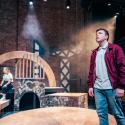
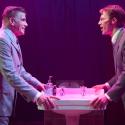
 It's not just that the decent-seeming Robert is soon called out for having had a thing for hating people: here as elsewhere, Shawn (the author pictured right in his role as Dick) is chronicling the limits of civility and civilisation as refracted through a reunion of theatre people at The Talk House hostelry of the title. Look beyond the bonhomie and nostalgia (for a brief while, you may feel as if you've wandered into a non-musical version of Follies) and you find bitterness coupled with an apparently infinite capacity for violence. It's no wonder that the play's final word, again spoken by Robert, is the simple question, "What?" – in these supremely disorientating times, what else is there to say?
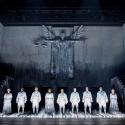
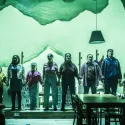
Indeed, and without overstating the case, it seems fair to group this play, and Ian Rickson's characteristically expert staging of it, with an ever-expanding genre of variably apocalypse-themed pieces that includes Caryl Churchill's Far Away; Stephen Karam's current (and brilliant) New York hit, The Humans; and almost everything from Martin Crimp. It's very clear by the end of Evening at The Talk House that its characters exist either to kill or be killed, and though the Quay Brothers' setting suggests the genteel decay of a longtime watering hole – New York's Coffee House is, one assumes, the real-life inspiration – there's precisely nothing polite about the war zone that this theatrically-minded assemblage constitute between them.
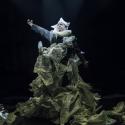
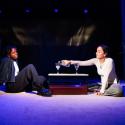
Robert sets the scene, but it's only as the others gather for cake and ostensible celebration that the governing ferocity snaps into place – alongside lashings of comedy, much of it at the expense of the self-regard either of theatre folk, the male ego or both: there's a great moment when Robert clambers across a table to put the make on Jane (Sinéad Matthews, pictured below), his squeeze from years past who has returned to her waitressing job at The Talk House after time spent abroad as, wait for it, a murderer. ("You know, I did it the nice way," she remarks by way of self-absolution.)
 And though their talk may till the familiar showbiz soil of career regrets, missed opportunities and the like (Robert, for one, laments the declining importance of theatre in public life), these putative aesthetes seem newly galvanised by having become either perpetrators or recipients of violence or sometimes both. Shawn's shambolic-seeming Dick may resemble a sodden butterball as he hoves into view nursing the wounds of a recent beating, but the visible scars only remind him, or so he tells Robert, how terrific the experience was: "It was quite fun, I'm serious." Elsewhere, the magnetic Naomi Wirthner, playing the wardrobe supervisor of old, Annette, lays bare a career shift from tailoring to the more lethal practice of "targeting" in language that contains eerie echoes of recent headlines from our anxious times; separately, the introduction of sheep imagery into the debate marks out Shawn's gallows humour at its Swiftian best.
A mixture of lamentation and satire, some of it self-directed (the much-discussed title of the play-within-the-play suggests Shawn's own 2009 Royal Court entry, Grasses of a Thousand Colors), the play's "narrative" consists of the gradual coming into focus of its forbidding world-view, and those wanting a more literal-minded evening out should stay well clear. I can't imagine a less helpful comparison, having now seen the play, than to approach it as a quasi-existential version of Agatha Christie – which is how this world premiere staging, produced in association with the Broadway impresario Scott Rudin, was presented in some of the speculative pre-opening commentary.
As ever with Shawn's work, the play couples agreeable, comfortably recognisable surroundings with a ruthless enquiry into a level of disagreeability, or worse, that catches the characters off-guard no less fully than it does the audience. To that end, note the number of times in Evening at The Talk House that someone issues an elaborate apology on one front only to embrace activities in another that most playgoers, or so one hopes, would never condone. Or maybe they would? That, after all, remains the ongoing question posed by Shawn's altogether remarkable career, which here asks afresh how we can possibly hope to win the so-called war on terror when that very impulse begins, as it were, at home.