When Hindle Wakes opened in 1912 in London, the script was burned in the street. Stanley Houghton, a member of the Manchester School of playwrights, had exposed one of society's double standards: that it was fine for a man to have a guiltless fling before marriage, but it was not acceptable for a woman. The problem with Bethan Dear's earnest revival is that the play no longer holds the same moral force. Today, the idea that Fanny Hawthorn, a mill girl, goes away for the weekend with Alan Jeffcote, the mill owner's son, and then refuses to marry him is hardly shocking.
Solidly constructed, Hindle Wakes outlines each character's viewpoint, saving Fanny's until last. Fanny's parents want her to marry to avoid the community thinking ill of her. Alan's parents agree so that the community don't think they have a son who shirks his duty. What the families should do – to complicate matters, Alan is engaged to someone else – is an interesting question, but one that neither grips nor inflames in the way it might have done originally.
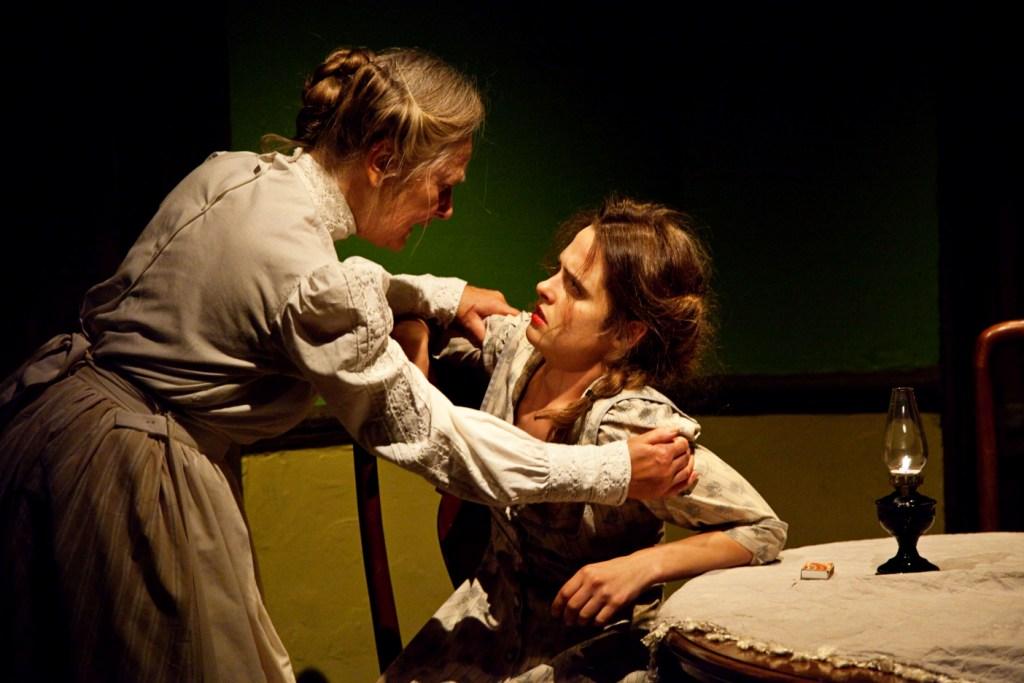 A captivating Ellie Turner (pictured right, with Anna Carteret) leads a strong cast as the spirited, articulate Fanny. Anna Carteret is loud and uncompromising as her religious mother, while Peter Ellis plays her father as kindly, but weak. Team Jeffcote comprises the power-motivated mill owner who will sacrifice everything for duty and his haughty wife, played with a sharp wit by Susan Penhaligon.
While the confines of the tiny Finborough Theatre suggest the close-minded nature of the fictional Lancashire town of Hindle where the action takes place, the space limits the staging. Except for one brilliantly amusing scene in which Alan – played with panache by Graham O’Mara – returns home drunk, bumping into tables, knocking over ornaments and dozing off standing up, there is little movement. In each of the four films that have been made of Hindle Wakes, the story has been opened up. This staged production – the first in London for more than 30 years – is faithful to the original, with the emphasis on conversations, revelations and moral arguments. An important social marker it may be, but as theatre Hindle Wakes is inescapably old-fashioned. It is a play of its time.
In contrast, The Man on Her Mind is about as close to the canon of classic plays as Fifty Shades of Grey is to heavyweight literature. This is a heart-on-its-sleeve American rom-com which reflects rather than illuminates any psychological insights and then jettisons them in favour of fantasy.
 Amy McAllister (pictured left with Samuel James) plays the central character Nellie with quirky vulnerability. Nellie is so lonely in her Manhattan shoebox of a studio flat – the set, designed by Emma Bailey, is the best thing about this production – that she invents an imaginary boyfriend resembling her sister's neighbour. Leonard, the neighbour, is also lonely and invents an imaginary girlfriend resembling Nellie. Nellie and Leonard eventually get together and the play takes a quasi-religious turn with the imaginary friends – referred to more than once as "souls" – also hooking up.
Georgia Mackenzie puts in a strong turn as Janet, Nellie's down-to-earth and dominating sister, who has settled in suburbia with her husband Frank. But much of the rest of this play is pretty gloopy. Hurska could have explored the mismatch between dreams and reality. Instead, the real characters seem a bit too content with reality for those who crave relationships with the people of their dreams. With its big jazz numbers between scenes and its expressive acting, The Man on Her Mind sells its fantasy with uncompromising gusto. It is not unbearable. Houghton, however, with his emphasis on realism and his support for female independence, would have been baffled. (Two stars)