The Bond film theme plays and the lights go up at the Bush’s Studio space to reveal, not a tuxedoed superspy, but a slim figure in casual clothes sitting on a raised platform. He starts his first speech, then stops, makes asides to the audience, then restarts it. Then wishes it was a film, “which it isn’t”.
The figure is Nikhil Parmar, writer of this 60-minute play, who peoples the little stage with a whole neighbourhood: his family, cousins, friends and fellow tenants. Usefully, he has given them all different ethnic accents to help us work out who is who. Scenes rapidly transform, cued by pings and lighting changes, niftily directed by Georgia Green.
Parmar’s character is called Zayan but those not trying hard enough, casting directors included, typically call him Zane. Zayan is an actor by training but a man who is anything but in reality: unmarried father to little Sienna, adoring brother of dead sister Sashi, unappreciated son, part-time waiter and weed-dealer. But auditions come along infrequently, and he has stopped attending them. His ex, Ella, loved him because he was funny, then she didn’t. They had met at RADA; she works in film distribution. She comes round to tell him she is seeing someone else now, a rival from their year, a Korean actor who is moving up the ranks to work in a prestige TV drama – “BBC, with HBO”. Zayan is horrified.
 The world onstage is tonally mixed. It’s almost slapstick at times, when Zayan’s invisibility leads bin-men to take away his daughter’s empty pram, briefly left unattended. In other moments his anger spills out into the rage of a revolutionary, which he entertains the idea of becoming: a retread of the Islamic fundamentalist, now superseded by Chinese hacker terrorists. It takes a moment to realise Zayan is probably talking about terrorists in popular culture, such as the films and TV dramas he is going up for, though maybe not. He is, though, (initially) thrilled to be cast in a film as an Indian doctor.
Is it enough? Zayan tries to joke his way to good humour about his invisibility, but his joshing wilts as his lack of earnings sends him back to live with his parents. At the family home, the ghost of little Sashi is a constant presence, urging him on. Can he turn things round? His friend Karim has just had his sitcom, Jumping Jihadis, cancelled. He himself is finding that white casting directors, whose empty chatter we hear, only want him to drop the humour and play characters with “grit”. Perhaps, the two men conjecture, Brown actors should go for it and embrace this new kind of protagonist and seek roles as Islamic terrorists, if it makes them more visible? Never mind all the more mundane stories they could be telling instead.
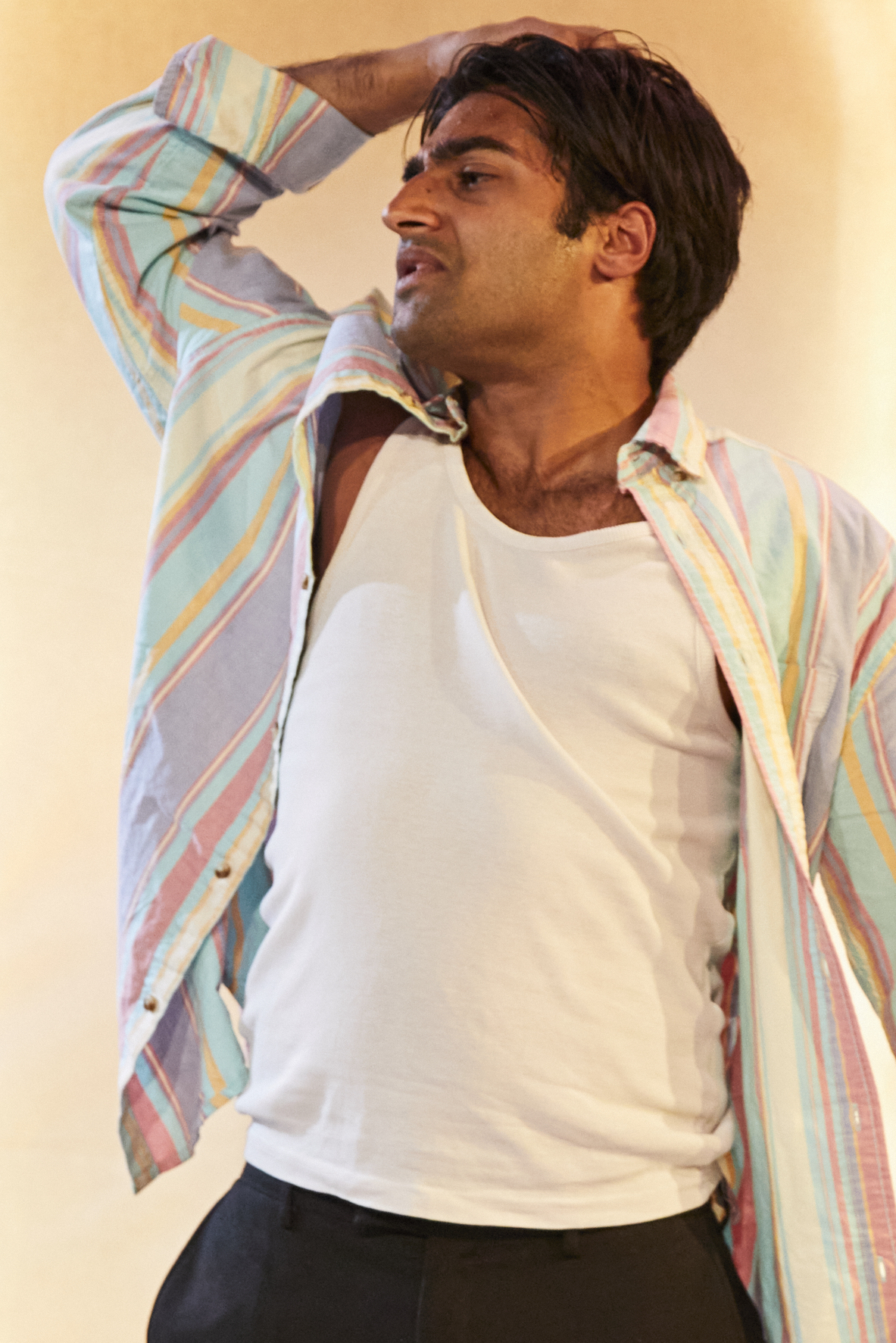
Parmar is a personable, dynamic performer with a light comic touch. He turns the small Studio into a two-way performing space where somebody in the front row might be asked to hold his imaginary crying baby for a bit. We are drawn in by his energy and affability to consider Zayan’s story, whose fictitiousness he regularly reminds us of, deconstructing the material as he goes along, and throwing in. “If this were a film, which it isn’t.”
HIs message is clear enough: Brown people have become part of the backdrop and just aren’t visible enough to the white majority. (And to many white theatre professionals.) The delivery of the message is anything but simple, though: a network of characters who sometimes rush in too fast for the audience to fully grasp what is happening until the next quick-change to a new character, a different scenario. Parmar’s comedic skills and enthusiasm drive the piece along, especially at the end, though a more sustained release of emotion might make the finale build and land with more punch. But it’s an hour well spent, and Parmar is a talent whose work will become incresingly visible.