It’s hard to keep up with what terms are in vogue amongst those who insist on classifying and vilifying young people, but one that you don’t hear so often these days is NEET (Not in Education, Employment or Training). Back in 2015 when Gary Owen's lauded monodrama Iphigenia In Splott premiered, Effie was a NEET, and a proud one to boot.
She is seen living the hedonism worthy of a fortnight in Ibiza for 52 weeks a year in er… Splott, a district of Cardiff, shit-faced, smoking and shagging. Effie may be a failure of society, but she's loving her life. Or so the lady protests. When she meets an Afghan war veteran for a one-night stand, she feels something stir inside her, a feeling of being (and playwright Owen’s phrase is critical here) "not alone". She tries calling, texting and even pitches up at his home, but we’ve all guessed why she’s getting the cold shoulder and we’ve all guessed what’s going to happen next. Few will guess what happens after that.
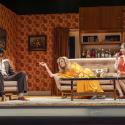
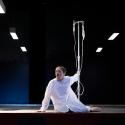
Sophie Melville (pictured below) is no less supercharged seven years on from when she first played ("inhabited" is the better verb) Cardiff's Effie. It’s a bravura performance to rival Prima Facie’s Jodie Comer (her near-contemporary and, praise be, another actress who can do a working-class accent without the benefit of three years voice-training at RADA). She prowls the big stage of the Lyric Theatre, the largest on which the play has been performed, disgusting us, charming us and, somewhat problematically, calling us to action.
Whether shouting or whispering, she is riveting throughout, and that’s just how Effie likes it. She can be sexy and repulsive – sometimes simultaneously – but she's also funny and clever, with enough self-awareness to know that in unleashing her id and denying her superego, she's only fooling herself. So it’s all the more poignant when she’s shown what "not alone" feels like for the first time in her life, only to have it snatched away not once but twice. That, in turn, prompts her own version of Iphigenia’s sacrifice for the good of others. Structurally, I’m not sure it all works. I grew up with people like Effie and, though they can be capable of these gestures, there’s perhaps too much weight placed on the sentimental in driving her cathartic decision: the drip-feed of images of the helpless, the abandoned and the rescued. Is that enough for Effie’s cathartic burst of empathy, her Damascene conversion to altruism and the peculiar revenge it brings as compensation? Maybe – she’s young and young people can change their views after events far less traumatic than that which overwhelms Effie’s worldview.
Like all art, this celebrated play finds new meanings in new settings. Director Rachel O’Riordan (who, since 2015, has gone on to run the Lyric Hammersmith) writes in the programme that "Iphigenia in Splott is a call to arms. It presents the impact of austerity and social injustice, and of the devastating impact cuts make on those who have little to lose." That much is true.
Notwithstanding the rousing closing speech, not to mention recent opinion polls, I still wondered. Such calls go down well in London, with theatre audiences who probably never meet an Effie and who structure their lives in such a way that they (and their children) never will. But the harsh (and dangerous) reality is that when the Effies are given the chance to vote, they usually don’t and, in consequence, they allow those from their communities who do vote to send men and women to legislatures who want more austerity, not less.
Look at what has happened in the UK since Effie first stepped forward with her cri de coeur seven years ago – 2016’s referendum, 2017’s general election, 2019’s general election (I accept that Wales, specifically, often voted differently to England). Abroad, the neo-fascists are on the march in the USA and Europe, winning because they are backed by supporters drawn from "Left Behind" post-industrial places like Splott. It’s not new – this happened in the 1930s, when the call to arms was literal and not metaphorical. But the play’s polemic feels a little naive/hopeful (delete to choice) in the face of the torrent of electoral responses to austerity.
A call to arms? Arms, you say? Let's be careful about what we wish for.