

Dismemberment is a key motif in the writer-director Simon Stone’s The Oresteia. It reflects the treatment of two of the piece’s several dead bodies, as is hinted at when their killer is asked where he buried them. “Many places,” he replies coolly. And it’s what Stone himself has done with his ancient source material,
As the play’s publicity materials announce, it is “after Aeschylus and others”. But the trilogy Aeschylus left us (actually, a tetralogy, according to a programme essay by an eminent classicist: a lost satyr play was the fourth part) is like a rock formation that’s only visible when the tides allow. Unlike Aeschylus’s steady unrolling of the curse of the house of Atreus, Stone’s piece has St Vitus’ dance, toggling between various dates from 2016 to 2026, which he has helpfully projected onto the scenery. But the chronology is still confusing unless you are as steeped in the story as he is.
Proceedings begin with the extended Middelton family assembled at home in deepest Kent. They inhabit, like most of Stone’s characters, a revolving glass box full of top-of the-range furniture and accessories. A 21st birthday party is being prepared for the twins, Alice (Rosie Sheehy) and Isabel (also, briefly, Sheehy), though Isabel’s attendance isn’t definite as she is busy protesting with the Peace Alliance against an arms company, Middletech. It’s co-owned by her father Chris (David Morrissey) and Mel (Lloyd Hutchinson), better known to classics students as Agamemnon and Menelaus.
Already, your brain may be whirring: Isabel seems to be behaving more like Antigone, another rebellious, principled soul with serious father-issues, rather than the more passive Iphigenia, sacrificed by Agamemnon so the gods would give him a fair wind to pursue his ambitions in the Trojan War. For this, on his homecoming, his wife Clytemnestra murders him in his bath. Which takes us to the end of Aeschylus’s Agamemnon; his The Libation Bearers then shows the fruits of this homicide, when Orestes in turn kills his mother and her lover, Agamemnon’s cousin Aegisthus, egged on by his now semi-deranged sister Electra. Finally Aeschylus resolves matters in The Eumenides, a bid for curses and blood killings to be resolved, not by an endless cycle of violence but by the rule of law. There's a clear through-line linking the three plays.
But Stone turns it into a pretzel. He delays a re-enactment of the crucial triggering scene, the patriarch’s murder, picking up the story almost seven years later, at the moment when a ludicrously garrulous detective (Hutchinson again) arrives at the Middleton home to talk to Augie (Tom Glynn-Carney) about his father’s apparent suicide four years earlier, two and a half years after Chris left Montie, his American wife (Mary Louise-Parker). Instead of this murder we first witness Montie’s, along with her lover Jerome’s (John Macmillan); then we finally backtrack to the fateful evening when Chris and his new girlfriend, Chandra (Rhakee Thakra, aka Cassandra), come to his old home for dinner, invited by Montie. Aeschylus’s cumulative sense of doom becomes an exercise in rejigging material for histrionic effect, but at the expense of audience comprehension.
Stone’s dismembering is oddly echoed in Augie’s speech about sawing up the corpses of his mother and her lover, then “re-membering” them in surreal formations: a penis for her, breasts for him, limbs in all the wrong places. So it goes with the characters, who seem to hail from different walks of drama. Morrissey’s Chris is a four-square blunt northerner, much as his roles often are, hilariously lampooned by daughter Alice for it; but Alice would be more at home in a flatshare sitcom set on the wilder shores of Chelsea, her accent close to Princess Di's and the F-word popping up in every sentence. Mel is a bullish boor, who says of his fleeing wife Helen, “‘Live and let shag’ was her motto.” But Montie is from the darkest of dark comedies, mordantly funny and witch-like, plotting her outrages with a gleeful cackle.
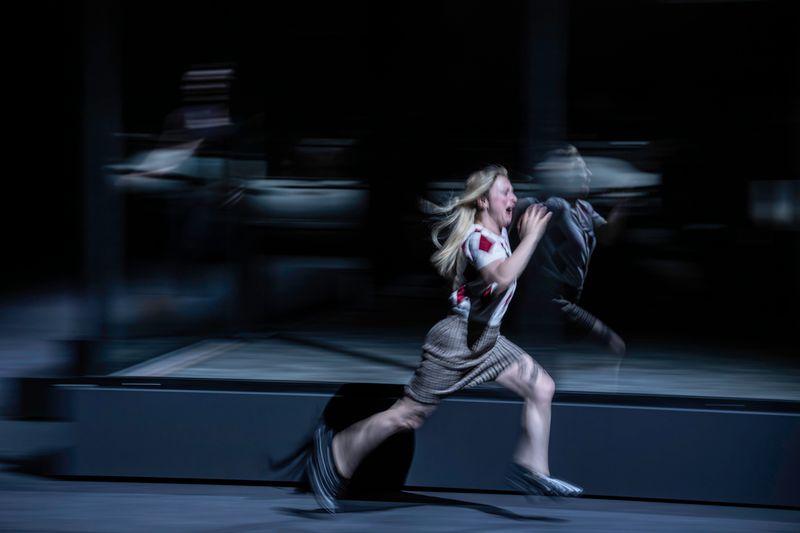
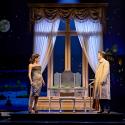
Nothing in this household suggests the term "Tragedy", except perhaps for the death of Isabel, who makes a brief appearance, and exit (pictured above, Rosie Sheehy as Isabel), and the delicately featured Augie, almost smaller than his backpack, increasingly psychotic and probably suffering from PTSD after his army stint in Afghanistan. He has the sardonic humour of Hamlet revealing what he's done with Polonius's body, but none of that character's tragic dimension.
There may well be a modern take on this ancient story worth telling, but Stone makes it very hard to decide this is it. Crucial plot points are buried in deliberately overlapping dialogue (especially in the first scene) that's delivered at breakneck speed, as if that is indeed the recreational drug all the Middletons mix into their cocktails. Vital issues are blurred: is Chris as culpable as his daughter Isabel implies? Has she been “sacrificed” by him in some way? She for the most part has only the volatile Alice to plead her case, a conflicted twin who both admires her sister but feels inadequate alongside her. Electra is one of Greek tragedy’s sadder creations, but there is little that’s equally sad about Alice.
The performers are to be commended for attacking their roles with brio, but they perhaps play their banter too much for laughs at times. My seat neighbour on opening night found everything uproarious, so much so that he made my seat shake, but nothing happening onstage had that same impact on me. It wasn’t a dull evening, and oddly the four hours' playing time didn’t drag, but at every turn I kept thinking, why are we here? Why am I trying to understand these well-heeled but unmoored people and their monstrous behaviour, without a clear road map? We know from his staging of Innocence at the Royal Opera House and Phaedra at the National, in much the same set, what a powerful director Stone can be, but this is a reworking without a destination. He throws mentions of the Syrian civil war and Putin into the mix, but it’s not enough to give the piece a solid political underpinning; and as psychological drama it’s all heat and not enough light.






Add comment