We’ve had Chess the musical; now, here’s Chess the play. Tom Morton-Smith, who has experience wrestling recent history into dramatic form with the acclaimed Oppenheimer, turns his attention to the 1972 World Chess Championship in Reykjavík, in which American challenger Bobby Fischer battled the Soviet Union’s Boris Spassky. The event gained outsize importance from the Cold War propaganda battle – the two men pawns in their countries’ games, and the match characterised as the lone hero versus the Soviet machine.
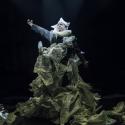
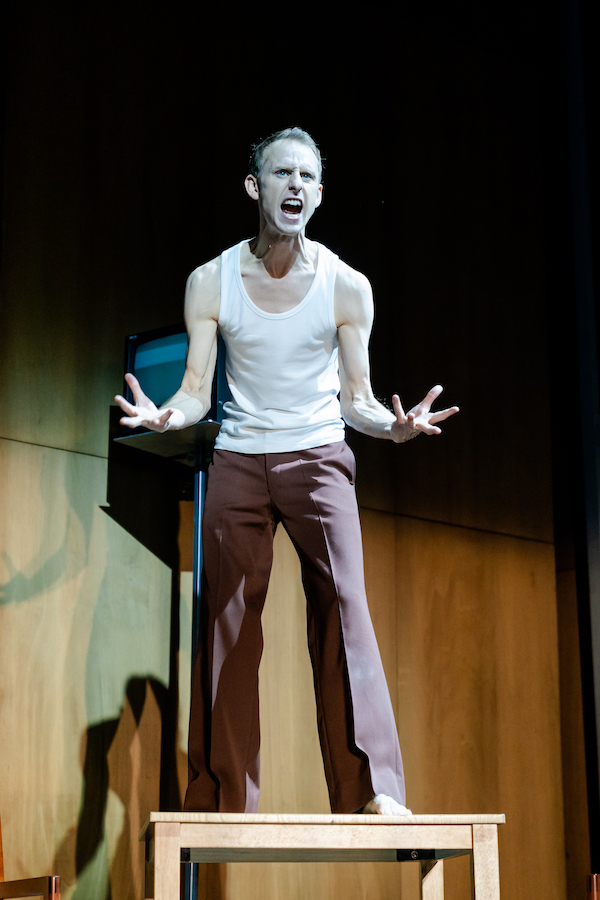
The play follows the tournament through, as both Fischer (Robert Emms, pictured below right) and Spassky (Ronan Raftery) spiral into paranoia, amplified by their various minders; at one point, there’s even talk of poisoning a dog. Meanwhile, the tournament organisers are more concerned with keeping the show on the road – and wondering whether catering to the whims of the diva-like American maverick, opening the floodgates for more like him, is really worth the trade-off of a TV broadcast, international publicity and renewed interest in the game since the brash Fischer gained celebrity status.
 Morton-Smith has clearly done his research, and there are lots of fascinating ideas flying around here – some particularly timely, such as governments’ use of soft power, suspicions of cheating or foul play, how a charismatic individual can disrupt the system, and an attack on the very notion of objective truth. There’s also an interesting strand on how we indulge the bad behaviour of those we consider “geniuses”. However, running at an unwieldy near-three hours, this feels like material in search of a play. Crucially, it’s missing a streamlined, compelling dramatic arc, as well as the excitement and tension of a true thriller.
The title is perhaps misleading, since we spend far more time with the flamboyantly obnoxious Fischer than we do with Spassky. Emms gives a thoroughly committed performance as the former, particularly as Fischer unravels both physically and mentally, spewing antisemitic conspiracy theories (while denying his own Jewish heritage) and descending into a childlike state. However, a little of Fischer goes a very long way, and it begins to feel like we’re just repeating the same points: he’s terrified of losing, he needs to not just beat but destroy his opponents, he has a confused hatred of communism tied into his relationship with his mother, and – though he’s their boy wonder – he has no great love for America, or anyone else, since they all look down on him. It’s Fischer versus the world.
Ironically, Spassky, too, dislikes the nation he purportedly represents, but his position is perhaps the more interesting, and, as presented here, more nuanced. Being chess champion affords him the luxury of being apolitical in a feverishly political sphere, stepping outside Soviet strictures and into the escape of a comparatively clean, simple endeavour. Yet Fischer’s dubious gamesmanship – he turns up late to matches, demands a special chair, questions the chessboard – gets under Spassky’s skin, and his gradual loss of control is beautifully portrayed by Raftery. It’s just a shame that we only get to know Spassky in the second half, and that there’s little interaction between these two chess masters, who, despite their differences, understand one another on a profound level.
 Part of the problem is that the chess matches themselves are confusing and undramatic. It’s unclear to the relative novice how the tournament and the scoring works, how Fischer and Spassky’s playing styles compare, and what we should be looking out for in their various encounters. Surely there are some theatrical devices that could be employed to open the game up to an audience? Or even something as simple as the use of commentary, since these matches were broadcast? What should be riveting duels are mainly incomprehensible.
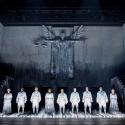
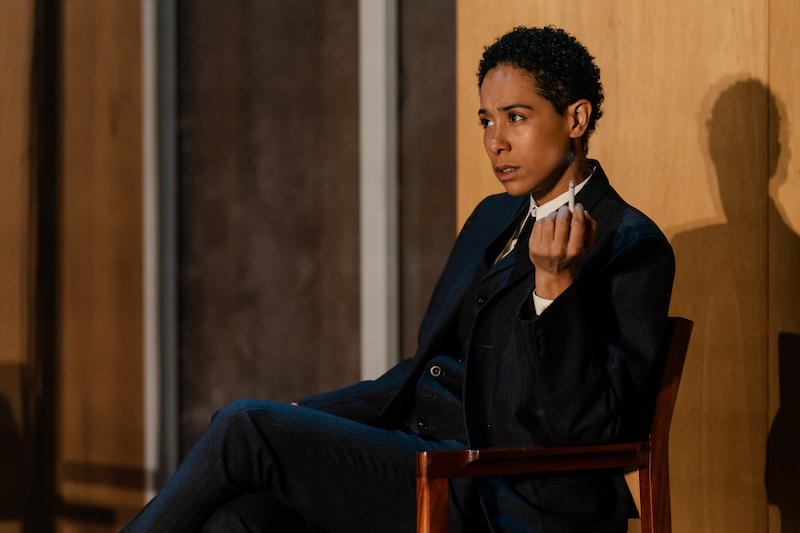
It’s also difficult to get a handle on the wider context, and how important this event was to those watching around the world. Other than brief use of video, we mainly spend time with people in suits standing around arguing in this one place – and the supporting characters lack definition. The exception is perhaps Soviet minder Nikolai Krogius, thanks to a commanding performance from Rebecca Scroggs (pictured above). There’s some much-needed levity, too, from Gary Shelford’s Icelandic policeman.
Annabelle Comyn’s production is most engaging when the tale descends into farce – Jamie Vartan’s set collapsing in on itself as the poor tournament organisers are forced, by the crazed Soviet and American teams, to search light fixtures for sabotage devices and x-ray chairs to hunt radio transmitters. But a key phone call between Henry Kissinger and Fischer pre-tournament is too muffled to understand, and – other than one match with some inventive movement from Mike Ashcroft – the piece generally feels static and repetitive. There’s an awful lot of pontificating about metaphorical readings of chess, not enough demonstrating through drama, or allowing the audience to connect to the characters and reach our own conclusions. There’s almost certainly a pertinent play somewhere in here, but it’s yet to fully emerge.
- Ravens: Spassky vs. Fischer is at Hampstead Theatre until 18 January
- Read more theatre reviews on theartsdesk