

If you’ll forgive me the first of two tiptoes into Gonzo Journalism, a few weeks ago I found out that I have a faulty gene - not a romantically tragic Romanov one, but a defect on the double helix that had already manifested itself in a condition affecting my family and that I may have passed to my sons.
That crucial medical knowledge leads to early diagnosis and allows for preventative treatment if required, but what if I had known about it 30 years ago, just before my DNA was shuffled at conception's roulette wheel? What if its impact were greater, life-altering, even life-threatening for any child? What if all my DNA was known, a quantum computer spooling out the chances of developing hereditary diseases instantly for me and for everyone else who could pay for it, like the ante-post odds for the Grand National - insurance companies would be keen? And what if my DNA could just be tweaked that little bit to make that son or daughter a bit more Citius, Altius, Fortius? Well, as a wise man once said, there’s gold in them thar hills.
That’s the main idea animating Aaron Loeb’s UK debut, R.O.I. (Return on Investment), but there are plenty more packed into a heady, head-spinning 90 minutes that starts in the dystopian near-past, Covid Times natch, and finishes in a dystopian near-future - and it’s all terrifyingly plausibly.
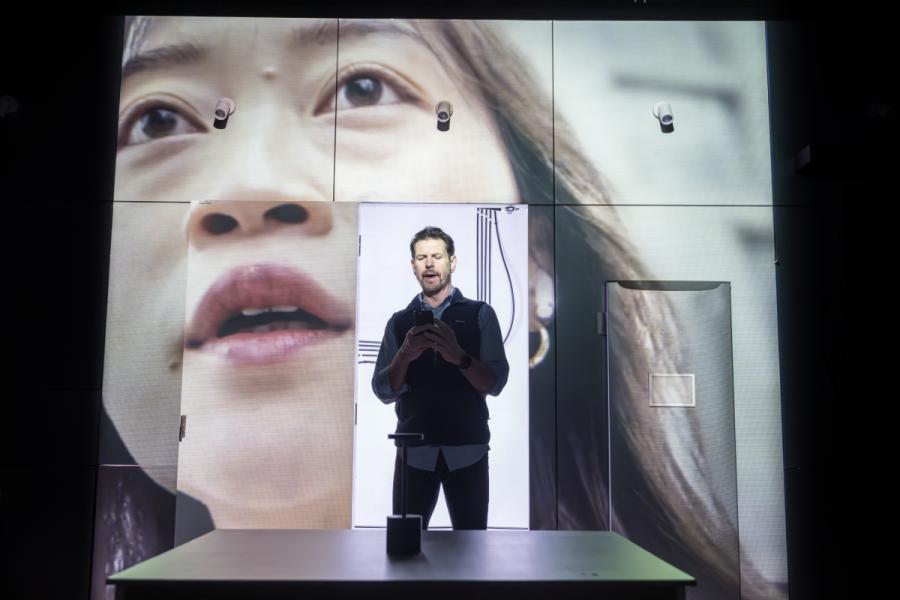
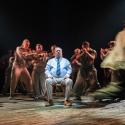
Paul Montrose is a tech bro who made lorry loads of money in Silicon Valley and now runs a venture capital fund, searching for start-up unicorns amongst the crowds of duds destined never to make it. Lloyd Owen (pictured above) gives him that tall self-confidence us Brits only get from an expensive education and a kale and blueberry smoothie lifestyle in a home that looks like a Macbook (good work from Rosie Enile). He’s not quite a caricature, and he needs not to be, else the dilemmas that begin to pile up would be too easy to dismiss.
May Lee is his vanguard warrior. She searches for people and projects that will yield the rewards that give the play its rather unappetising title (though maybe it’s not quite so unpalatable in Swiss Cottage if the estate agents’ windows are to be believed). Millicent Wong is all efficient hard work and cool judgement, everything falling into the unproblematised grid that corporate capitalism has provided, backed by her Ayn Rand inspired belief in the intrinsic moral worth of making money. However, she also shares her boss’s glib desire to do good with the Montrose Fund as well as pile up the cash, at least as far as the PR sloganeering goes.
We can be cynical about that now, but Google’s 2004 IPO prospectus included these fine words "Don't be evil. We believe strongly that in the long term, we will be better served - as shareholders and in all other ways - by a company that does good things for the world even if we forgo some short term gains." A glowing New Yorker profile around that time swallowed that homily hook, line and sinker - as did I, proudly ditching Netscape for Chrome.
May is shaken when she’s pitched by an oddball scientist, Willa, whose breakthrough has sequenced DNA so effectively that it can eliminate the big beasts of the healthcare landscape - cancer, dementia, diabetes - before they roar. Like dinosaurs, they’ll be hit by her comet and extinct in a generation. You can imagine what Big Pharma will think of its cash cows no longer giving milk and mobilising its forces to respond.
But this triumph of the Willa leads her into paranoia, racist fantasies and a love triangle that Puccini might have enjoyed setting to tunes. Letty Thomas never forgets that Willa is mad, but she largely reins in the outer limits of her fantasies in a subtle performance that produces the credibility that a black comedy needs to avoid toppling into farce, It’s not impossible to imagine a tech oligarch saying some of Willa's lines and the US happily embraced Wernher von Braun and his goosestepping chums from Peenemünde, so a little Nazism can always be excused if the prize is big enough.
Loeb’s play sparkles when these moral dilemmas are front and centre, the nexus between capitalism and science continually poked and probed, the profit motive necessary but, er,,, cancerous. They’re stirred into a heady mix of raw racism and doomsday geopolitics with the carapace of ethical boundaries proving to be of little effect against the tsunami of money rolling in and the sweet tang of White Supremacism spicing up the action.
He’s less good at writing the lust and love (requited and unrequited) between the three, the challenge of making the mad scientist, the venture capitalist and the COO into a ménage à trois proving, understandably, tricky. The ending too felt a little out of place, as if shipped in from a Philip K Dick film adaptation to tie up some loose ends.
But the play grapples with ideas that present a clear and present danger to any cosy consensus that may or may not exist between the fields of science and ethics, questions not often discussed by the man on the Clapham Omnibus - except when prompted by that most egregious of tabloid headlines “Boffins playing God”.
Back to a bit of gonzo and those sons of mine, with or without my corrupted gene. Both want to do good (like Google and the play’s Montrose Fund), so one is undertaking an MSc in Bioinformatics, the other works in a controversial area of Climate Change. But what do they do when a Willa whispers in their ears, with Paul’s cash in her hands and their student debt rising like a V2?
In more senses than one, don't ask me.








Add comment