With its mistaken identities, a meddling mother, a chest of precious jewels, gulling of fops and two pairs of thwarted lovers, it's easy to see Shakespearean overtones in Oliver Goldsmith's 1773 masterpiece. And because She Stoops to Conquer's witty and intelligent heroine, Kate, outsmarts her would-be suitor Marlow, it's even more tempting to see it as having shades of The Taming of the Shrew, only without the difficult bits for modern audiences.
Whatever else it may be, She Stoops to Conquer is a delightful and warm-hearted comedy of manners that is as relevant today in its depiction of snobbery and class as it was more than 200 years ago. It was based on an incident in Goldsmith's own life. When travelling in his native Ireland in his youth, Goldsmith asked for directions to the best house (meaning inn) in the town and was deliberately misdirected to the local worthy's home. After ordering the best food and wine, Goldsmith discovered the jape only when asking for the bill the next day. He added several subplots to create one of the funniest plays in the English language.
 As the play opens we are in the monied Mr Hardcastle's house in the country, happily far away from the foppery and frippery of London that he so despises. He awaits a friend's son, Marlow (Harry Hadden-Paton) - to whom he wishes to wed his daughter, Kate - and Marlow's friend Hastings, who is secretly attached to Mrs Hardcastle's niece, Constance (Cush Jumbo), heiress to a fortune in jewels. Also there is Mrs Hardcastle's son by a previous marriage, the well named Tony Lumpkin (nicely played by David Fynn), a bonehead layabout who wastes his life in the Three Pigeons inn, and whom Mrs Hardcastle has affianced to Constance in order to get hold of the jewels herself.
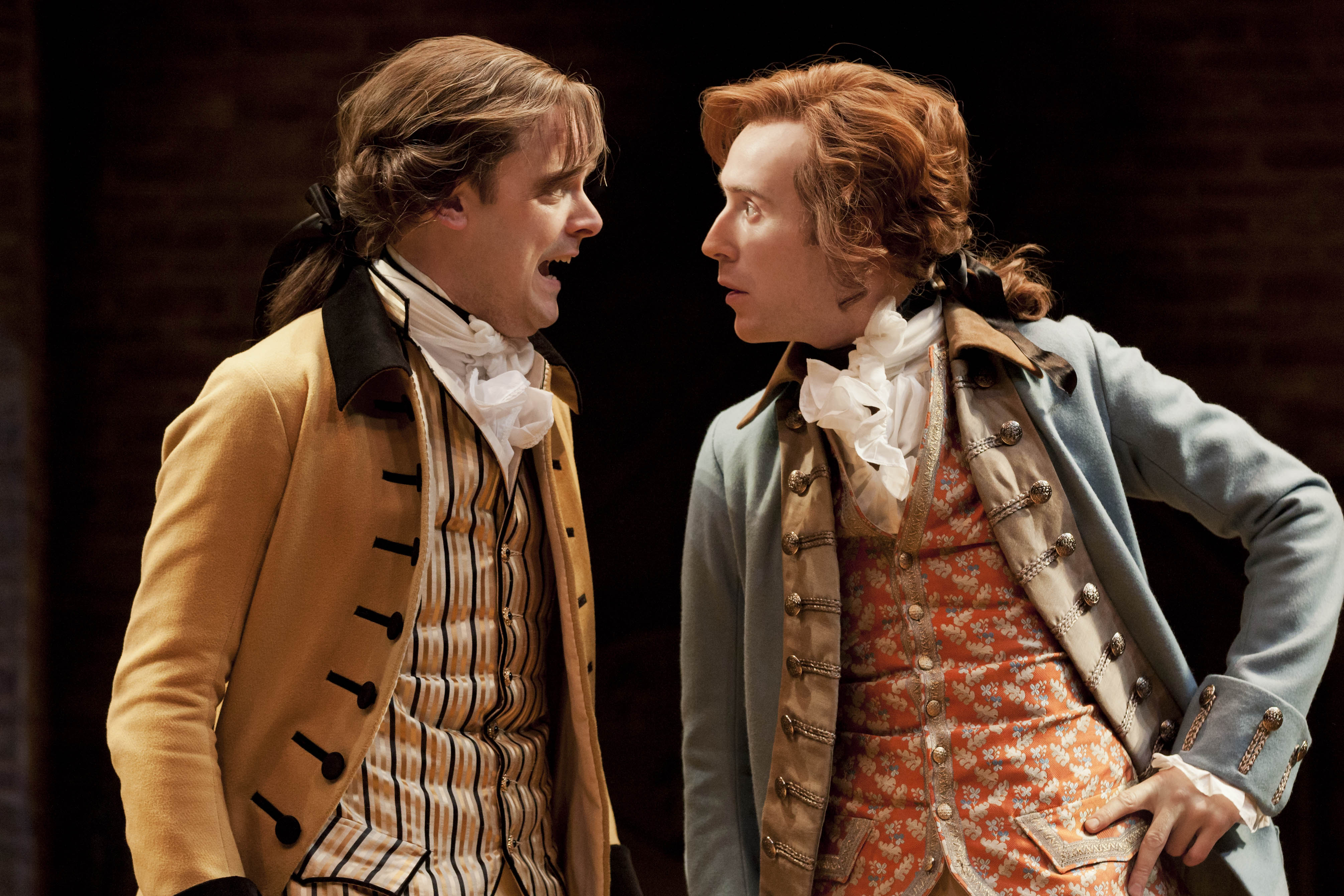
When the two preening young bucks from London (pictured above, Harry Hadden-Paton and John Heffernan) stop at the Three Pigeons to ask for directions, Lumpkin decides to play a joke on them by sending them to Mr Hardcastle's house, telling them it's the finest inn around. As Hardcastle is expecting Marlow and Hastings, he treats them as honoured guests despite their haughty treatment of him, while they, thinking him an innkeeper with ideas above his station, become ever more ungracious.
Lloyd avoids overdoing the modern parallels - although they are there to be drawn, of course
Marlow has a curious affliction which means that he becomes a yammering, stammering fool with women of his own station, but is a real charmer with wenches - so Kate, realising the joke that Lumpkin has played, proceeds to woo Marlow by pretending to be the “inn's” barmaid. Hadden-Paton nicely negotiates the buffoon finding his voice through love and the later exchanges between him and Kate are genuinely moving.
Mark Thompson's design and Yvonne Milnes' costumes look lovely, and Jamie Lloyd's spirited production is full of laughs, although sometimes the comedy is pitched a little too high, even in this exuberant play - as Mr Hardcastle says at one point, “This is overacting, young sir.” The added music and dance, meanwhile, slow up the action in a drama that really needs to be played apace.
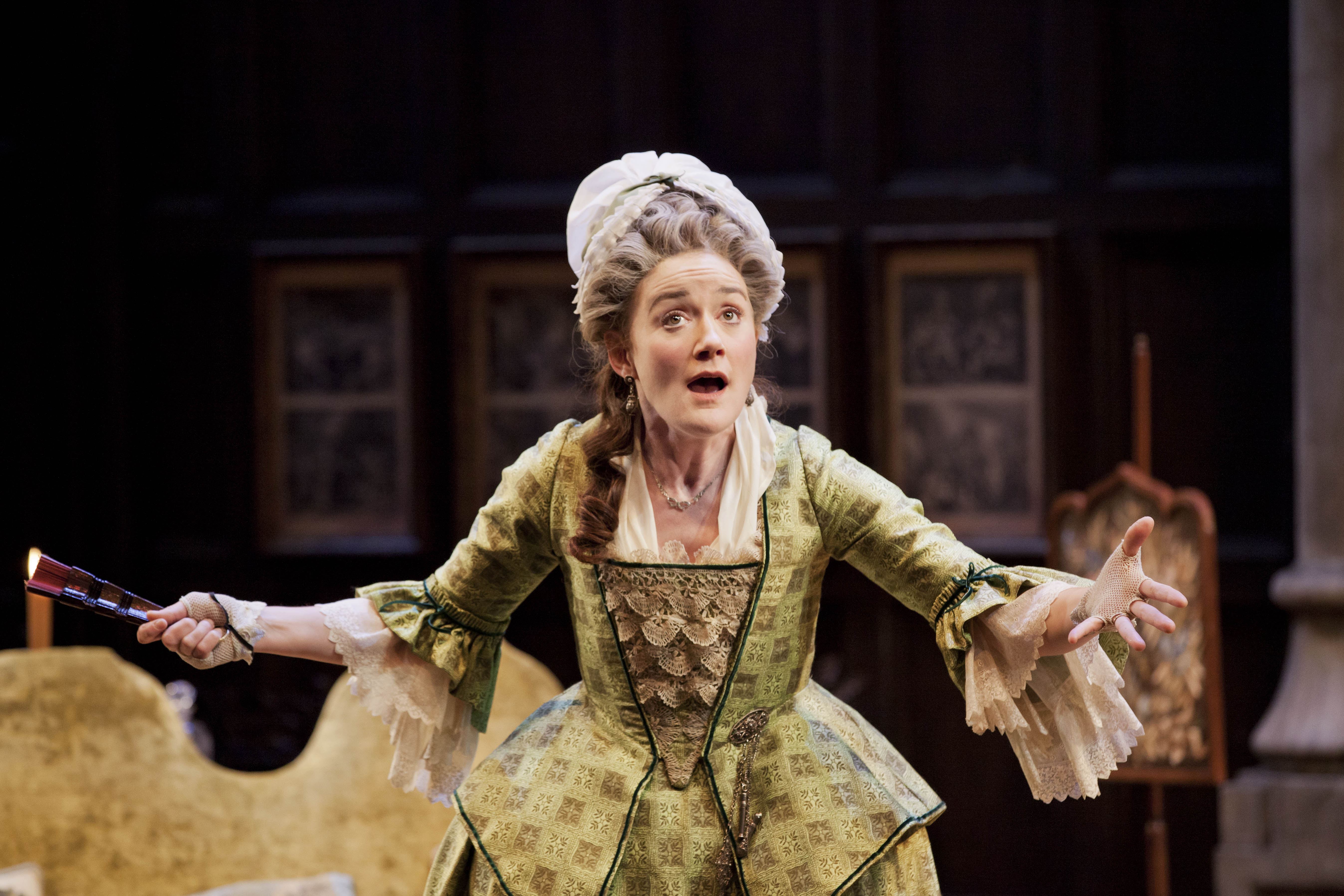 But this is a production stuffed with great turns; Steve Pemberton's blustering Mr Hardcastle, Katherine Kelly (lately the blingtastic Becky McDonald in Coronation Street) is a nicely saucy and appealing Kate, and John Heffernan is a deliciously vain Hastings, while Sophie Thompson (pictured above left) steals every scene, even if her Mrs Hardcastle lacks any real venality. The scene in which she tries to appear posher than she is to impress Marlow – with mangled vowels all over the place - is a particular delight, so too the exchanges between Hastings and Marlow where they discuss which of their dandified outfits they should wear to woo their lovers.
Lloyd avoids overdoing the modern parallels - although they are there to be drawn, of course - and instead gives full vent to Goldsmith's description of his work as “a laughing comedy”, which serves to reminds us what a great play this is.
- She Stoops to Conquer is in rep at Olivier Theatre, London SE1 until 21 April. The 29 March performance will be broadcast live to more than 800 cinemas in the UK and worldwide