Tim Crouch is one of our great theatrical alchemists. Most famously – in his conceptual show An Oak Tree – he creates a portrait of grief in which each night an actor who’s never seen the script before plays a grieving father who believes that his daughter has metamorphosed into an oak tree. What’s so extraordinary about the piece is the way that Crouch breaks down any factor that might seem to contribute to authentic emotion, carefully pointing up the show’s anomalies until the story itself grabs by us the throat. In his directorial debut at the Sam Wanamaker Playhouse, he does something similar with Shakespeare’s The Tempest, smashing up the play like a ship in a storm, and creating something new from the flotsam and jetsam.
For decades this play has been critiqued for the imperialist stench that accompanies Prospero’s treatment of Ariel and Caliban. In response Crouch – who also plays Prospero – breaks down the characters' speeches so that they are shared between the four main individuals living on the island: its Indigenous inhabitants, Ariel and Caliban, and himself and his daughter Miranda. In a play where storytelling confers authority, this cracks the play’s original power structure. Through taking on his words, each character is given their chance to challenge Prospero’s narrative of why he treats them as he does.
The most significant script innovation comes at the point when Prospero justifies his enslavement of Caliban. Where, in the original, he accuses the latter of having wanted to rape Miranda, “thou didst seek to violate the honour of my child,” here Miranda implies she was attracted to Caliban. It is she, rather than Caliban, who expresses regret that they haven’t “peopled this isle” with their children. Later in the play, when Caliban quietly echoes her official lover, the prince Ferdinand, you feel the full pathos of his loss.
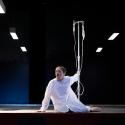
Rachana Jadhav’s design is a mesmerising tropical collage of objects that have been washed up from the sea: effigies, masks, rusty cogs, white wings that could have come from birds or angels, a jumble of battered texts, old mugs, and tins. In the centre is a lapis lazuli-blue screen with an inverted gold dome, in the middle of which is suspended a two-dimensional model ship.
It’s part visual playground, part sacred space, in which the objects take on quasi-magical powers as they’re used to create this new version of Shakespeare’s story. The shipwreck at the start is conveyed by the model ship being spun round manically. At other points effigies representing different characters are brought to the front of the stage, not least a high-heeled shoe welded to a wine-bottle to evoke Prospero’s power-hungry sister Antonia.
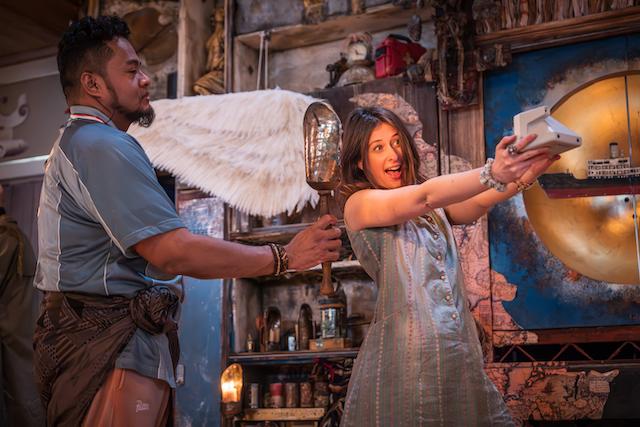
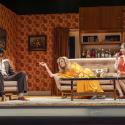
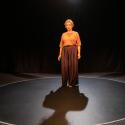
Sophie Steer (above right) gives a vivid performance as Miranda, simultaneously wild-at-heart and sensitively alert to the world’s wonders. Faizal Abdullah (above left) is a defiantly assertive Caliban, sporting a Gazza football shirt, often adding rich stripes of auditory colour by delivering the text in his native Singaporean Malay. Naomi Wirthner – of Slow Horses fame – is a shaman-like Ariel, as acerbic as she is wise in her dealings with Prospero. Crouch’s Prospero, in the meanwhile, alternates between acting like a benign Dr Faustus and lashing out with tyrannical cruelty, whether chiding an audience member for mobile phone use or mocking Caliban’s speech patterns.
The entire enterprise is as stuffed with fascinating ideas as Jadhav’s glorious set, yet the resulting lack of cohesiveness starts to take its toll. We understand that the power of storytelling is being questioned, as indeed is the nature of the relationship between actor and audience. Several characters delightfully emerge from the stalls, whether it’s an “usher” who turns out to be Prince Ferdinand (Joshua Griffin), or Jo Stone-Fewing’s engagingly apologetic bicycle-helmet-clad King of Naples Alonso. Prospero’s treacherous brother becomes Antonia (Amanda Hadingue), a Home Counties snob with a Pilates habit who deploys her mobile phone like it’s her birthright.
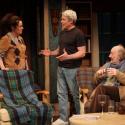
Yet while the artifice of it all is as pleasingly elegant as filigree metal, there’s a sense that when we look through there’s very little behind it. Some jarring elements don’t help. The slapstick portrayal of Trinculo and Stephano as lost female Spanish tourists is extended for far too long. A disco sequence when the whole set lights up and everyone starts dancing (see below) is a surreal step too far.
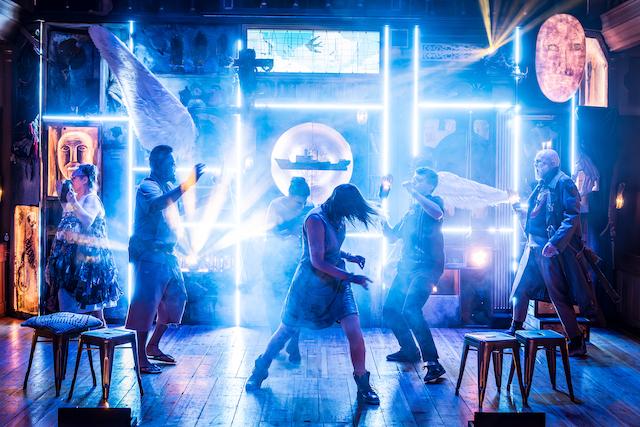
The production almost gets away with it. Orlando Gough’s stunning compositions, ethereally performed by the singers Emma Bonnici and Victoria Couper, use hums, trills, and wild-as-the-wind melodies to evoke the sounds of an enchanted natural world. There are some wonderfully magnetic moments, not least Miranda’s ‘brave new world’ encounter with more humans than she has ever seen before. As Prospero, Crouch is always fascinating to watch, and his authority when he decides to use it is as chilling as it is abrupt. Yet despite the many virtues of making this a conceptual experiment rather than an enchanted isle, at the end it feels all too easy to leave it.