

Francisco Zurburán’s The Lamb of God (Agnus Dei), 1640 (main picture), must be the most compelling religious picture ever painted. Visually, it couldn’t be simpler; perhaps that’s why the image nails you to the spot. A lamb lies on a ledge with its feet tied together, awaiting slaughter. Instead of struggling, it remains absolutely still – as though resigned to its fate.
A metaphor for the martyrdom of Christ, the lamb is far from being an abstraction, though. Zurburán has painted its fleece with such exacting detail that you could almost plunge your fingers into its warm, woolly depths. Its feet protrude over the ledge so they appear to jut out of the picture into your space, literally and metaphorically. You are not just a bystander, then, but a participant – morally implicated in the animal’s fate.
For a painting to speak to you this directly across a gap of nearly 400 years is remarkable. And given that the majority of Zurburán’s paintings communicate the intensity of his Catholic faith, their profound effect on a non-believer like me is even more extraordinary. It makes one wonder why the artist who along with his friend Diego Velázquez was the most important painter in 17th century Spain is so little known here, and makes this National Gallery survey of his work so very welcome.
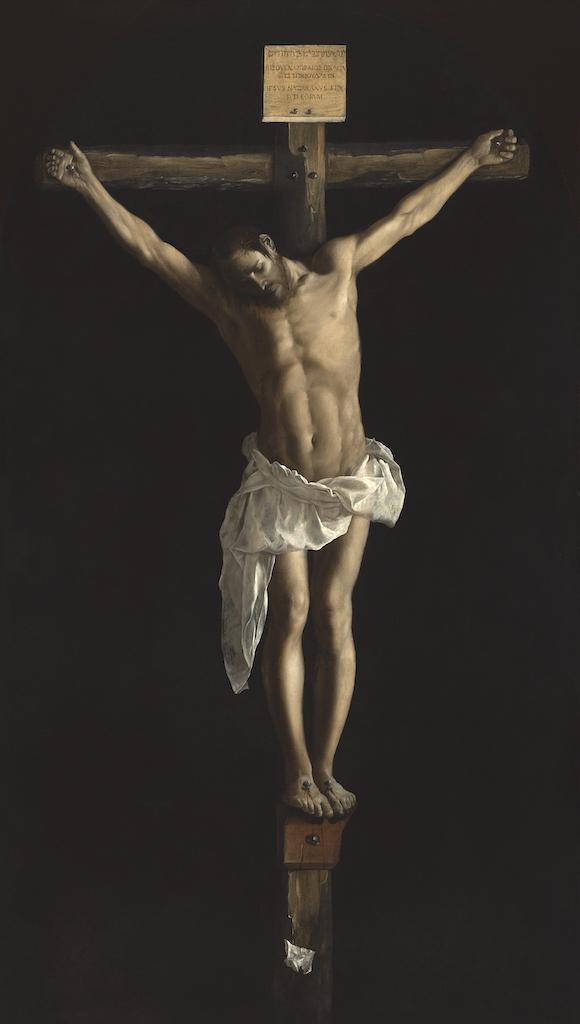
Entering the first room, two things hit you – Zurburán’s radical approach to traditional subject matter and the drama with which he brings the ineffable down to earth and makes it appear to be happening before your very eyes. Christ towers above you, nailed to the cross (pictured above: The Crucifixion, 1627 by Francisco de Zurbarán. The Art Institute of Chicago). Silhouetted against a dark ground, his body is lit from the right to maximise the sculptural effect. This is pure theatre and the results are so life-like that Jesus seems to be standing there, in the very flesh.
From the droop of his head to the tension in his chest and outstretched arms, every detail of his athletic body is masterfully conveyed. Captured with similar perfection are the textures of nails and rough hewn wood along with the white loin cloth crisply draped around his hips. (Zurburán’s father was a haberdasher and his son was a master at describing the weight, texture, colour and hang of different materials).
Most striking, though, is the fact that Christ’s feet are firmly planted on a wooden plinth, a detail that emphasises his humanity while also reminding us of the model posing for the picture. The white of the loin cloth is echoed in a piece of crumpled paper attached to the cross on which Zurburán has signed his name in a trompe l’oeil flourish. Painted in 1627, this is the artist’s earliest known work and he seems determined to demonstrate his supreme skill by creating a tour de force.
And it worked. His reputation spread rapidly and within two years he was invited by the city council to make Seville his home. He’d moved there from Extremadura when he was 15 to study painting, sculpture and gilding and, apart from a brief stay in Madrid, lived in the city for the rest of his life. Mainly due to its trading links with Spain’s overseas territories, the port town was extremely wealthy and the many religious institutions that flourished there were eager to commission such a talented local artist.
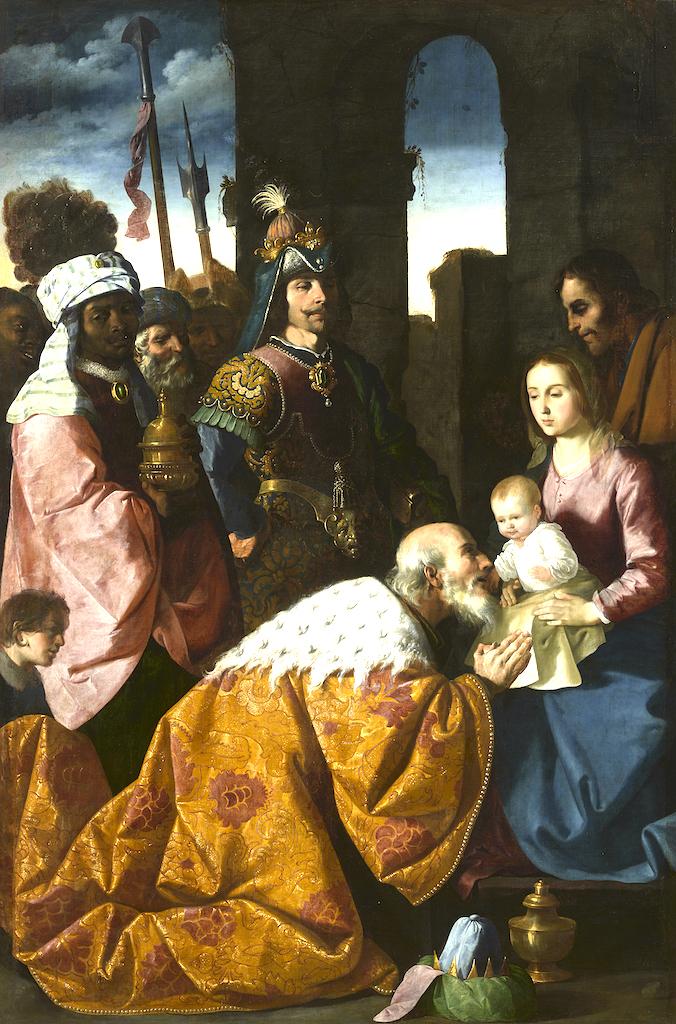
One such project was for a 15-metre-high altarpiece portraying scenes from the life of Christ. The goal, of course, was to impress and, judging by the three panels on display, the ensemble must have been pretty overwhelming. But with a unique combination of exquisite detail and charming incident, Zurburán brings the stories to meaningful life and thereby avoids pomposity. Take for example The Adoration of the Magi (1639) (pictured above). We see Melchior kneeling in front of the Christ child, his gold brocade cloak crumpling in luxurious folds around his ankles. The fringe of his ermine collar echoes the tufts of his thinning hair and spindly grey beard. He may be the King of Persia, but he is also an old man. A page boy watches in fascination as his master prostrates himself in front of the infant while, in his eagerness, the king thrusts his nose towards the baby’s chubby face. Meanwhile Jesus, who is clearly modelled on a real child, looks at him with benign curiosity and, in one of the most delightful encounters in religious art, lifts his hand as if to pat the old man’s cheek.
Some 20 years later, Zurburán would paint Mary breastfeeding her baby; the little boy gazes up into his mother’s eyes while Joseph, who is usually treated as little more than an elderly bystander, is portrayed as a handsome young man looking on with paternal affection. The ability to humanise even the most solemn moments of the Christian story meant the artist was forever in demand – tasked with portraying the same subjects over and over again. He painted at least 15 Immaculate Conceptions, for example. But he also invented new subjects, including Mary at home with her young son. Jesus has pricked his finger on a crown of thorns; seeing the blood triggers in her an awareness of the suffering that awaits him and plunges her into deep melancholy. Rather than being a cypher onto which the faithful are invited to project their thoughts and feelings, Mary becomes, in his hands, a young woman with a rich inner world.
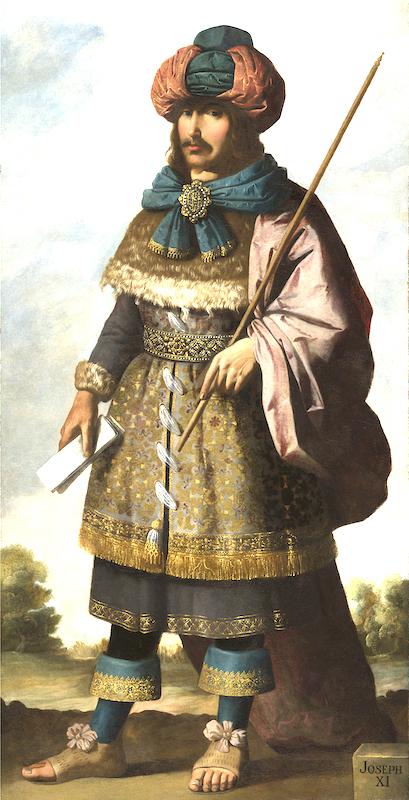
The sons of Jacob, on the other hand, are like models in an exotic fashion show (pictured above right: Joseph, 1640–5). Each man represents one of the tribes of Israel, which gave Zurburán the chance to deck them out in fanciful costumes and show off his amazing skill at portraying embroidered silks, satins, damask, furs, leather and precious stones. The same attention is lavished, though, on the plain brown homespun worn by St Francis of Assisi. Zurburán shows the saint clutching a skull – a reminder of the brevity of life and the vanity of those earthly riches he was so adept at portraying.
Above all, Zurburán was a gifted storyteller; occasionally, though, he chose to address his subject obliquely. Veronica is said to have wiped Jesus’ face with her veil as he passed her on the way to Calvary, and his features became imprinted on the cloth. Instead of portraying the event literally, though, Zurburán chose a more conceptual approach. A white cloth hangs from three pegs; at its centre is the smudgy outline of a face that seems to be fading before our very eyes. The Veil of Veronica, 1658, is more than the depiction of an event; it’s a meditation on the evocative power of art and the fragility of imagery.
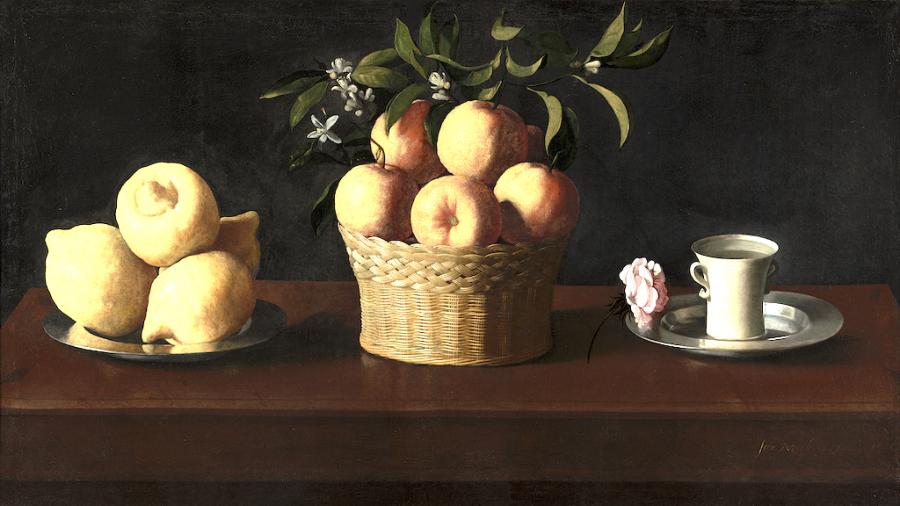
Zurburán most astounding achievements, though, are the still lifes he imbues with religious significance. In his hands, a cup of water and a pink rose on a pewter plate become a meditation on the purity of the Virgin Mary. This simple image appears several times – in a painting of Mary as a young girl, for instance, and in Still Life with Lemons, Oranges and a Rose (1633) (pictured above) where it stands on a table beside a basket of oranges and a plate of lemons arranged with the exactitude of ritual objects on an altar. Dramatic lighting and the stark clarity of the image lend this mundane scene a spiritual dimension.
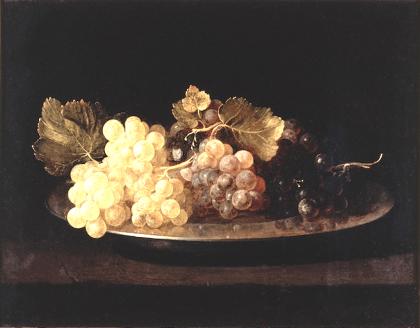
The basket holding the oranges also features in a still life painted by Zurburán’s son Juan, who was as brilliant a painter as his father. Sadly, he died of the plague aged only 29, but not before creating the subtlest and most beautiful portrayal of black and white grapes in the whole of western art.
Two geniuses in one exhibition. You’d be crazy to miss this wonderful show !
Add comment