Peer at the small print and it’s clear that Berlin to Broadway with Kurt Weill is actually a spruced-up repackaging of a show originally devised by Gene Lerner and arranger Newton Wayland, about whom Opera North’s programme tells us nothing. The cabaret-style production’s two halves take us neatly through Weill’s career, the linking narrative divvied out among the 11-strong cast in a manner that suggests a primary school class assembly.
But it works handsomely. Veteran director Giles Havergal’s hands-off approach would surely have pleased Weill’s testy collaborator Brecht. And having the songs accompanied, superbly, by Martin Pickard on piano means that we hear more, not less. The cast, mostly drawn from Opera North’s chorus, are in evening dress throughout, assisted intermittently by hats, props and chairs. Leeds’ intimate City Varieties makes for an ideal venue: this production would feel lost in a larger space.
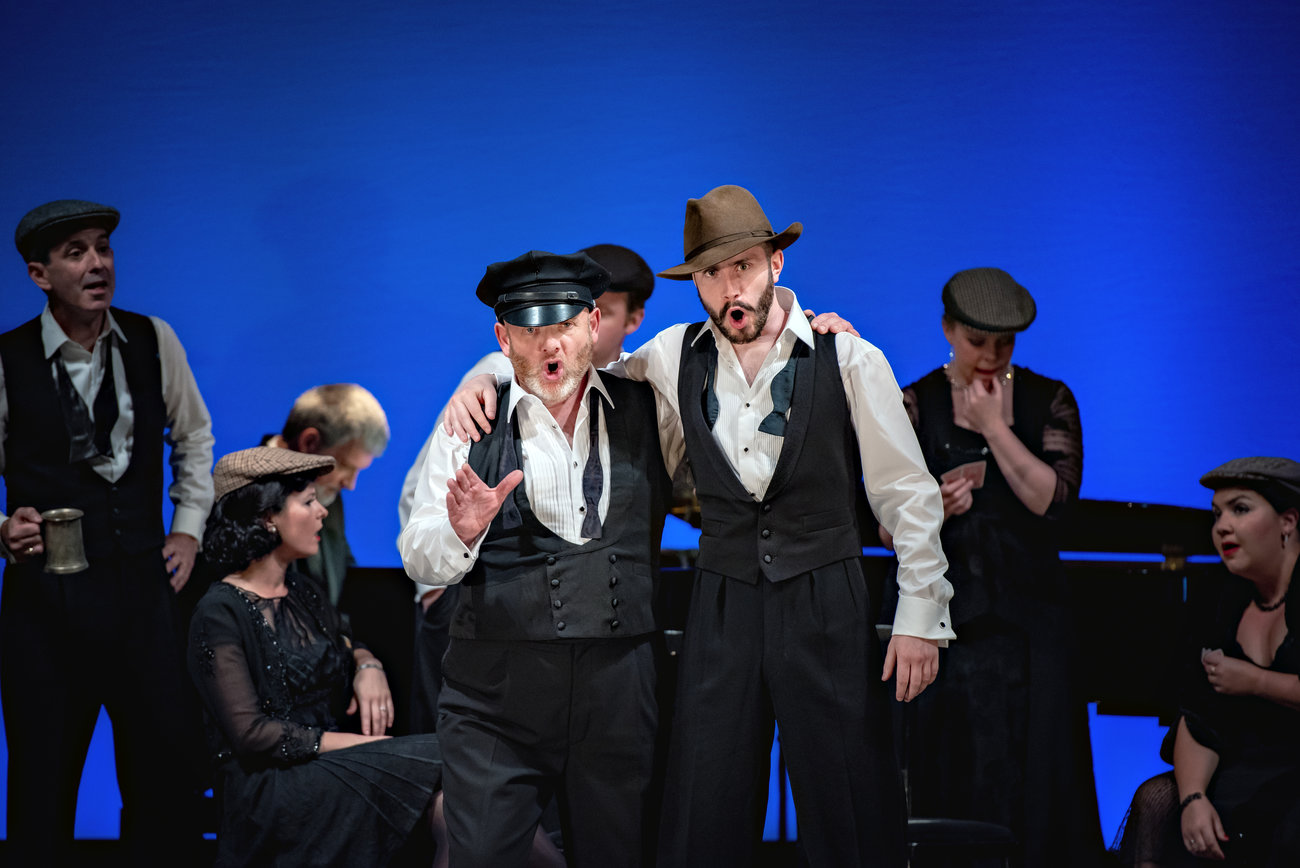
The first act’s Berlin sequence includes all the hits you’d expect: pin-sharp English versions of “The Ballad of Mack the Knife”, the “Alabama Song” and “Pirate Jenny”, and a startling sextet performance of the “Benares Song” from Mahagonny, Weill’s sleazy harmonies really hitting home. Delivery is never too operatic, except, rightly so, in Lorna James and Nicholas Watt’s exquisite German rendition of the “Duet of the Cranes”, again from Mahagonny. I’d not heard all of these translations before, my favourite being a revamped “Cannon Song” (“Let’s all go barmy/And join the army/We chop ‘em to bits because we like our hamburgers raw”), spat out with fury by Alex Banfield and Richard Mosely-Evans (pictured below). The meteoric rise and fall of the Brecht/Weill partnership is succinctly outlined, the near-catastrophic premiere of The Threepenny Opera a highlight. The songs, however, do begin to blur into one another without a linking plot, and Weill’s stylistic tropes begin to grate when they’re heard without much of a gap.
 Thus it’s a relief to cross the Atlantic for the second half, picking up the story of Weill and his on/off spouse Lotte Lenya after they had left Nazi Germany. Weill loved his new home, renouncing his European origins (“I am an American composer.”) and embracing Broadway musical theatre. Yet listen carefully and you can still hear the gears grinding away beneath the music’s gleaming surfaces: the best of Weill’s American numbers have a rawness and poignancy that really hit home. Dean Robinson throws in a lovely rendition of Knickerbocker Holiday’s “September Song”, and Watts’s account of “Johnny’s Song” from the long-forgotten Johnny Johnson brings tears to the eyes. Funniest is “The Saga of Jenny” from the 1941 psychoanalytical musical Lady in the Dark. Ira Gershwin’s lyrics are superb, and Amy Freston savours every syllable.
Weill became an American citizen, only to suffer a near-terminal setback when his and Gershwin’s 1945 show The Firebrand of Florence proved to be an expensive flop. He attempted to write a popular opera (1947’s Street Scene), and later teamed up with Alan Jay Lerner. The title number from Weill’s final musical Lost in the Stars is handsomely delivered by bass Gordon D Shaw and the ensemble, but it’s too syrupy for comfort. Death came in 1950 as he was working on a musical adaptation of Huckleberry Finn, for which five numbers survive. We don’t hear any of them here, ending instead with powerful ensemble renditions of “What Keeps a Man Alive” and “Mack the Knife” – an ironic reminder that this composer’s biggest American hit was a posthumous revival of The Threepenny Opera.