Every 21st birthday deserves a party, and the Bridgewater Hall in Manchester celebrated the anniversary of its opening with a weekend of fun and "access" events, ending with a recital by four pianists on its four Steinway pianos – playing them all at once, in eight-hand arrangements.
It was very different from the opening 21 years ago, when orchestras dominated the programmes. This time even Manchester Camerata, the chamber orchestra with which the hall co-promotes events, moved round the corner to play in the gallery at HOME, a newer arts centre. But one of the early discoveries about this hall was that its acoustic favours small-scale sounds more than large ones. The first highlight of its Sunday birthday programme was a beautifully intimate and informal song performance by Jacqui Dankworth (pictured below by John Kentish) with guitarist Craig Ogden, who’s head of guitar at the Royal Northern College of Music and one of the Bridgewater Hall’s “associate artists”.
 Miss Dankworth was suffering from a bout of flu, and they didn’t complete the slated programme, but what they did was magical – based, we were told, on an album already recorded but not out yet. The pieces were wide-ranging, from the folk song The Water Is Wide (aka O Waly, Waly) to Willie Nelson’s Crazy, with Paul Simon, Henry Mancini, Richard Rodgers, Burt Bacharach and Tom Waits along the way. The guitar arrangements, by a variety of hands including William Lovelady, Craig Ogden and Ogden’s pupil James Girling, were fascinatingly varied and very skilfully played. Michel Legrand’s How do you keep the music playing was a lovely, light and lyrical highlight, and Ogden added a couple of guitar solos, by Barrios and Django Reinhardt arranged by Roland Dyens, to underline the brilliance of his technique.
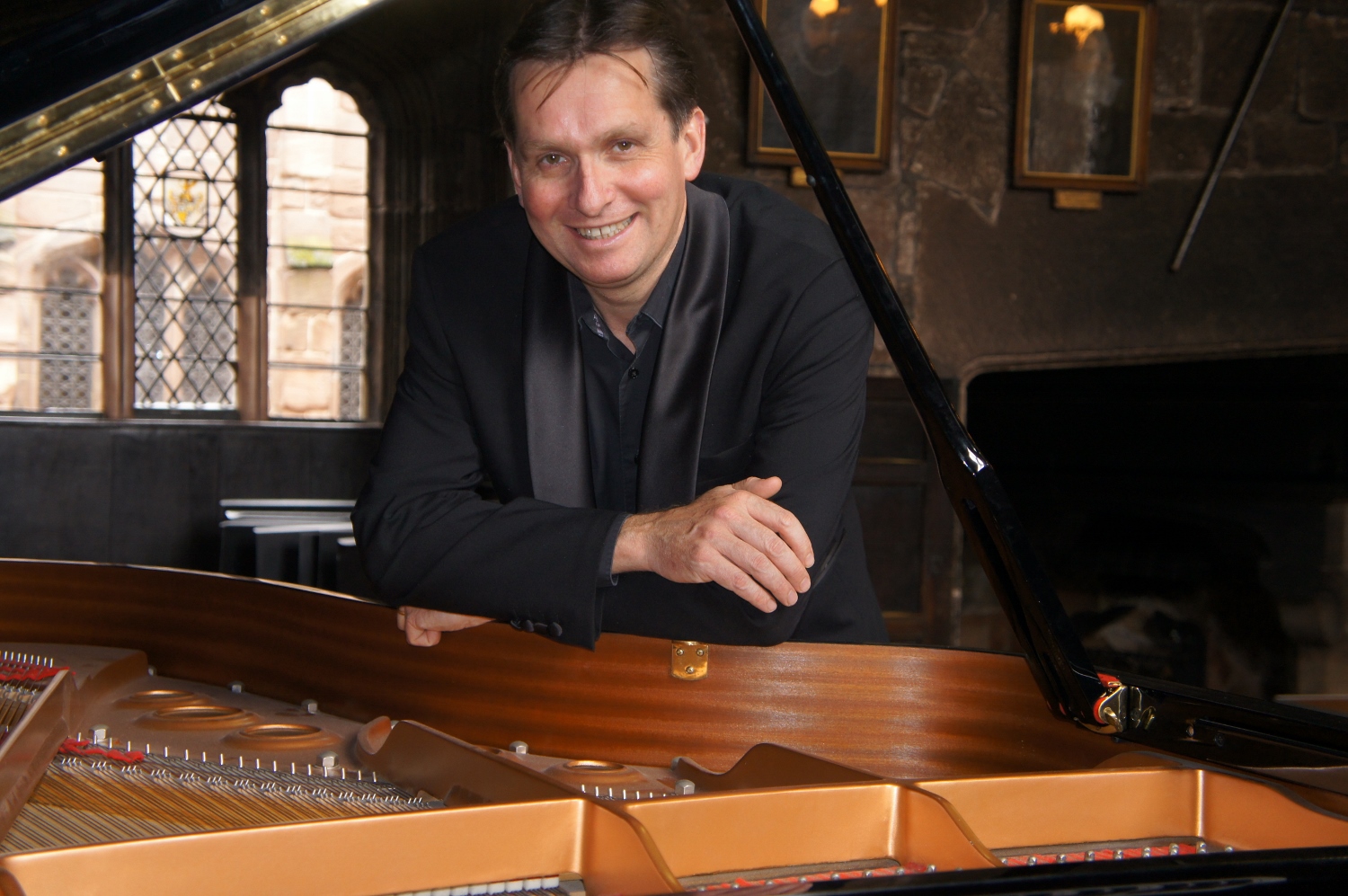
The four-pianos programme featured Noriko Ogawa (long associated with the Bridgewater Hall’s piano extravaganzas and another associate artist), Murray McLachlan (head of piano at Chetham’s School of Music, pictured below), Graham Scott (head of piano at the Royal Northern College of Music), and his equally distinguished predecessor and another associate artist, Martin Roscoe.
It was always going to be a bit of a romp, and what shows up most on occasions like this is the skill, or lack of it, of arrangers who turn orchestral pieces into eight-hand versions. Some work better than others.
 Mozart’s Overture to The Magic Flute , for instance, was not as sparkly as it could have been, but big scores, with plenty of doubling already inherent in the textures, can sound really good and true-to-life this way, and that was almost surprisingly true of “Mars” and “Jupiter” from Holst’s The Planets – and in Wagner’s “Ride of the Valkyries”, believe it or not. The arranger of the Holst was clever enough to enhance the big tune in “Jupiter” by adding a new pair of hands each time it needed a crescendo – smart move.
Hirohisa Shono’s Fantasy on Themes from [Gershwin’s] Porgy and Bess was a pleasant medley of tunes with a fugue tucked in, but the Mambo from Bernstein’s West Side Story was (on this occasion) a classic case of too many notes. And amid all the flurry, they didn’t shout “Mambo!” very loud, either. In truth, on the brief occasions when the four virtuosi split to appear as piano duettists, the musical results were much more satisfying. Murray McLachlan and Noriko Ogawa played a remarkably effective arrangement for two keyboards of Debussy’s Prélude á l’après-midi d’un faune , and did so very beautifully. And Martin Roscoe and Graham Scott played the original piano duet versions of Dvořák’s E minor and G minor Slavonic Dances – the popular ones: Op.72 No. 2 and Op. 46 No. 8 – with the latter in particular firing up delightfully.
They had an encore: the closing section of Beethoven’s Ninth Symphony, for eight hands. Good fun, but it prompted thoughts of what Dr Johnson said about dogs walking on their hind legs (or was it something else?) – one marvels not that it is done well but that it is done at all.