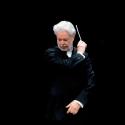
It's a considerable irony that a musician as dedicated and as serious as pianist/conductor Christian Zacharias should suddenly, at the age of 63, gain bragging rights on Youtube (see next page). There wasn't really that much he could do about it. It happened last October. A mobile phone went off as he was directing a Haydn concerto from the keyboard in Sweden. You can see his silent but intense frustration as he stops playing. “Don't answer,” he says. He waits until the loud noise of the moble phone stops, and gets back to playing. Accidents happen, and "Haydn Killed by Cell Phone" has now been watched over 600,000 times.
His Mozart and Schubert recital last night was played, uninterrupted, in front of a completely packed Wigmore Hall. It was a cleverly devised programme, as Misha Donat's typically thorough programme note elucidated very well (perhaps the Wigmore Hall could start to make these available online.)
It was in the slower movements that Zacharias was at his most alchemical. A particularly serene and well-judged moment was the Andante sostenuto second movement of Schubert's final B flat Sonata. That movement starts with eight bars of a melody in the right hand and an identical repeated pattern of four C sharps rising through the octaves from the left hand, the final note of each figure played with hands crossed. That short but eloquent episode seemed to crystallize Zacharias' strengths, his depth of understanding of this music, and his desire to communicate it. Whereas the right hand declaims and gives the logic to a melodic narrative, the left hand is an exercise in calculating what weight, colouring and delay to give, in the moment, to each of these identical, repeated hand movements. Another joy was the first movement repeat, mesmerisingly far slower than the first time, psychologically detached, Schubert truly as the sleepwalker.
Zacharias' Mozart makes the most of the way the music develops by jumps, by sudden and unpredictable departures into new territoryThe two Mozart sonatas, K310 from 1784 and K533/494 from 1786/8, which constituted the first half were a beautifully contrasted pair. Zacharias has said in interviews that it is the asymmetries and irregularities which appeal to him. Indeed, Zacharias' Mozart makes the most of the way the music develops by jumps, by sudden and unpredictable departures into new territory, the pianist taking joy in the irresistibility of each new idea. The high point of the first half was again a slow movement. Zacharias gave the Andante of the later sonata air, each iteration of the rising scale theme lived through as a de-crescendo-ing retreat.
A warning note. Christian Zacharias' conducting career in both the concert hall and the opera house, which started in 1992, is now in full flow. So he has made it clear that he will tend to do more conducting, and give fewer piano recitals: "When you give piano recitals, then you are one day here, the next day there - I could without the to-ing and fro-ing," he has told a German interviewer. He has also expressed misgivings about whether he still wants to commit the preparation time necessary to give recitals. It would be a shame if the irresistible poetry and intensity he increasingly brings out from the piano in this core classical repertoire were to disappear altogether.
Over the page: "Haydn Killed by Cellphone" on YouTube
Zacharias stope a performance of a Haydn Concerto when a cellphone goes off:
and makes a joke of it in his Mozart encore: