

Leonard Elschenbroich and Alexei Grynyuk crafted a fine programme for their EIF recital, centring around Brahms’ relationship with the Schumanns. He famously met them in 1853, when Robert Schumann declared him the next great thing in German music. The following year, however, Robert attempted suicide, launching a decline that lasted until his death. Brahms stayed close to Clara until her death in 1896, in response to which he wrote the Vier ernste Gesänge.
The only “originally scored” thing on the programme (★★★★) was Brahms’ Second Cello Sonata, which Grynyuk and Elschenbroich played with beautiful purity of tone and a palpable sense of finishing one another’s sentences, a true partnership. They gave the impression of understanding the music’s hidden depths, bringing an undercurrent of seriousness to a slow movement whose marking is “affettuoso”, then bringing affectionate warmth to a muscular sounding scherzo and finale. In a surprise bonus, they then brought on Nicola Benedetti – the EIF’s director and also their trio partner – to play their encore, the slow movement of Brahms’ last piano trio, where the strings and the keyboard seemed to ask and answer one another’s questions (the three pictured below in trio incarnation). This is clearly a team who know how to listen to one another as well as how to play together.
The rest of the programme saw Elschenbroich’s cello stealing repertoire from its original source, something about which he, strangely, said nothing during his spoken introductions from the stage. The sets of Romances by the Schumanns were well chosen for their contrasts rather than their similarities: Clara’s (originally written for piano and violin) are clearly love songs, while Robert’s (originally for piano and oboe) are more serious and incisive. Elschenbroich’s cello sounded slightly better in Clara’s violin line than in Robert’s oboe part, no doubt due to the affinity of one string instrument for another. In both, however, he surged with passion and involvement while Grynyuk acted as the straight man, sitting stock still at the keyboard. 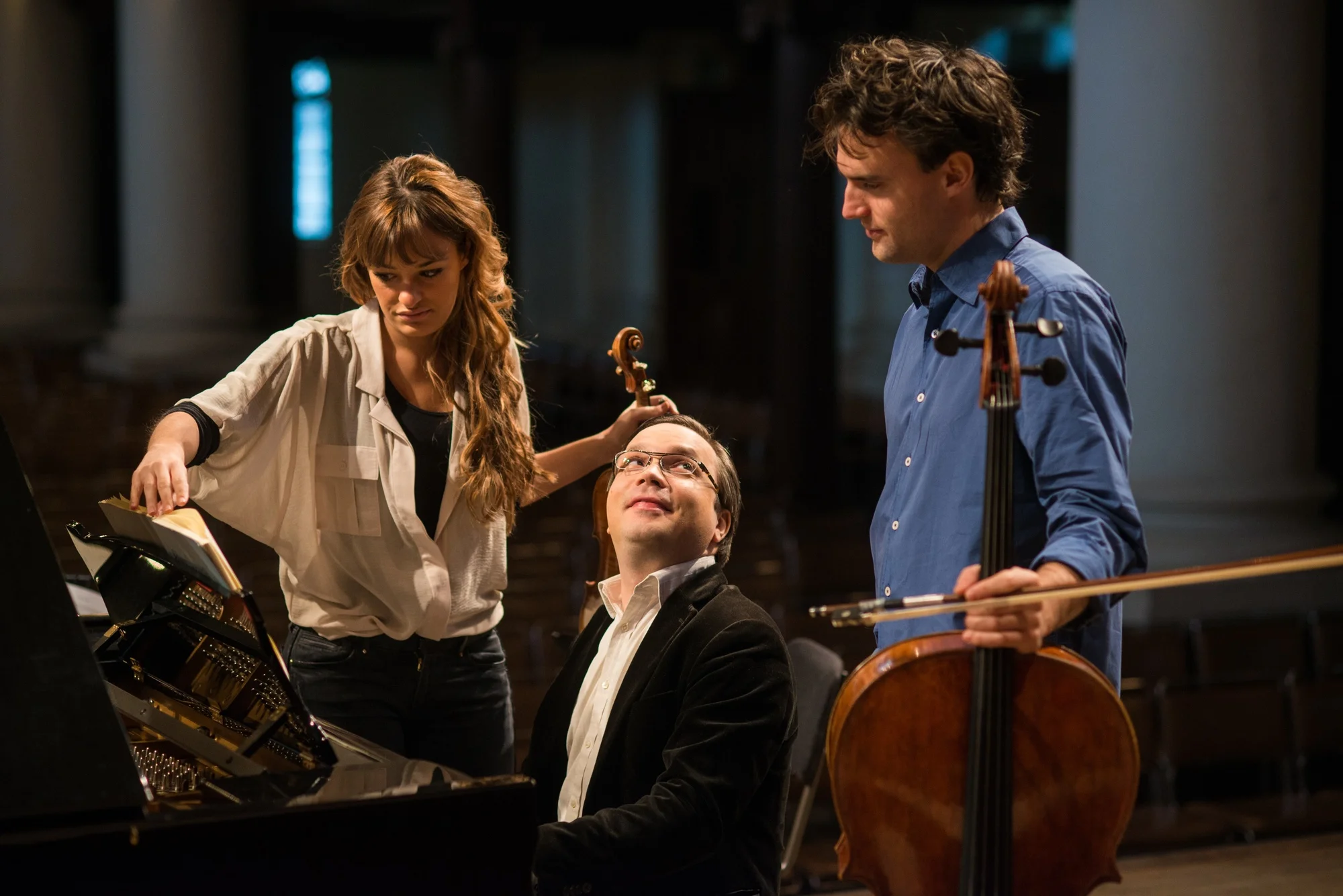 The finest thing in the concert, however, was their playing of Brahms’ Vier ernste Gesänge, where the cello made a stunningly effective replacement for the singer. They’re mostly sung by a bass or baritone, after all, which fits the cello’s register very well, and Elschenbroich’s playing fitted the songs like a hand in a glove, bringing surging mahogany richness to the lower music with an imploring, keening edge to the higher lines. Both he and Grynyuk got the emotional mood just right. Who needs the text when the playing is as communicative as this?
Mutual listening of, if anything, an even more intense kind was on display the following morning from the Fibonacci Quartet (★★★★), here making their EIF debut as an ensemble. They played Janáček’s Intimate Letters quartet with ensemble that was as tight as a drum, and this very security gave them the freedom to give full reign to the music’s emotional intensity. Janáček’s explosive, improvisatory textures had a sense of each instrument flying free but tethered deep down to the same common base, with intermittent outbreaks of heart-melting lyricism coming between precise outbursts of abrasion. Likewise, Smetana’s Quartet No. 1 was full of passionate intensity, only just softening for the more lyrical sections, and they ratcheted up the ebullience of the finale in both intensity and speed, making the final onset of the composer’s deafness sound all the more cruel, and turning the coda into a poignant lament.
Next to this, Helen Grime’s First Quartet contained some moments of softly floating textures, but lots of Janáčekian interjections with some angry outbursts of emotion which were admirably played but somewhat unforgiving. Apparently, the quartet is Grime’s response to becoming a parent for the first time, to which one can only think: yikes!


