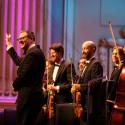
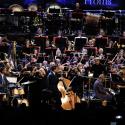
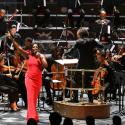
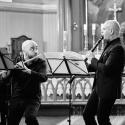
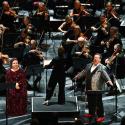
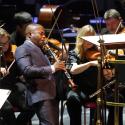
Be a soloist: take responsibility for yourself. These are not maxims often encountered in musical ensembles where unity of purpose and execution is valued, but they lie behind the philosophy and sheer style of Ensemble InterContemporain, which Pierre Boulez founded in his own image to show confidence in the necessity and vitality of a Modernism always under threat when an easy life and easy listening are so easily bought.
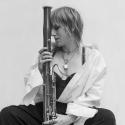
The Barbican’s celebration of Boulez in his ninetieth year began last week with the solemn obsequies of his Rituel and continued here in a vein of remembrance with Mémoriale. This started life as an elegy on the death of Stravinsky, but other personalities dear to Boulez became encoded within its history. The solo flautist Sophie Cherrier preceded it with Debussy’s Syrinx in a performance calibrated to its context: delicately uninflected, free and flowing, almost naïve.
Next came Asymétriades (2014) by Yann Robin (b.1974), a concertante work for double bass and ensemble inspired by the mysterious, indescribable forms in Solaris (the original novel by Lem rather than Tarkovsky’s film). For all its exploitation of percussive sonority – bows dancing and scraping up and down violins and cellos, the solo bass groaning under the bridge and a gong on the piano strings as well as a handsomely equipped percussion section – Robin’s language is one of continuity, not contrast, of rapid and intense pursuit which careers around corners only to find more of the same, like a flat-out run around the seedier quartiers of Paris.
The scoring suggests a late engagement with the Minimalism so contrary to a Boulezian aesthetic of richness and complexityWhat’s welcome is the absence of an oppressive agency impelling the chase, and despite the weight of the ensemble leaning towards the bass, a Boulezian force of conviction prevents the piece from outstaying the welcome of its 20-minute duration and rescues it from the potential clichés of its lexicon of effects. The bassist Nicolas Crosse hardly broke sweat in a performance of phenomenal assurance and dexterity.
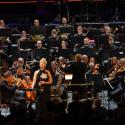
Pintcher’s own Choc (Monumento IV) from 1996 began with a rate of change hardly less rapid but to the opposite effect of internal protest and discontinuity. The ‘shocks’ of the title arise within the piece reacting to itself, chord by chord, like the elements of a chain reaction, but on a first listening they didn’t add up to an impression of shock or even surprise. It was hard to avoid the suspicion that much remained unheard, both by the composer and his listeners: a charge impossible to level at Boulez, whose Sur Incises occupied the concert’s second half, and filled the Barbican’s stage with its unique tripled trios of piano, harp and percussion. The scoring suggests a late engagement with the Minimalism so contrary to a Boulezian aesthetic of richness and complexity, and so do the repeated chords and motifs that would have been unthinkable for the creator of Le marteau sans maître – but then so would Agon to the composer of Le sacre, or the Missa solemnis from the perspective of Beethoven’s Septet. The great composers change, remodelling themselves and so shaping their times.
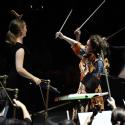
If the glittering scales, circular momentum and dramatic pauses of Sur Incises seemed more extrovert than in previous performances led by George Benjamin and the composer himself, that may be down not only to the determinedly soloistic personalities of Ensemble InterContemporain but Pintscher’s direction. With a Premier League haircut, rangy stride and snappy podium moves, he commands the centre of attention, and you sense that’s the way he likes it.