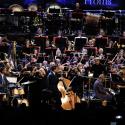
The Royal Festival Hall rather belied its name for a visit to London on Saturday of France’s premier new-music ensemble. It can’t be helped that the more intimate space of the Queen Elizabeth Hall next door is presently closed for renovation, but with the balcony and back of the stalls both empty and unlit, the place presented a more dismal aspect than usual. A flimsy excuse for a programme booklet, summarising three complex scores in 900 words, did little to assuage a depressing first impression that some rather embarrassed tokenism was at work.
The advantage of squeezing a diverse and enthusiastic audience nearer the stage was soon manifest, however, in the opening minutes of Jonathan Harvey’s Bhakti. With the 12 musicians of the Ensemble InterContemporain in front and speakers above, behind and to the sides, boundaries between source and perception melted away.
Bhakti has worn its age as lightly as another classic of 1980s British modernism, the Earth Dances of Birtwistle presented by happy coincidence at the Barbican the night before. They draw the ear in opposite directions: down and inward to a magma-filled core of dissonance in Earth Dances, out and upwards towards some far horizon of bliss glimpsed in the 12 brief Sanskrit-inspired movements of Bhakti. Total immersion brought renewed appreciation for a score that, more than any other, exemplifies the composer’s special gift for sanctifying the secular properties of music – breath, instruments, hands, ears – with lucid and understated harmony that floats free of tonal and atonal limits.
Presented in a composer-authorised "short version" that shaves a quarter of an hour off its original, perfectly satisfying duration of 55 minutes, Bhakti preceded the UK premiere of Hermes V by Philippe Schoeller. The composer is best known in his native France for composing a new score to Abel Gance’s pacifist silent classic of 1919, J’accuse. Necessitating an elaborate stage rearrangement, this intended final panel of an incomplete cycle made for a lengthy first half, and on a first listening, it offered scant consolation for the truncation of Bhakti.
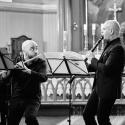
You’d expect restless activity from a piece named after the messenger of the gods. From a pupil of Pierre Boulez, you would hope for every note to take its place in a fluid but formal structure. One out of two, I’d say, and I didn’t care for the clichéd punctuations of a large Japanese rin bell which periodically drew the melee up short and into shape before Brownian motion prevailed once more. A scintillating idea scattered across instruments like popping fireworks, and returned for an abrupt conclusion.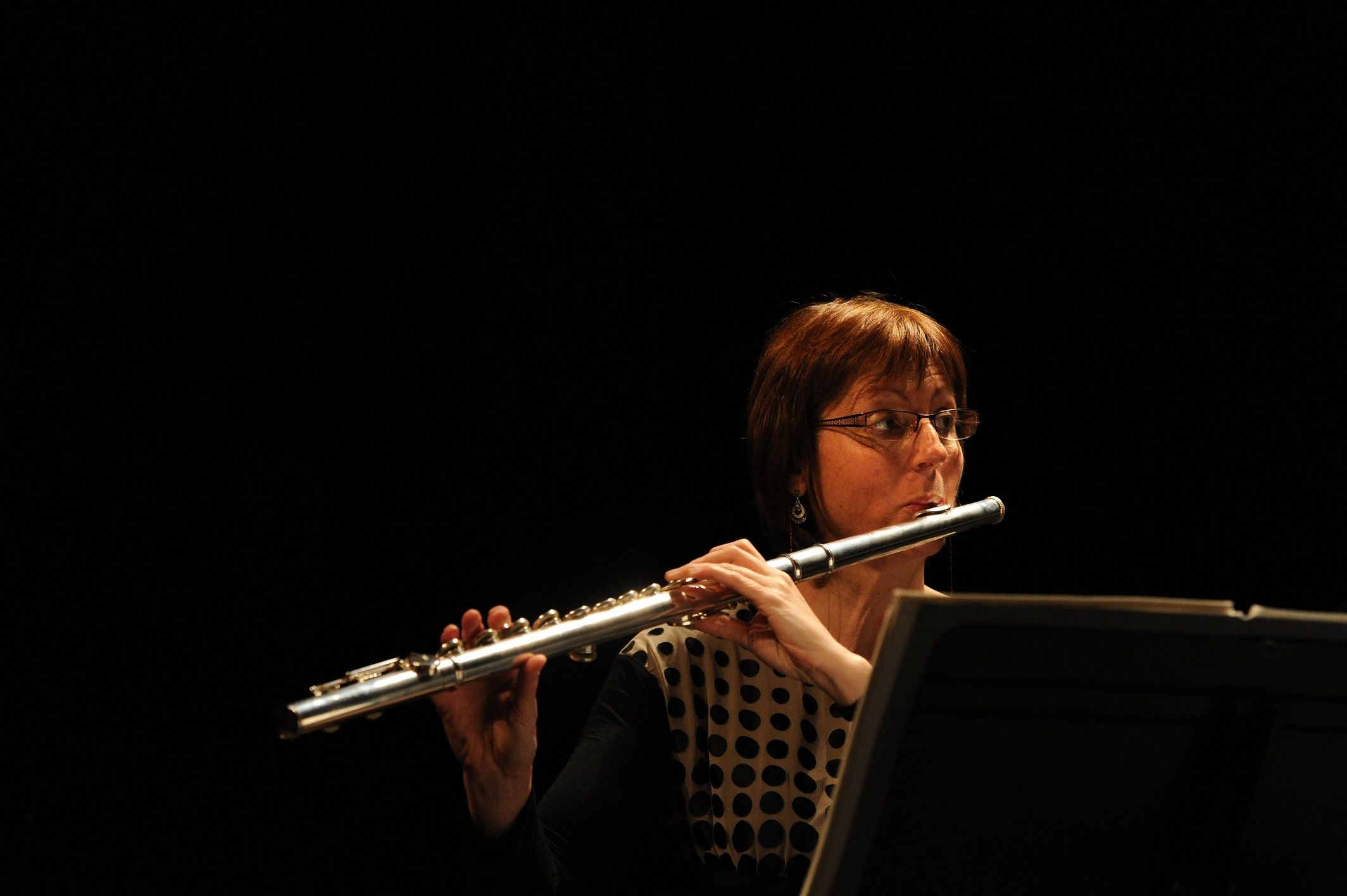 One figure at the feast was missing: Boulez himself, founder of the electronic studio IRCAM where Harvey wrote Bhakti, and of the EIC itself. He took his place with …explosante-fixe… which has become a signature piece for the ensemble. In the flautists Sophie Cherrier (pictured above) and Emmanuelle Ophèle, we had two of the work’s original soloists at the point of its definitive realisation in 1995, joined here by their younger colleague Matteo Cesari.
There is an elegiac aspect to …explosante-fixe…, but it was held in reserve by Matthias Pintscher’s unfussy, clear-sighted direction of gossamer-thread textures that richly fulfil both the promise and the paradox of the title. The units of musical sense are tiny, tossed between instruments and into the floating electro-acoustic world above and around the audience, but they are drawn together by the composer’s absolute control of pitch: the piece sounds pointilliste even if it wasn’t written that way.
Celebration is the keynote for the first two-thirds of …explosante-fixe…: of the figures therein recalled with deep affection, including Stravinsky and the EIC’s first flautist, Lawrence Beauregard; also of virtuosity on the part of the EIC’s members, IRCAM’s technology and the composer’s own craft. Only quite suddenly, just before a second and final electronic interlude, did the shadows lengthen. Once the instruments returned, their animating spirit had departed, or so it seemed, and Pintscher and the EIC left us with an uncanny sense of friends abandoned to private grief. Boulez may have left the building but he's with us for a while yet.