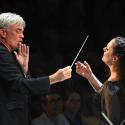
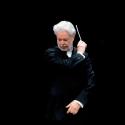
A time must come again when British orchestras return to complete Tchaikovsky ballet scores in concert, as in the BBC glory days of the great Rozhdestvensky. We were halfway there with The Nutcracker's second act in Mark Wigglesworth’s second programme as the Bournemouth Symphony Orchestra’s Chief Conductor. The "first act” was in any case a shimmering miracle too, a true partnership with another collegial master, Boris Giltburg, in Rachmaninov’s Third Piano Concerto.
Wigglesworth M – not to be confused with Ryan, who may well have improved since I last saw him in action – has by no means drawn a short straw in comparison with the two other greatest British conductors currently in vivacious action, Edward Gardner at the helm of the London Philharmonic Orchestra and Robin Ticciati at Glyndebourne (Wigglesworth took English National Opera to new heights for a season and a bit, but a McKinsey’s wrecking ball, with the complicity of the administration, swept aside his conditions for a full-time company). He’s in excellent past company at the Bournemouth helm, including the likes of Paavo Berglund and Andrew Litton. And he seems to have inherited from Ukrainian Kirill Karabits a string section, led by ex-BBC Symphony Orchestra violinist Amyn Merchant, in excellent health.
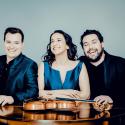
To those strings he applied judicious romantic portamento and, more important, a supple sweep to match the pianist’s easy movement in the mighty Rachmaninov concerto. Thanks to the most natural of gear changes, and Giltburg’s mercurial interchange of subtle introspection with sudden but clearly-defined thunder, it didn’t feel at all like a bravura monster, rather a symphony-concerto with the novelties of form – first-movement cadenza modifying the recap to come with its intimate study of the second theme, slow-movement free fantasia leaving unfinished business to the mesmerising heart of the finale – effortlessly emphasised. Several excellent principals, chiefly bassoonist Tammy Thorn and first horn Olivia Gandee, shared song duties prominently alongside Giltburg (pictured above), and Wigglesworth injected extra drive and thrust, the true excitement of live performance, into the extended final cavalcade. If you didn’t get the message that Giltburg is one of the most poetic and reflective pianists of our time, he lovingly reinforced it with the G major Prelude, Op. 32 No. 5, as his encore – about as far as you can get from the impressively rampaging Roman Rabinovich at the Wigmore Hall the other week, who dropped a point by preferring loud for both his Rachmaninov extras.
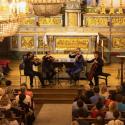
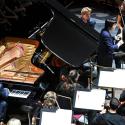
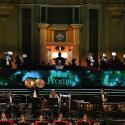
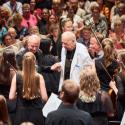
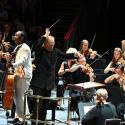
Amusingly, the publicity for the Nutcracker act embracing the famous divertissement told us that “the music tinkles in the memory like a lost music box”. Far from it: what resonates in the memory here is sheer stylish panache from a master conductor, delivered with full amplitude by the spirited players. The wide auditorium of the Portsmouth Guildhall, a strange mix of shabby and smart, reverberated to the high style of the big numbers, Wigglesworth playing with some of the dynamics and applying his own freedom to the spirit of the imperial waltz, but never excessively so in either case (pictured below: after the performance in the Guildhall).  No-one could have been left unmoved by Tchaikovsky’s sheer genius in endlessly resourceful orchestration. Seeing as well as hearing it reinforced how he postpones the entry of silky double-basses in a supremely sinuous and refined Arabian Dance, how many changes he rings on the two French songs of “Mother Gigogne and the Polichinelles”, which Wigglesworth whipped up to fever-pitch; how, you wonder, could nearly every ballet production omit it (I was lucky that my first Nutcracker as a child was London Festival Ballet’s, which included both this and John Lanchbery’s arrangement of an unscored English jig).
Final impressions, though, were of string heart and soul, the cellos impassioned at the heart of the Waltz of the Flowers paving the way for their great, descending-scale melody in a Pas de deux which ended with dazzling and precise force. At the other end of the scale, there was the finest solo artistry from harpist Eluned Pierce’s extended cadenza and Alistair Young’s celesta-playing, twinkling in so much more than just the Sugar Plum Fairy’s variation. Next season, please, the complete Sleeping Beauty – it’s all genius.
- Poole performance to be broadcast by BBC Radio 3 on Monday 16 December
- More classical reviews on theartsdesk