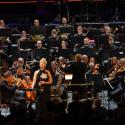
Depth, height, breadth, a sense of the new and strange in three brilliantly-programmed works spanning just over a century: all these and a clarity in impassioned execution told us why the BBC Symphony Orchestra was inspired in choosing Finn Sakari Oramo as its principal conductor. Their anniversary journey through Nielsen’s symphonies next Barbican season – itself a heady mix announced amid the palms of the singular conservatory before a vintage assembly of performances around the Centre – is more fascinating in prospect, for me at any rate, than the promised visits of the New York and Berlin Philharmonics.
There will be more Sibelius tone-poems, too, from Oramo and the BBCSO, and we can’t get enough of those. Last night’s concert started with a stunner, Pohjola’s Daughter, a perfectly constructed symphonic movement focusing on the Finnish national epic Kalevala’s greybeard hero Väinämöinen as he tries to achieve the tasks set by the Maid of the North and falls at the last hurdle. Since the epic venture ends in failure, Sibelius's music ends as well as begins in darkness. There could have been no more arresting cello solo than Susan Monks’ at the start, a runic “once upon a time” that pierced the soul.
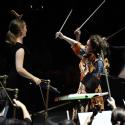
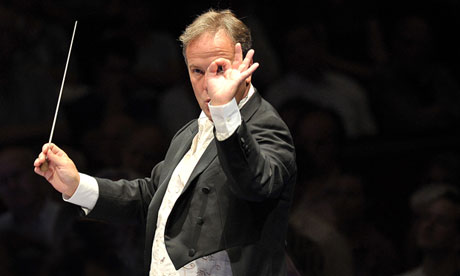
Oramo (pictured below by Chris Christodoulou) switched from Väinämöinen’s steady mustering of heroic forces to the delicate vision of the Maid spinning on a rainbow “high in the airy blue” with a master story teller’s sleight of hand. And while I don’t buy the line that Bernard Herrmann wrote the slasher music in Psycho inspired by Sibelius’s most extraordinary orchestral effect – Herrmann knew his Prokofiev, and it surely derives from the convent hysteria in Prokofiev’s Fiery Angel – Sibelius's scything still sounded as fresh and amazing as if it was written yesterday.
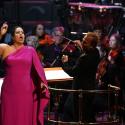
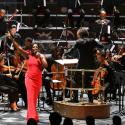
 How to follow that? Well, bringing on feisty contemporary-music exponent Leila Josefowicz for the UK premiere of Esa-Pekka Salonen’s Violin Concerto was a good enough way to do it. Salonen, one of the current reigning triumvirate of great Finnish conductors with Oramo and Jukka-Pekka Saraste (sorry if I don’t rate Osmo Vänskä so highly), is a composer whose textures always hold the ear. And Josefowicz’s stratospheric moto perpetuo at the start was almost as daunting as the non-stop role John Adams has written for her in another concerto corker.
Quite how these poetics related to the third movement disco-rock wild rumpus I’m still not sure, especially as Salonen’s briefest of notes gives little away about his avowedly personal impetus, but that worked, too, with drum-kit pyrotechnics from Gareth Roberts. And while it strikes me that the violin lines are always held in an iridescent chrysalis, never quite breaking out in to fullest life, Salonen saves the depths for the final "Adieu", in which Josefowicz’s high-wire poise once again met deep sound from the lower instruments before a final tantalizing, unresolved Debussy chord hinting at new adventures. Salonen has taken a leaf out of Sibelius's book in knowing how to end well
Genius in conception, infinite pathos in executionWould Shostakovich’s Fifth Symphony come as a slight disappointment? Brought up on the larger-scale Eighth before I heard a note of the Russian’s most popular work, I’ve usually found it more of a compromise, essential in the wake of Stalin’s big 1936 attack on musical modernism. But Oramo’s interpretation and the orchestra’s nuanced playing had me eating my prejudice at each precise new sound. What dazzled was the sureness of Shostakovich’s instrumental clarity in illuminating each stage in his argument. Nothing illustrated that better than the heart of the great Largo, music for Soviet people to grieve to in the terrible purge year of 1937. You think the expression can’t go any deeper than the divided-string swell from a haunting pianissimo to Largamente, ff. But this performance capped the pain of that with oboist Richard Simpson’s desolate drooping phrases below a barely-audible violin tremolo. Genius in conception, infinite pathos in execution.
As so often, the BBCSO’s entire wind department, none better, covered itself in glory (not sure why Oramo didn’t get the best of bassoonists, Julie Price, to take a solo bow like her colleagues at the end). The four trombones marked an awe-inspiring cornerstone in the big first movement, while harpist Sioned Williams and pianist Elizabeth Burley, a luminous duo in the Salonen, took Shostakovich’s cue to refine their haunting contribution here. And nothing illustrated Oramo’s conducting skill better than the final chord of a deliberately cold, unyielding “victory”: only a master conductor could get it to resound so that the audience didn’t break into immediate wild cheers but sat in stunned silence until the lowering of the baton. With three great symphonic performances already this season – Mahler One and Beethoven Eroica as well as this – and the Villa Lobos day that was Oramo's doing, it’s clear that great times lie ahead for this partnership.