Treasure our young continental European musicians in London while you can. Only last week I learned that so many of the overseas students at London's Guildhall School had stories to tell about being questioned in public (usually "are you Polish?" with the negative ramifications that implied). Certainly that was true for the Estonians, two of whom celebrated their country's 99th birthday as a republic yesterday lunchtime - the big day is on Friday; expect much more in centenary year - with assistance from their London embassy and the City Music Society. Both sponsors must have been very proud of the results.
Soprano Mirjam Mesak graduated with first-class honours from the Guildhall and is now on its Artist Masters Programme. Pianist Kristiina Rakeshevich moved from Tallinn to London in 2010 to study with Guildhall Professor Joan Havill. Both are totally accomplished artists already, musically irreproachable, and they put together the kind of recital you dream of hearing: an introduction to Estonian gems, followed by a balance between songs in Italian, Spanish and English and piano-only intermezzos.
Mesak's timbre takes some adjusting too: a light, vibrant lyric voice where any hint of tightness is offset by forward placement and generous surprises in the amplitude when she soars. Surprises went hand in glove with how far late romantic Estonian composer Eduard Tubin could also go. "Õnne ootel" ("Waiting for Happiness") explodes with all the dark anguish of vintage Rachmaninov; Mesak and Rokashevich rose to the challenge. "Igatsus" ("Longing") catered for sweeter lyricism, perfectly poised here.
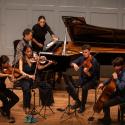
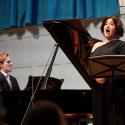
 Slightly more astringent songs by Mart Saar, roughly contemporary with Tubin, filled a gap in my knowledge of the Estonian song repertoire, but the masterpiece was undoubtedly a daunting opener, Kellad (The Bells) for solo piano by the great Heino Eller, where a left-hand bell-ostinato is wrenched out of kilter in the central welter, only to reassert itself. Rokashevich (pictured right) had the perfect measure of this titan, and the space she gave to Liszt's Petrarch Sonnet 104 showed real mastery. Debussy's "La soirée dans Grenade" from Estampes brought with it a real surprise in Rokashevich's sleight-of-hand rolling-out of vivid guitar strains in the night just before the quiet close.
Cleverly, the Italian- and Spanish-based piano pieces brought in a Hungarian and a Frenchman in segments otherwise very idiomatic. I've not heard Lauretta's "O mio babbino caro" from Puccini's Gianni Schicchi delivered with such artistry in concert; Mesak has the measure of authentic messa di voce and phrase-roundings, as well as an understanding of the young girl's plight; you felt this Lauretta might really throw herself in the Arno if she didn't get what she wanted. Travesti pageboy Oscar's "Saper vorreste" from Verdi's Un ballo in maschera, sprung with the right waltzing rubato, showed a role Mesak could take on right now; I'd also like to see her as Sophie in Strauss's Der Rosenkavalier and perhaps Zdenka in his Arabella.
Two of Granados's Canciones Amatorias, a dark and a bright one, made me hungry for more of this true individual among composers, and indeed to hear Rokashevich in the ineffable Goyescas. But the built-in encore brought us back to the City of London with a rapturous account of Bridge's "Love went a-riding". No need to make any allowances for the youth of either performer; this is a recital, and a programme, that would have shone among the best at the Wigmore.