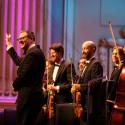
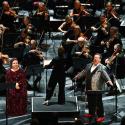
Helmut Lachenmann is a sort of George Bush of contemporary classical composition, a bogeyman, a warrior, an ideologue. In my time his name has always been served up with an exclamation mark - "you like Lachenmann!?" - partly because his politics have always reveled in anti-social extremes, partly because his musical tools were always either abstraction, noise, difficulty or perversity (musica negativa, as Henze once put it), his enemy, having a good time. The results are as intimidating to the ears (and performers) as his medieval face (picture, left) is to the soul. And in 50 years of celebrated compositional activity around the world, no commercial British orchestra has ever extended a hand of friendship to him - I presume in case he bit it off. Until last night.
For anyone expecting (hoping) to have their hands viciously bitten off, their ears chewed up, their bloodied eardrums spat out, as I was, the London Symphony Orchestra's performance of Double (Grido II), in the superbly competent hands of fellow composer Peter Eötvös, would have been a bit strange. The programme notes hinted, tentatively, at what sort of "strange" this would be. The musical vision about to unfold was "even 'beautiful'". Even 'beautiful'? It turned out that meant plain ravishing.
At the piece's heart is a glistening mass of stereophonic sounds and surfaces, built up from a huge repository of textures, which involve the bowing of mutes and wooden bodies, that have become a Lachenmann trademark. Even with all the explorations of colour from the Spectralist school and British New Complexity types, Lachenmann's harmonic slides and croaks and whispering and rumbling seem to herald from a completely new world. I felt like Columbus encountering the fruits of the Caribbean. And, as the piece rushed by, effortlessly, attractively, wondrously, I puzzled as to why we had been prevented from seeing these exotic gardens of orchestral colour before.
It's not even as if the harmonies or structures were all that difficult to take on or, to some rudimentary extent, to follow. A vast single movement sonata-like landscape was being conjured up, with a darting, dynamic exposition, a dark, croaky, muddy slow movement, a radiant tremoloed scherzo (in which the musical windows are flung open on a glorious major third), a Mahlerian bit of Nachtmusik, a recapitulation and coda. The orchestra extended their palette to incorporate these new vistas quite brilliantly. And a beaming Lachenmann lolloped onto stage at the end like some creature from the Stygian rivers of a Bosch painting to very appreciative applause.
It wasn't a huge leap from Webern's ever welcome arrangement of the Fugue (Ricercar) in Six Voices from the Musical Offering, BWV 1079, a kind of classier, Second Viennese version of A Young Person's Guide to the Orchestra, to the Lachenmann. And it wasn't far musically to the Brahms First Piano Concerto either, which was given a fearsome rendition by a worryingly breathy Maurizio Pollini. The performance wasn't clean, and it wasn't pretty, and it certainly wasn't Romantic. But Brahms never suffers from this sort of modernist blow-dry. The stillnesses were barer than ever post-aeration; the melodies, leant on by Pollini, harried by Eötvös, never allowed by either to ponder, were all the more fragile, the recapitulation all the more ferociously cold, terrifyingly martial, in these windy concrete surroundings.
Ignore Pollini's bungled parallel runs and enforced ritardandos, this was storytelling at its most bleak and most true. Eötvös had a hand in steadying the ship at hairy moments, drying out the textures, and delivering a most perfectly judged coda to the Rondo finale. And the London Symphony Orchestra's woodwind played its part in the first movement interplay with Pollini.
A better case for the vitality and emotional necessity of that supposedly driest of traditions, the intellectual German musical tradition that has flowed without break from Bach to Brahms to Webern and now Lachenmann, has never been so convincingly put.