Last night's Prom offered an intriguing mixture of French music both sacred and profane, with a British world premiere as its centrepiece. Duruflé’s pious Requiem rubbed shoulders with Ravel’s wordly homages to the Viennese waltz, Valses Nobles et Sentimentales and La Valse. Perhaps the most intriguing element was the least familiar, the world premiere of Simon Holt’s flute concerto Morpheus Wakes, written for the soloist Emmanuel Pahud, accompanied by the BBC National Orchestra of Wales under Thierry Fischer.
Simon Holt (b.1958), whose work often has a mythological starting point, describes Morpheus Wakes as depicting the god “slowly waking from a deep, troubled sleep”. It begins with hesitant gestures from the soloist, on alto flute, and the reduced ensemble, denuded of violins but supplemented by spiky cimbalom. The orchestration was augmented by one of the worst communal outbursts of coughing I can remember at the Proms, which undermined the atmosphere. The dreamy opening developed gradually into extremely virtuosic writing for the flute – Emmanuel Pahud says “this is really one of the fastest, if not the, fastest piece I’ve seen so far” – and I enjoyed hearing the rarely-heard upper register of the alto flute. There was also a great deal of skill in the blending of the soloist with the two orchestral flutes, doubling on piccolo and bass flute.
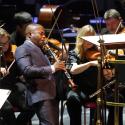
Holt’s concerto does not pit the soloist against the orchestra, as in the Romantic concerto, but rather his soloist – the technically jaw-dropping Emmanuel Pahud (pictured below) – is primus inter pares in an ensemble of soloists. The music is both haunting and, at times, startling, intricate and infinitely careful in its scoring, if hampered slightly by the audience intrusion and a slightly awkward stage layout.
The climaxes in the 'Kyrie' and at the 'Hosanna in excelsis' were both genuinely exciting
Morpheus Wakes was bookended in the first half by the two Ravel pieces. Like many of his orchestral works, Valses Nobles et Sentimentales was originally a piano piece, composed in 1911 and orchestrated a year later as a ballet score. It is made up of seven waltzes and an epilogue, moving from a brash opening through a range of intimate and extrovert interpretations of the waltz. The music is a tribute to Schubert, who wrote sets of waltzes both noble and full of sentiment, although the harmonic world is echt-Ravel, and the orchestral colours glistening and subtle.
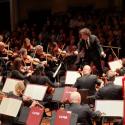
The orchestral version smoothes out the hard edges of the solo piano original, particularly in the slow second dance and the final epilogue. To be critical, there were some co-ordination issues in the first waltz, and the second was too slow and diffuse for my taste, but the BBCNOW warmed to its task and, guided by Fischer’s authoritative conducting, negotiated the rubato of the seventh waltz very effectively.
 La Valse was conceived as an orchestral ballet score in 1920, commissioned by Serge Diaghilev, although the impresario of the Ballets Russes rejected the finished score, observing perceptively that “it isn’t a ballet: it’s a portrait of a ballet”. La Valse is a lavishly realised work, building to grand climaxes of Viennese opulence. The orchestration is even more varied than in Valses Nobles et Sentimentales, particularly in its use of low registers, such as in the creeping and creepy opening. The piece, for the most part, consists of Ravel promising, then denying, the grand sweeping melody. Only at the very end does the massive climax occur, an electrifying tutti, with percussion at full tilt, bringing the hall to life.
Maurice Duruflé’s Requiem of 1947, which comprised the second half, is a world away from Ravel’s louche waltzes and Holt’s dreamy, contemporary flute concerto. The notably meticulous and self-critical Duruflé (1902-1986) produced a small body of work, of which only the Requiem has entered the repertoire, particularly in its version with organ accompaniment. Here we heard the original orchestral version, in which the choir is joined briefly by two soloists. Clearly a close cousin of Fauré’s Requiem, in its eschewing of the blood-and-thunder of Verdi and its solo “Pie Jesu”, it is extraordinary, given the quality of the vocal writing, that it was Duruflé’s first choral work. Although it is largely meditative in tone, there are stirring climaxes, in which the choir can give their all.
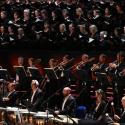
Duruflé was a devout Catholic and a virtuoso organist, excelling as an improviser, and developing, through his career as a church organist, a strong interest in plainchant. The Requiem is based closely on Gregorian chants for the mass for the dead, often declaimed unadorned by sections of the choir, with a gentle underscore. This is quite exposing for the choir, a combination of the BBC National Chorus of Wales and the National Youth Choir of Wales, who were largely assured and together, apart from a slight car-crash moment in the sopranos in the “Libera me”. There is little counterpoint or chordal writing in the piece; the best moments for the choir to show off were the climaxes in the “Kyrie” and at the “Hosanna in excelsis”, both of which were genuinely exciting. Baritone Gerald Finley sang his short solos with appropriate humility and lack of unnecessary theatricality; soprano Ruby Hughes sang the “Pie Jesu” eloquently, although it felt a little low for her voice. The very end was superb, the choir finally given a rich achordal harmonisation of the chant over hushed strings, a communal reaching for an elusive life beyond life.