After a Messiah last Christmas by one of London’s finest professional chamber choirs that was straight off the factory production line – mindlessly and maddeningly correct, just, I suspect, as it had been the five other times they performed it that week – I vowed to do things a little differently this Easter. Bach’s Passions certainly need skill and musicianship, but what they need above all is sincerity and heart. With that theory in mind, I went looking for a performance by a good amateur ensemble; when I found one by the Anton Bruckner Choir that also numbered Jacques Imbrailo and Ed Lyon among the soloists I didn’t look any further.
By happy chance this St Matthew was also Lyon’s German-language debut as the Evangelist – a performance as far from the usual Oxbridge croonings the role normally gets in the UK as could be imagined, but one so rhetorically direct, so dramatically urgent that it felt like the only possible option. As anyone who heard Lyon’s Steersman in the Royal Opera’s recent Der fliegende Holländer will know, this is a voice that’s only getting more powerful. By embracing that power, singing Bach’s recitative fully and well, keeping it on the voice almost all the time (with just the occasional anything-Gilchrist-can-do floated top note), Lyon brought operatic scope to this familiar sacred story, summoning vivid earthquakes and almost upstaging James Hall’s excellent “Erbarme dich” with the intensity of his preceding recitative.
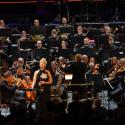
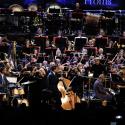
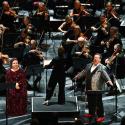
The choir tackled Bach’s athletic chorus writing with precision and tremendous energy
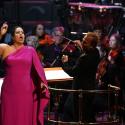
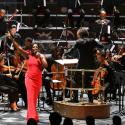
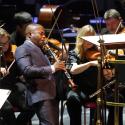
Imbrailo (pictured below) was a slightly different matter. His Christus, though warm and charmingly simple, never felt like it was really in the body, like he was busking – albeit very competently – his way through a score that has as many challenges as most operas. With recitative never fully allowing his voice to blossom it was a delight when he remained on stage to deliver the bass’s final recitative and aria. A moment of melodic arrival, of release after the tensions of the crucifixion, “Mache dich” is also deceptively difficult, and once again Imbrailo didn’t quite bring the same vocal control to it that we get from him in the opera house.
 Rounding out a fine team of soloists were soprano Elinor Rolfe Johnson, bass Philip Tebb, countertenor James Hall and tenor Gwilym Bowen. Hall (so strong in Hampstead Garden Opera’s recent Calisto) was a stand-out – his bladed purity needing little pressure to fill the space, finding some lovely vocal colours in his arias. Bowen is a tenor rapidly establishing himself in the early music scene, and I suspect we’ll be hearing an Evangelist from him before long. For now the voice is still a little tight, a little overworked, but promising much for the future.
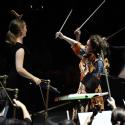
Conductor Christopher Dawe drew fine performances from his singers, who tackled Bach’s athletic chorus writing with precision and tremendous energy, shading their chorales with great delicacy. I was only sad not to hear more from the Grey Coat Hospital Chamber Choir, who brought a wonderful innocence and directness to their Part I chorale singing, going sadly unacknowledged at the end of the evening. The Orchestra of St John’s – with the wonderful addition of a gamba – played nicely enough, but the evening was marred by some astonishing lack of sensitivity from the wind section, who set tempos rocking on a number of occasions by ignoring Dawe’s clear beat and taking their own, rather speedier, approach into cadences.
Walking away from the performance I felt no great urge to rush back and hear the Monteverdi Choir, The Sixteen or Academy of Ancient Music. What we lost in orchestral flair and virtuosity we gained twofold in the energy of singers and sense of community that prevailed. Bach’s Passions are great music, but they are also communions, collective acts of faith. Last night I left believing, which is exactly as it should be.