Orchestral volcanoes were erupting all over Europe around the year 1915. It was courageous enough to make a mountain chain out of three of them in a single concert. I was less prepared for the white-heat focus applied by that stalwart Dane Thomas Dausgaard, and completely flummoxed when he and Jian Wang, a cellist with the biggest yet most streamlined sound I’ve ever heard, made total sense of the only overblown monster on the programme, Bloch’s "Hebraic Rhapsody" Schelomo.
Andrew Huth’s programme note made special claim for its “gorgeous orchestral colours”. But it’s bound to sound as thick and splashy as a score for a Cecil B De Mille epic alongside the tumultuous glitter of Prokofiev’s Scythian Suite. Always a hair-raising opener to any concert, this Russian primitive's wild rumpuses (rumpi?) didn’t merely shriek and grind; you could hear everything, even the two harps, in the welter.
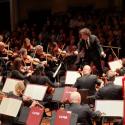
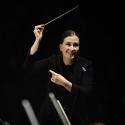
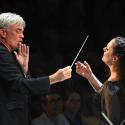
You could also see Dausgaard fine-tuning the sound as he sprang or crouched – no mere showman he. And sometimes the textures are all there is in this attempt by the young Prokofiev to write another Rite of Spring for Diaghilev, albeit on his own more metrically regular, bludgeoning terms. The three flutes passed their spooky undulations around exquisitely in one of the rare calms, and brass paced their exhausting roles to a magnesium-flare conclusion in the sunrise that saves Scythian hero Lolly from destruction by evil Chuzhbog.
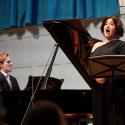
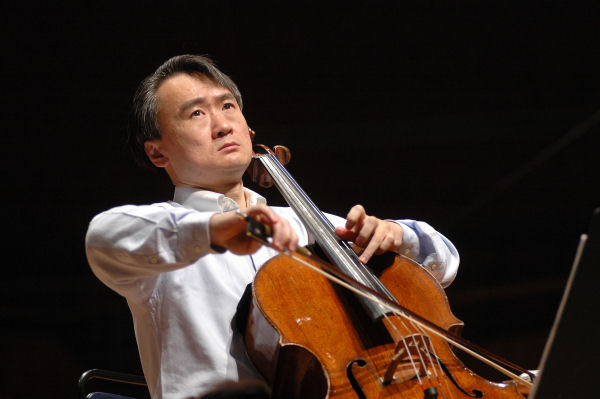 This may well be the only time ever that Bloch’s song of Solomon has made total sense and stayed wired in ever bar (though there's a recording by Rostropovich and Bernstein that almost convinces). That was thanks partly to Wang (pictured right by Xu Bin) as cultured chameleon, his drawing us in to growly interior monologues and his ability to ride even the densest textures. But it was equally a partnership with an orchestra on razor-sharp form, hurling out screamingly sensual climaxes and honing the repeated-note rhythms of a later dance that brings some variety to Bloch’s hothouse rave.
Nielsen’s Fourth Symphony, that wartime manifesto of the inextinguishable life-force, ruled the roost. It’s a Dausgaard speciality, though explosive composer and conductor show few signs of Danishness as we understand it from the common sense and naturalness that still prevail in Borgen. Dausgaard hurtled towards the woodwind centres of gravity – clarinets and first oboe (peerless Richard Simpson) brimming with character - only to uproot our moorings in unexpected ways time and again.
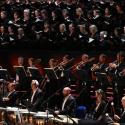
Have the BBC Symphony strings ever played with greater intensity than in those lonely slow-movement lines punctuated by the gunshots which explode into rapid fire in the mother of all conflicted finales? The two sets of timpani were placed in unusual opposition here – the first backstage centre, the second on the left of the platform in place of back-desk violinists. Jeremy Cornes was every inch the equal of that superlative thunder-god John Chimes; their duel was the icing on the cake in a symphony which always seems to bring out the best in its interpreters. Another flawless concert for me in less than a week: how long can this go on?
- Listen to this concert for the next seven days on the BBC Radio 3 iPlayer
- The next BBCSO concert, of Beethoven and Tippett, is at the Barbican on 1 March
- Read David Nice's blog, I'll Think of Something Later