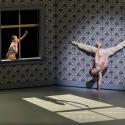
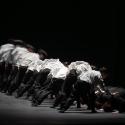
Crisis-management has always been part of a choreographer’s skillset, but staging a new ballet with two large alternating casts has rarely been fraught with so much risk. It was one hell of a week for Valentino Zucchetti, first soloist at the Royal Ballet and creator of Anemoi, the 20-minute work that opens the final programme in the company’s 90th birthday season. In the last days of rehearsals the 33-year-old was already on the back foot, re-jigging sections of the piece as several dancers fell prey to injury. Then, 24 hours before opening night, disaster struck and half his cast were forced to isolate. Calling up every remaining junior-level dancer in the company, Zucchetti was still one dancer short.
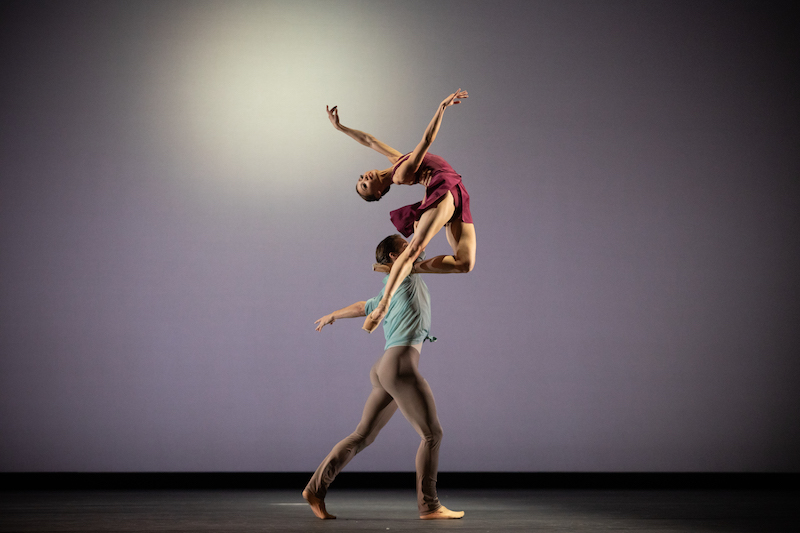
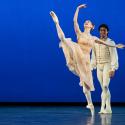
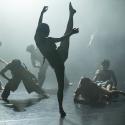
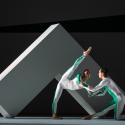
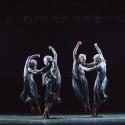
What’s refreshing about Zucchetti’s work – on the evidence so far – is that he’s unusually determined to resist the pressure to innovate for innovation’s sake. In terms of steps, the current lexicon suits him fine. What interests him is pattern and formulation, and he rarely shows the same idea twice. He’s good on visual metaphor too, and once you know that the Anemoi were the four winds of Greek mythology, each associated with a season and its weather (represented here by four principal dancers), it’s easy to see the corps de ballet as their wind-blown effects: scudding clouds, sea spray and fields of waving corn. Leticia Dias is sensual and flirty as the summer wind, Mariko Sasaki keen-edged as the chilly one, cutting a swathe through the upper air in startling lifts (pictured above). Zucchetti is a choreographer unafraid of beauty, which takes guts these days. His choice of music – a movement from Rachmaninov’s Symphony No.2, its big tunes delivered swooningly by a reduced ROH Orchestra – makes that doubly clear.
The shocking close involves a stage hand with a mop and bucket
The miscellany of shorter pieces that follows brings a counter-balance. Morgen, a new duet by Wayne McGregor set to the Richard Strauss song of that title, achieves intimacy despite its modernism, and the fact that the eventually enraptured pair seem barely to notice one another for half the piece. César Corrales is preoccupied by the snaky possibilities of his upper body, while Francesca Hayward strikes lonely balances some distance away.
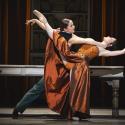
Mats Ek’s woman with water (declaring its nonconformity by refusing to capitalise) is superficially simpler and starker but packs a bigger punch. It’s good to see Mayara Magri, newly promoted to principal, stretched in this direction. She’s a strongly built dancer, no slip of a thing, and Ek’s work demands strong women. Clad in an orange tent dress (men: beware), Magri contemplates an empty glass set on a bright green table. The colour pop would be enough in itself, but it also points to a milestone of modern dance, The Green Table, a work made in 1932 by the German choreographer Kurt Jooss addressing the futility of peace negotiations.
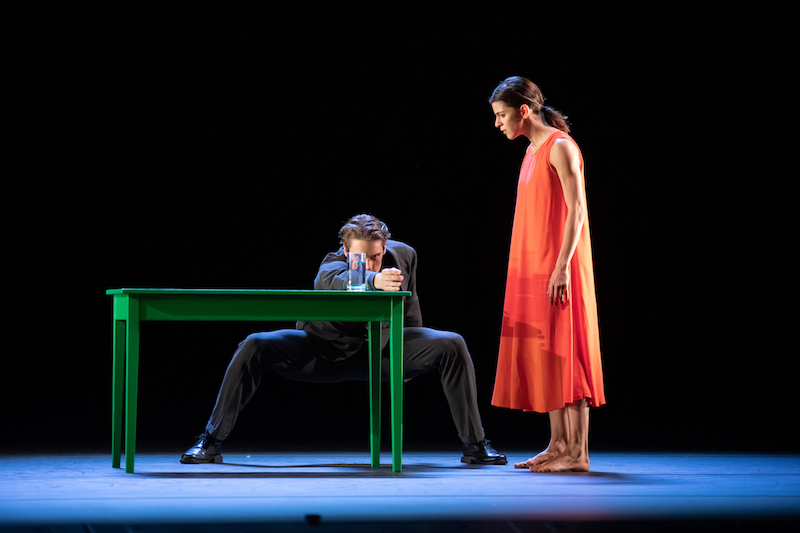 Militantly unpretty, the movement vocabulary is pure Ek with its squats and lunges, head butts and flexed heels. When a man (Lukas Bjõrneboe Brëndsrõd, pictured above with Magri) abruptly appears with a jug and fills the glass with water, Magri gulps it down in one. He half-fills it several times more, between bouts of alpha-male posturing on and around the table. Is the glass half-full or half-empty? Is the guy useful only as a provider? That’s the woman’s dilemma. The shocking close, involving a stage hand with a mop and bucket, doesn’t bode well for her.
The other duets on the bill – all seen before on the Covent Garden stage – do a nice job of covering the company’s main bases. Ashton, MacMillan, Wheeldon. But no look-back could be complete without a nod to The Sleeping Beauty, and Ninette de Valois’ production of it that forged this company’s identity in the immediate post-War years. We’re treated to the full third act, culminating in the grandest of grand pas de deux, with both Marianela Nuñez and Vadim Muntagirov on-form and on fire. Never mind that Tchaikovsky’s score has been scaled back for a Covid-spaced orchestra, the trombone covering four horn parts at the music’s climax. Professionalism and verve carry the day.