Unlike the controversial Netflix show Baby Reindeer, which challenges many of the same attitudes towards sexual harassment, self-delusion, and stalking’s gender bias, Alice Lowe’s second feature as director, writer, and star does not bill itself as a true story.
Quite the opposite, in fact. Timestalker is totally – and delightfully – bonkers right from its first scene, set in 1688 against a backdrop of the Scottish Covenanter uprising, where Agnes, a dowdy spinster (played by Lowe herself and introduced, literally, at a spinning wheel) falls headlong in love at a public execution, again quite literally. Rushing the scaffold to embrace a handsome rebel priest (Aneurin Barnard), who is about to be broken on the wheel, she trips and impales herself on an executioner’s axe, enabling the condemned man to escape amid the confusion and schlocky gore.
Truth comes in different shapes and sizes, of course, and Lowe has produced a wonderfully imaginative shape-shifting story in which Agnes, like a cross between Virginia Woolf’s Orlando and Rowan Atkinson’s Blackadder, pursues her beloved through the centuries from prehistoric forests to New York in the 1980s and then into a dystopian future, one hundred years from now, by which time poor Agnes has become a gun-toting riot cop in face visor and bulletproof vest. (Pictured below: Aneurin Barnard and Alice Lowe)
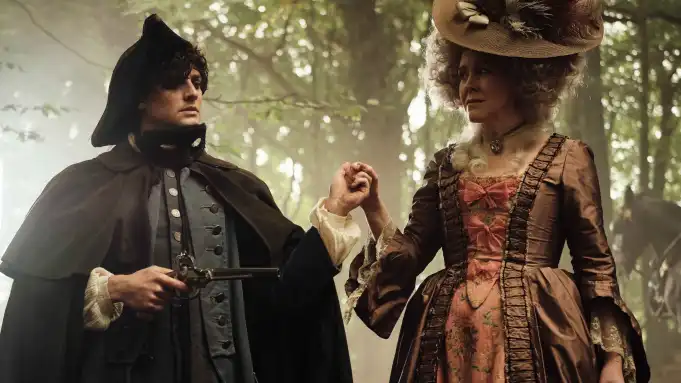 Decapitation and disappointment, neither of which ever seems to deter Lowe’s time-travelling stalker, provide the film with its unifying themes. In the second episode, for instance, set during the French revolutionary period, Agnes is an aristocratic bluestocking bedecked in a gravity-defying Marie Antoinette periwig but trapped in a loveless marriage to a syphilitic brute (Nick Frost), who burns her books on the grounds that enlightenment in any woman is a form of brainrot. “I’d rather a rotten brain than a rotten cock,” she tells him before she loses her head, literally, while rescuing Alex (Barnard again), now a romantic highwayman, from her jealous husband.
The big hair returns, and old romantics become New Romantics, in the New York story where Agnes, now a permed and shoulder-padded groupie, chases after Alex who has metamorphosed into a vain Adam Ant-type pop star, still conveniently clad in the same highwayman coat, and ushering her to the same grisly ending. “I always meet my soulmate,” she tells a Greenwich Village tarot reader (Zach Wyatt). “I save his life, and then my head comes off!”
At times, the intriguing eccentric variations give Timestalker the feel of a Channel 4 sketch show, but anyone who has followed Lowe’s career from her breakout role in Garth Marenghi’s Darkplace (2004) will know that her often deadpan sense of comedy can do a lot on a low budget to conjure the strange and bizarre. Her directorial debut, Prevenge (2016), saw her play a pregnant serial killer. In this follow-up fairy tale of violently unrequited love that is beautifully shot by Ryan Eddleston and designed by Felicity Hickson like a paintbox of different colours, it’s the protagonist herself who comes the serial cropper.
So Timestalker is a clever film that nods to Terry Gilliam and Stanley Kubrick and Sally Potter – and even, in its opening scene, to the Vincent Price cult classic Witchfinder General (1968). And, pace Richard Gadd, it does actually tell a true story, however fantastical, about the obsessive pursuit of love. But it’s also, rather oddly, hampered by some persistently lame jokes. In that opening scene, for example, one of the executioners says to Agnes of the rebel priest, “D’you think he’s a holy man? He’ll be holey when we’re done with him!” Or perhaps that’s the point of Timestalker, the triumph of imagination along with Carry On humour?
- More film reviews on theartsdesk