Think of Holly Golightly, and it’s more than likely that the face you’re picturing is Audrey Hepburn’s. And, while this adaptation by Richard Greenberg of Breakfast at Tiffany's is much closer to Truman Capote’s novella, it doesn’t have an ounce of the appeal of Blake Edwards’ famous film. Directed by antiseptic efficiency in a Leicester Curve production by Nikolai Foster, it’s numbingly dull – a dreary, inert tale of brittle, dislikeable people, inhabiting a tastefully designed bubble that is rarely pricked by events from the outside world.
The war gets an occasional mention, but no one seems terribly interested. All the piece has to sustain it is its portrait of a lopsided, distorted relationship between a sexually confused writer and Holly, described by her creator as an “American geisha” – here portrayed by popstrel Pixie Lott, whose name is surely the sole reason for this staging’s presence in the West End.
Lott doesn’t have to worry too much about comparisons to Hepburn’s iconic look in the movie, given that the play, like the book, is set in New York in the 1940s, not the 1960s. And she’s far from terrible in the role of this elusive enigma, a character whose livelihood – and, in a sense, whose very existence – depends on her ability to be pleasing to whichever pair of eyes happens to be roving over her. Lott, slender, lithe and blonde, is dazzlingly pretty, and moves with confidence. But she’s a singer, trying on the role of actor. She speaks her lines with practised precision, and with repetitive rhythms and cadences – you can hear, and feel, the by-rote memorising behind every beat of her delivery. And in trying to convey Holly’s allure, she pushes her flirtatiousness and sensuality too hard. Only the biggest fool would allow himself to fall for her wiles.
 The production gets its money’s worth out of her by having her sing three times – not just "Moon River", but "People Will Say We’re in Love" as well as a new number, "Dying Day", by Grant Olding, all of them accompanied by her strumming on the guitar. She’s clearly far more comfortable here, and these interludes are pleasant enough. But they’re also opportunistic and wildly incongruous, given that Lott’s melismatic warbling and misty-eyed, middle-distance gaze would be better suited to The X Factor.
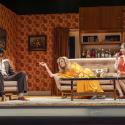
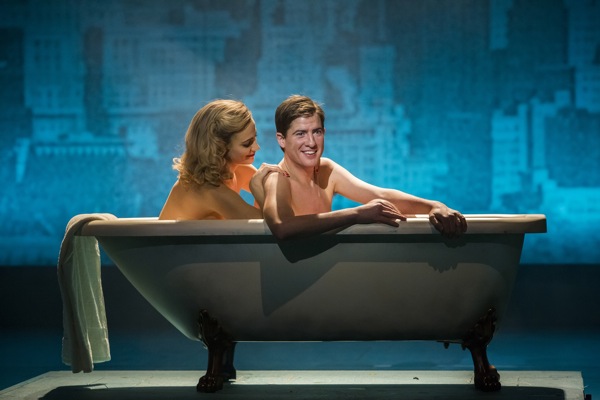
The rest of the time, to a jazzy, Brubeck-esque soundtrack, Matthew Wright’s sets glide balletically around, illuminated rain decoratively falls, and Matt Barber’s narrator Fred (pictured above with Pixie Lott) falls into a passionate, eroticised friendship with Lott’s Holly that is complicated by the fact that, as she herself acidly indicates, he would rather be sating his desires with one of the sailors hanging around the Brooklyn Bridge. Barber’s performance is decent enough, but it’s impossible to care what becomes of him, or of Holly. Happily, there is some warmth elsewhere, notably in the kindly barkeep Joe Bell (Victor McGuire); and if anyone comes close to engaging our sympathies, it’s Robert Calvert as Doc Golightly, Holly’s estranged and abandoned hillbilly husband, who stands outside her apartment door, rumpled and nervous in his overalls, smooths his white hair and tremulously asks Fred, “Do I look nice?”
Cat lovers may also enjoy the appearance of a lavishly fluffy white moggy – but being upstaged by a feline is probably nothing to purr about. Still, this isn’t a howler. It’s just difficult to see any point in it.
- Breakfast at Tiffany’s at the Theatre Royal Haymarket until 17 September
- Read more theatre reviews on theartsdesk