Writing for two pianos is something that – until last year – I had not attempted. I was contacted by Katya Apekisheva and Charles Owen, two pianists who have performed as a duo for many years, asking me to compose a duet for them to perform at the inaugural London Piano Festival. I met Charles back in 2014 when he performed my pieces A Hudson Cycle and Fast Stuff in New York. Time constraints led me to restructure and rewrite an existing piece in my portfolio, Fast Cycles, which I wrote for the late John Scott.
Writing for two pianos was easy, as I know a lot of the repertoire and I’ve played a lot of piano duets in the past. The trick is the internal question of “Why does this need to exist?” and “What can you do with two pianos that you can’t do with one?” (Katya Apekisheva and Charles Owen pictured below by Sim Canetty Clarke)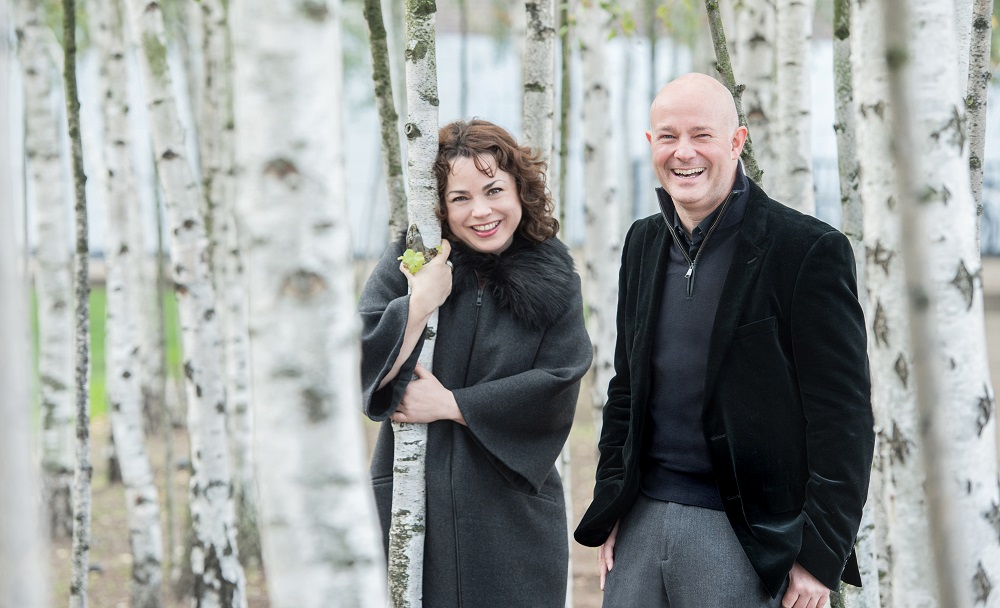
When starting a new project I always make a plan first. Nothing too detailed, more like a vague itinerary of “Today, I’m going from here to here”, but if you pull over and have a Starbucks you can deal with that later!
As a composer, I have to occupy people’s time. Why is my eight-minute piece better than eight minutes of silence? We’ve all been to contemporary music concerts and thought, "This is not preferable to silence!” Every note and every phrase has to keep the audience’s attention. I always play back my pieces on my computer and walk around the house. When I start thinking about laundry I know I’m bored with my own music, so I clock it and adapt it.
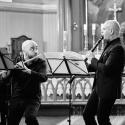
 Charles (pictured right with Nico) and Katya gave me complete artistic freedom when it came to writing Fast Patterns. My only brief was that it had to be for two pianos, as it’s being performed as part of their Two-Piano Gala at the festival. Now the piece has been written, I’ll be as involved as they want me to be. I think I’m going along to one of their rehearsals, but this is more for support. I’m not going to micromanage them; after all, it’s a piece for them! As a living composer, I know that if I’m not specific in my page markings then my music would be up for interpretation – musicians should be able to look at the music and play.
The piece feels and sounds entirely different than its former life as an organ piece. The organ version was more impressionistic; I was told to write a multi-movement piece and “Go nuts!” The two-piano piece has a completely different structure, and is far more percussive. Baroque composers reworked and reimagined their music, so why can’t we? The essence of the work is taking something rhapsodic and turning it into a percussive tennis game. The challenge of the piece is the harmonies that slowly fall and create a constant sense of motion. The perpetual motion is embraced throughout, with constantly changing metres, until the last eight bars.
Premieres are scary in terms of the funnel of ears. Up until a certain point only I will have heard the piece. Then, all of a sudden, a piece is premiered and thousands have heard it. It’s interesting how my own perception of a piece might change once I’m hearing it alongside the audience, especially when you see their own reactions to the music too.
On that note, I’ll see you on 8 October for the premiere!