

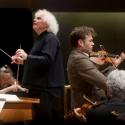
Bartók’s Music for Strings, Percussion and Celesta and Bruckner’s Sixth Symphony: few other conductors could get away with programming two such monolithic works, but Simon Rattle has a lightness of touch that can leaven even the weightiest musical utterances. Bartók dances, Bruckner sings. It’s a quality that he communicates easily to the players of the LSO, who responded with vibrant rhythms and clean, transparent textures.
When arranged around the piano, celesta and harp, the LSO strings comfortably fill the Barbican stage, making for large-scale Bartók. But the precision of the ensemble, as well as the unwavering tonal control, ensures a transparency that belies the scale. And when Bartók calls for the quietest of textures, as at the end of the first movement, the players can maintain that control at the very quietest dynamics. Rattle essays each of the early movements as a single utterance, the first as an undulating wave of string counterpoint, the second more varied in texture, but no less unified. The slow third movement was more severe under Rattle’s baton, but it was no less beautiful for the crystalline clarity of the textures. The finale is a more raucous affair, and more varied. What to make of the jazzy piano interjections early on? True to form, Rattle integrates them, and everything else, into an uneasy and constantly shifting unity. The finale builds to a flamboyant conclusion, curiously out of keeping with the rest of the work. But no apologies from Rattle, who finally loosens his grip and allows the players to give those final pages all they are worth.
After the interval, the LSO looked very much like a German orchestra
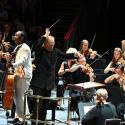
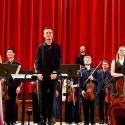
A similar dynamic played out in Bruckner’s Sixth Symphony, with Rattle propelling the music in a mostly up-tempo account, and again projecting his lightness of touch through the transparency of the orchestral textures, even at the loudest dynamics. When they took their seats after the interval, the LSO looked very much like a German orchestra. Second violins were seated stage-left, as were the horns. Double basses were lined up along the top tier. And German rotary valve trumpets and calf-skin timpani completed the effect. The horns benefited from the reseat, sounding clearer for not playing directly into a wall behind them. The basses projected well, through there were occasional ensemble slips with the now distant cellos.
Rattle’s tempos were fluid throughout, but his major interventions were few, the better to convey the bigger picture. He was selective with the structural junctures to emphasise, giving those moments all the more impact, particularly the recapitulations of the first and second movements. But elsewhere, Rattle’s focus was on sculpting phrases, especially with the strings, who got more than their share of his attention, the woodwind sometimes scrambling behind unmarked cues.
This performance used a new edition of the work, the “Benjamin-Gunnar Cohrs Urtext”. There are no major structural changes, the programme assured us, but a number of adjustments and articulation changes that hadn’t previously made it into a published score. Perhaps that was why the phrasing in the violin melodies in the first movement seemed so much more defined. It might also account for the two oboes rather than one for the second-movement solo – allowing Rattle to increase the volume of the string accompaniment, to dramatic effect. Further into the second movement, the timpanist played an extended roll with snare drum sticks, an unusual but effective device.
In the finale, Rattle intervened more, making emphatic distinctions between the episodes. Sometimes that felt too intrusive, lacking the breadth of expression he had previously fostered. But he compensated with many interludes of exquisite beauty, delicately shaping the phrases of the cello melodies, the woodwind exchanges, even the violin ostinatos. A deeply personal and emotionally complex reading, delivered to the highest standards by the LSO.
- This programme will be repeated at the Barbican on Sunday 21 January
- Read more classical music reviews on theartsdesk





Add comment