

You could imagine that normality had returned watching the live webcasts from the Wigmore Hall. The Hall has bucked the trend, and managed to present a full autumn season, to a carefully separated but still substantial audience. Yesterday evening’s concert was to be given by Quatuor Ébène, but they pulled out at the last minute—problems with travelling from France perhaps the reason. But the Wigmore Hall had another ensemble, the Elias Quartet, lined up and ready to give a similar programme. Given the unpredictable situation, the management has presumably organised last-minute stand-ins for pretty much everything—a salutary reminder that organising live events in the COVID era is at least twice as much work as before.
The Elias Quartet ran a year-long Beethoven project about a decade ago, which resulted in an informative website, and a string quartet cycle at the Wigmore Hall, which was released the house label. In other words, they are a known quantity when it comes to Beethoven. Their long association with this music is a clear benefit, and while the two quartets in this recital, op. 127 and op. 59, no. 2, only occasionally showed sparks of interpretive genius, their approach to this music is always personal and distinctive.
The Elias has a sinewy, muscular tone, with keen focus of line and well-balanced ensemble. Their sound sometimes lacks warmth, something the Wigmore acoustic can usually compensate, through not under the close miking of this webcast. The violin tone of leader Sara Bitlloch (pictured below) clearly defines the sound, her playing direct and clearly articulated. But she does not dominate, and the textures often seem built from the bottom up, with Marie Bitlloch on cello (they are sisters) grounding the sound with her prominent and dark bass voice. 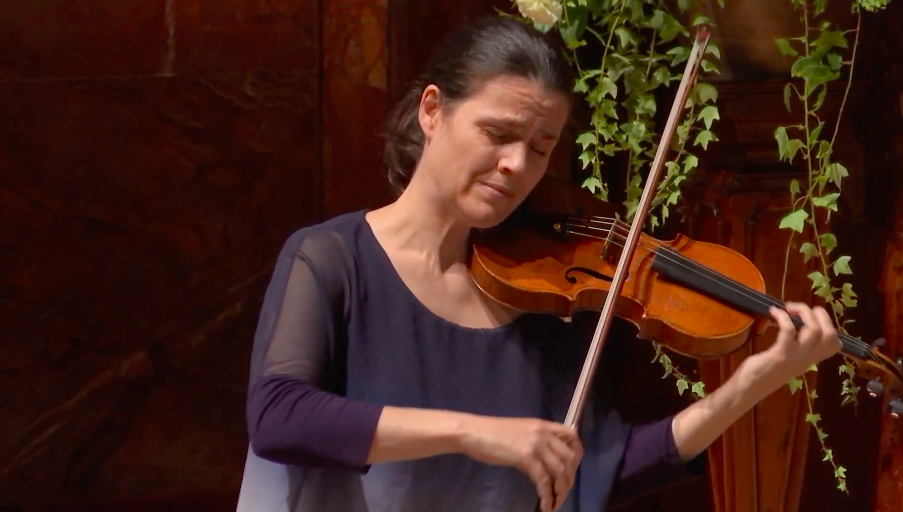 Op 127 is the only one of Beethoven’s late quartets to be in a traditional four-movement form, and initially, the Elias players seemed at pains to emphasise the music’s 18th-century roots. The textures of the opening were muscular but expressive, and through the first movement, and the first movement was propulsive throughout. The second movement is a puzzle, a set of variations that sometimes fit together smoothly, but at other times sit in angular juxtaposition. Here, the players focussed more on the mood of each variation and let Beethoven’s awkward transitions stand. The violin melody at the opening set the tone, played expressively but with minimal rubato. The coda returns to this mood, but now with the four players passing the ideas around, a gentle and sensitive interplay. The Scherzo was a bit civilised, with Beethoven’s sporadic outbursts lacking weight. But the finale was more impressive. Beethoven seems to be in two minds here. He opens with a huge chordal gesture, but immediately recedes into less decisive textures. The Elias players brought out this dichotomy with huge dynamic swells, and an impressively guttural sound in the tuttis, supported again by that rich cello tone.
The Op 59 No. 2 Quartet, the second of the Razumovskys, is middle period Beethoven, and is well suited to the Elias approach of emphasising the Classical elements without underplaying the Romantic passion. The first movement had a valuable sense of urgency, a mood that the ensemble was able to maintain, even across their generous pauses. Although the work is in a minor key, there are many passages of bright, ecstatic textures. These came off well, although the ensemble’s tonal control came unsteady at the loudest dynamics. The slow movement was more stately than sentimental, though the beautifully shaped phrases brought plenty of expression. The scherzo opened with delicate interplay but descended into (controlled) chaos for the Russian theme in the Trio. But the ensemble was never in danger, grounded as ever by the agile but rich tone of the cello. The players gave an outsized rendition of the finale too, achieving the Presto pace, but without reducing their generous bowing or rich tone. The result was chunky and angular, but none the worse for it, with little sense of veneration for Beethoven, but rather a feeling that the players were living one of his few moments of joy.
- The Elias Quartet give a second concert of Beethoven quartets at the Wigmore Hall today, 7 October 2020
- Watch this recital for the next month on the Wigmore Hall website
- More classical reviews on theartsdesk





Add comment