

It’s not what he says, it’s the way he says it. Few filmmakers have bent the term “auteur” to their own ends more boldly than Wes Anderson, whose arresting visual style, oblique wit and skill in picking actors who can mould themselves to the unique demands of Wes-world is surely unequalled.
You might argue that The Phoenician Scheme is little more than fanciful nonsense – I might be tempted to do so myself – but once on board you’ll want to stick around for the ride, even if much of it is barely comprehensible. It’s 1950, and the story revolves around Zsa-zsa Korda, a maverick tycoon who has made his millions in armaments and aviation and is “among the richest men in Europe”. He circles the globe in his own aircraft, and is the target of frequent assassination attempts. The film opens with the latest of them, as Korda miraculously survives his sixth air crash after a bomb demolishes his aeroplane (on board Air Korda, pictured below).
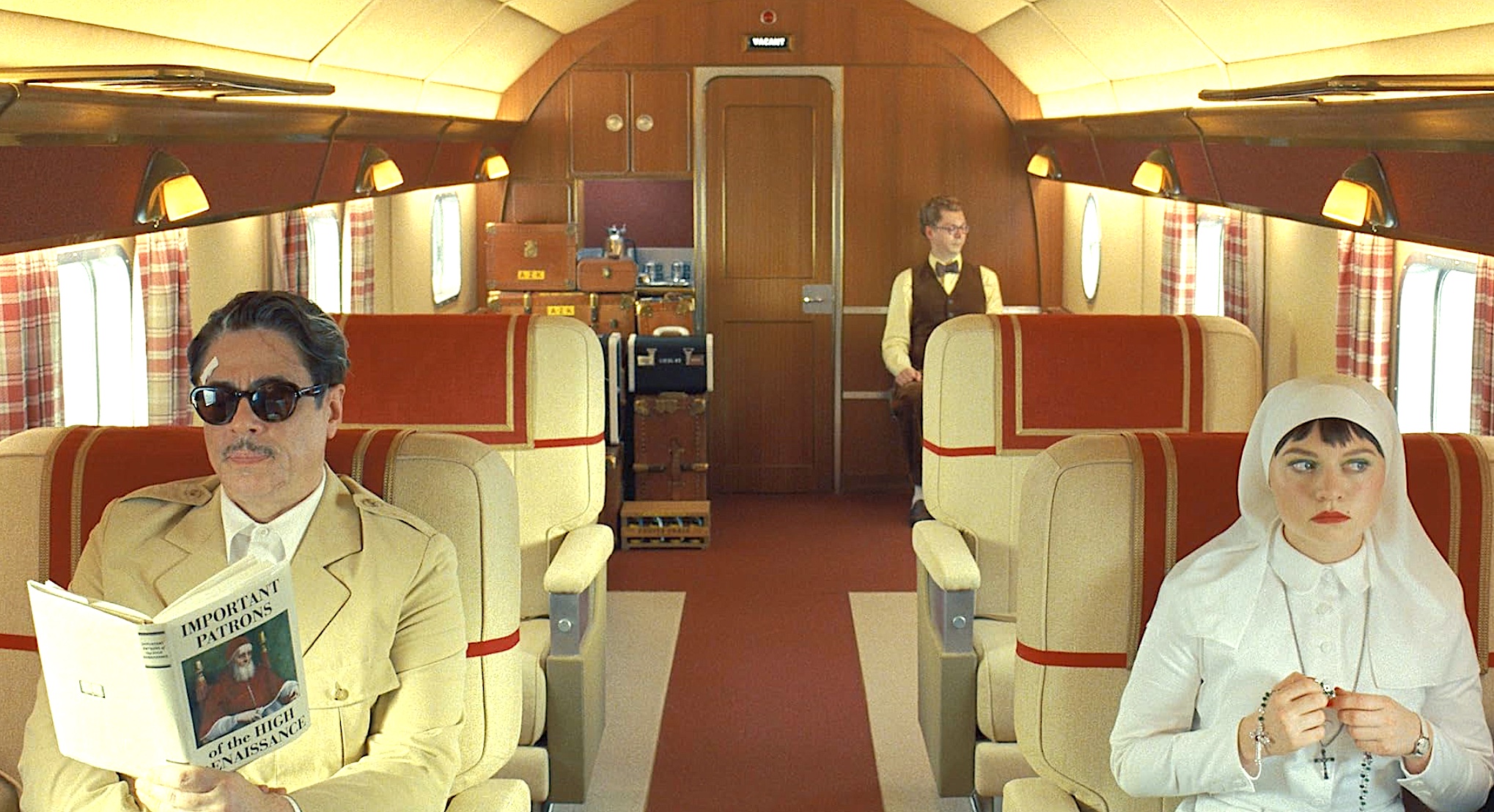 Death threats notwithstanding, Korda, played with aplomb by Benicio del Toro (vaguely resembling Brad Pitt’s weirder twin brother), is a man determined to carry out his mission. This is a gargantuan infrastructure project in the Middle East including such phenomena as the Trans-Desert Inland Waterway, which resembles something like a super-sized mash-up of the Suez Canal and the Aswan dam. Korda himself is like a Greatest Hits of monstrous tycoons, seemingly taking in elements of Donald Trump, Citizen Kane and Howard Hughes. Any allusion to film mogul Alexander Korda is presumably not accidental.
Korda’s progress in pursuing his megalomaniac scheme is hampered by a cabal of business rivals, glimpsed intermittently huddled behind a desk, whence their spokesman Excaliber (Rupert Friend) declares their objective to be “disrupting, obstructing, crippling Korda’s enterprise in any manner possible.” This inevitably means that all kinds of obstacles will appear in his way, like camel-riding gunmen, hostile jet fighters and an American spy disguised as a bumbling Norwegian dork called Bjorn (Michael Cera, pictured below).
All Anderson’s favourite visual tricks step out and take a bow. His carefully-arranged, lit and upholstered scenes are like dioramas where actors are used as animated pieces of scenery, carefully positioned to be pleasing to the eye and in harmony with the colour palette and choice of furniture. The colours themselves veer towards soft pastels, suffused with fuzzy taupe-esque light. The camera tends to be either fixed, or travelling laterally as though viewing the actors as a kind of fairground exhibit.
 The story, if that’s what it is, depicts the struggle between Korda’s relentless ambition and the demands of his private life, which he has brutally trampled over for several decades. Although he has nine sons, he has decided to make his daughter Liesl his sole heir. However, she is a nun, and is righteously sceptical of Korda and his motives, especially as he believes that he murdered her mother. Liesl is played by Mia Threapleton with stony detachment, while everybody else is merely deadpan and expressionless.
Still, there are puckish turns from Tom Hanks and Bryan Cranston as basketball-playing potential investors in Korda’s scheme, while Bill Murray crops up as God alongside F. Murray Abraham and Willem Defoe, in monochrome “afterlife” scenes that occur whenever Korda suffers another near-fatal event. Richard Ayoade hams it up as a terrorist, complete with Che Guevara beret, facial hair and submachine gun. Benedict Cumberbatch relishes a meaty cameo as Korda’s half-brother Nubar, garnished with a lavish beard and an austere pinstriped suit, like a 1930s fascist.
Having recruited Scarlett Johansson to play Cousin Hilda, it seems perverse to limit her to a few scant moments of screen time. “Help yourself to a hand grenade,” offers Korda, proffering his box of said explosive devices."You're very kind,” replies Hilda.
Nonetheless, if you like Wes, you’ll enjoy this, though it won’t tell you a lot that's new. If you don’t… then you still won’t.









Add comment